


Intergenerational solidarity and the family-welfare state balance
- PMID: 28794730
- PMCID: PMC5546341
- DOI: 10.1007/s10433-005-0001-1
Intergenerational solidarity and the family-welfare state balance
Abstract
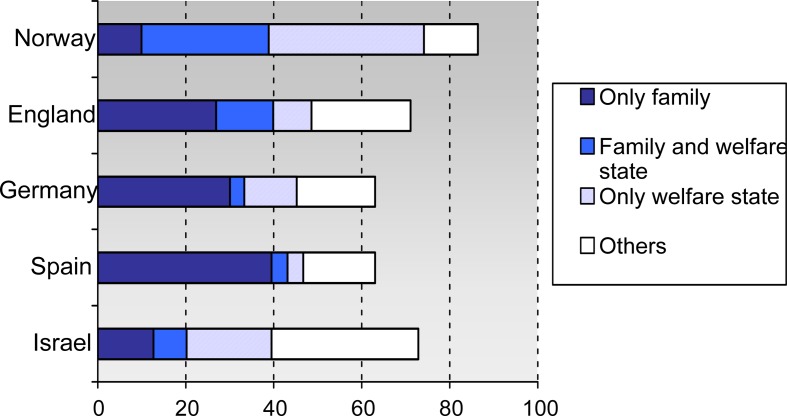
The article addresses the strength and character of intergenerational family solidarity under different family cultures and welfare state regimes in order to answer the following two questions: (1) Is intergenerational solidarity stronger under the more collectivist southern family tradition than under the more individualist northern tradition? (2) Is more generous access to social care services a risk or a resource for family care? These questions are explored with data from the OASIS project, a comparative study among the urban populations aged 25+ (n=6,106) in Norway, England, Germany, Spain, and Israel. The findings indicate that the welfare state has not crowded out the family in elder care, but has rather helped the generations establish more independent relationships. Intergenerational solidarity is substantial in both the northern and southern welfare state regimes, and seems to vary in character more than in strength.
Keywords: Cross-national comparisons; Elder care; Family–welfare state balance; Intergenerational solidarity.
Figures
References
-
- Bengtson VL, Roberts REL. Intergenerational solidarity in aging families: an example of formal theory construction. J Marriage Fam. 1991;53:856–870. doi: 10.2307/352993. - DOI
-
- Daatland SO. What are families for? On family solidarity and preferences for help. Ageing Soc. 1990;10:1–15. doi: 10.1017/S0144686X00007820. - DOI
-
- Daatland SO. Family solidarity, popular opinion, and the elderly: perspectives from Norway. Ageing Int. 1997;1:51–62. doi: 10.1007/s12126-997-1023-0. - DOI
-
- Daatland SO, Herlofson K (2001) Ageing, intergenerational relations, care systems and quality of life. An introduction to the OASIS project. Oslo: NOVA, report 14–2001
-
- Daatland SO, Herlofson K. ‘Lost solidarity’ or ‘changed solidarity’: a comparative European view of normative family solidarity. Ageing Soc. 2003;23:537–560. doi: 10.1017/S0144686X03001272. - DOI
LinkOut - more resources
Full Text Sources
