


Melatonin and mitochondrial function during ischemia/reperfusion injury
- PMID: 28795196
- PMCID: PMC11107672
- DOI: 10.1007/s00018-017-2618-6
Melatonin and mitochondrial function during ischemia/reperfusion injury
Erratum in
-
Author Correction: Melatonin and mitochondrial function during ischemia/reperfusion injury.Cell Mol Life Sci. 2018 Jul;75(14):2681. doi: 10.1007/s00018-018-2822-z. Cell Mol Life Sci. 2018. PMID: 29691591 Free PMC article.
Abstract
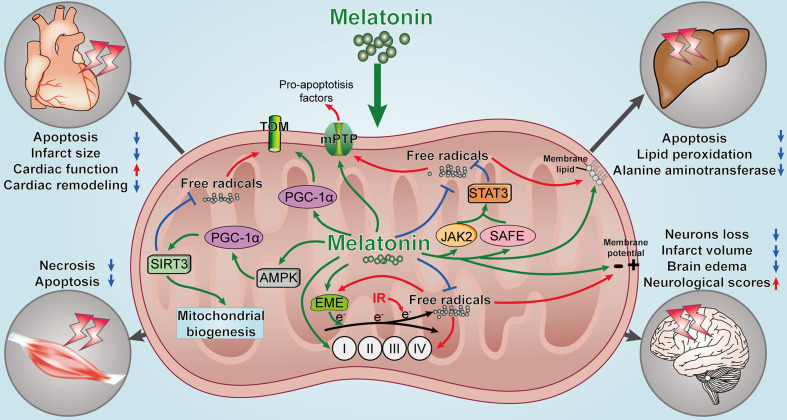
Ischemia/reperfusion (IR) injury occurs in many organs and tissues, and contributes to morbidity and mortality worldwide. Melatonin, an endogenously produced indolamine, provides a strong defense against IR injury. Mitochondrion, an organelle for ATP production and a decider for cell fate, has been validated to be a crucial target for melatonin to exert its protection against IR injury. In this review, we first clarify the mechanisms underlying mitochondrial dysfunction during IR and melatonin's protection of mitochondria under this condition. Thereafter, special focus is placed on the protective actions of melatonin against IR injury in brain, heart, liver, and others. Finally, we explore several potential future directions of research in this area. Collectively, the information compiled here will serve as a comprehensive reference for the actions of melatonin in IR injury identified to date and will hopefully aid in the design of future research and increase the potential of melatonin as a therapeutic agent.
Keywords: Ischemia/reperfusion injury; Melatonin; Mitochondria; Oxidative stress.
Conflict of interest statement
The authors declare that they have no conflict of interest.
Figures
References
-
- Petrosillo G, Colantuono G, Moro N, Ruggiero FM, Tiravanti E, Di Venosa N, Fiore T, Paradies G. Melatonin protects against heart ischemia–reperfusion injury by inhibiting mitochondrial permeability transition pore opening. Am J Physiol Heart Circ Physiol. 2009;297:H1487–H1493. doi: 10.1152/ajpheart.00163.2009. - DOI - PubMed
-
- Li T, Zhang Z, Kolwicz SC, Jr, Abell L, Roe ND, Kim M, Zhou B, Cao Y, Ritterhoff J, Gu H, Raftery D, Sun H, Tian R. Defective branched-chain amino acid catabolism disrupts glucose metabolism and sensitizes the heart to ischemia–reperfusion injury. Cell Metab. 2017;25:374–385. doi: 10.1016/j.cmet.2016.11.005. - DOI - PMC - PubMed
Publication types
MeSH terms
Substances
LinkOut - more resources
Full Text Sources
Other Literature Sources
Medical
