


doi: 10.1002/cpt.755.
Epub 2017 Aug 10.
New Pharmacogenomics Research Network: An Open Community Catalyzing Research and Translation in Precision Medicine
Affiliations
- PMID: 28795399
- PMCID: PMC5706548
- DOI: 10.1002/cpt.755
Item in Clipboard
New Pharmacogenomics Research Network: An Open Community Catalyzing Research and Translation in Precision Medicine
Clin Pharmacol Ther.
2017 Dec.
Abstract
The goal of pharmacogenomics research is to discover genetic polymorphisms that underlie variation in drug response. Increasingly, pharmacogenomics research involves large numbers of patients and the application of new technologies and methodologies to enable discovery. The Pharmacogenomics Research Network (PGRN) has become a community-driven network of investigators spanning scientific and clinical disciplines. Here, we highlight the activities and types of resources that enable PGRN members to enhance and drive basic and translational research in pharmacogenomics.
© 2017 American Society for Clinical Pharmacology and Therapeutics.
Figures
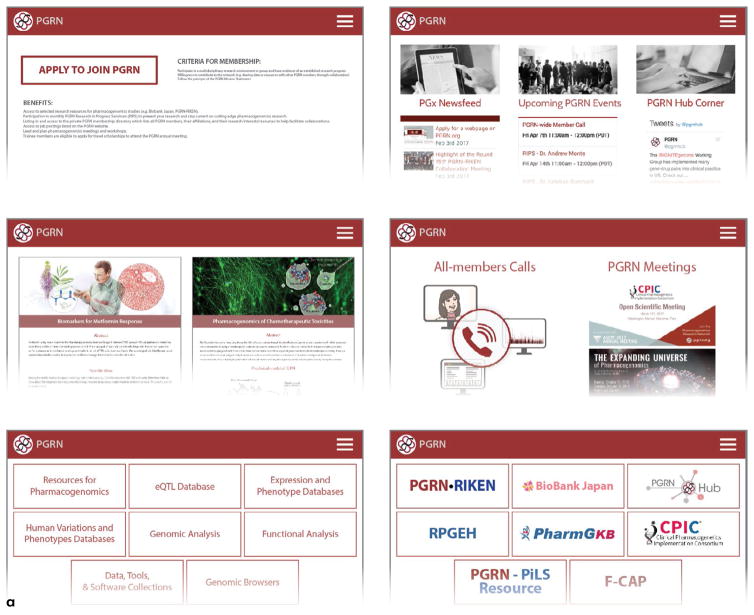
The mission of Pharmacogenomics Research Network (PGRN) is to catalyze and lead research in precision medicine for the discovery and translation of genomic variation influencing therapeutic and adverse drug effects. (a) The main features in pgrn.org includes where members can find important information related to pharmacogenomics research opportunities. (b) About our current PGRN Members. To date, the new PGRN includes 271 members (top left panel). The breakdown of the membership shows that 93% of members are faculty at universities or staff in other sectors, and 7% are trainees (top right panel). Though most members are from the United States, 20% are from countries outside of the United States (bottom left panel). Currently, there are 14 main disease areas that are focused by the PGRN members (bottom right panel).

The mission of Pharmacogenomics Research Network (PGRN) is to catalyze and lead research in precision medicine for the discovery and translation of genomic variation influencing therapeutic and adverse drug effects. (a) The main features in pgrn.org includes where members can find important information related to pharmacogenomics research opportunities. (b) About our current PGRN Members. To date, the new PGRN includes 271 members (top left panel). The breakdown of the membership shows that 93% of members are faculty at universities or staff in other sectors, and 7% are trainees (top right panel). Though most members are from the United States, 20% are from countries outside of the United States (bottom left panel). Currently, there are 14 main disease areas that are focused by the PGRN members (bottom right panel).
References
MeSH terms
Grants and funding
- R24 GM061374/GM/NIGMS NIH HHS/United States
- P50 GM115318/GM/NIGMS NIH HHS/United States
- R24 GM115264/GM/NIGMS NIH HHS/United States
- R24 GM115277/GM/NIGMS NIH HHS/United States
- U24 GM115370/GM/NIGMS NIH HHS/United States
- R01 GM109110/GM/NIGMS NIH HHS/United States
- R24 GM119977/GM/NIGMS NIH HHS/United States
- UL1 TR001427/TR/NCATS NIH HHS/United States
- UC4 DK104194/DK/NIDDK NIH HHS/United States
- P30 DK098722/DK/NIDDK NIH HHS/United States
- U01 GM061374/GM/NIGMS NIH HHS/United States
- P50 GM115305/GM/NIGMS NIH HHS/United States
- P50 GM115279/GM/NIGMS NIH HHS/United States
LinkOut - more resources
Full Text Sources
Other Literature Sources
