. 2018;9(1):17-29.
doi: 10.1080/21541264.2017.1329684. Epub 2017 Oct 4.

linc00673 (ERRLR01) is a prognostic indicator of overall survival in breast cancer

Affiliations

linc00673 (ERRLR01) is a prognostic indicator of overall survival in breast cancer

Ubaidat Abdul-Rahman et al. Transcription. 2018.

Abstract

LncRNAs are novel noncoding RNAs involved in the epigenetic regulation of gene expression by recruiting ribonucleoprotein complexes to specific genomic loci to initiate histone methylation and/or other chromatin modifications. LncRNAs themselves function as tumor suppressors or oncogenes, depending on the gene regulatory networks they govern. We identified lnc00673 (ERRLR01) as a marker of overall survival (OS) in breast cancer patients. Specifically, ERRLR01 levels were elevated in triple-negative breast cancer (TNBC) as compared with Luminal-A, Luminal-B, and HER2 breast cancer subtypes. ERRLR01 levels were also inversely correlated with breast cancer survival across all breast cancer patients. Upon stratification, OS in ERα- tumors correlated with negative overall survival, while in ERα+ tumors, ERRLR01 correlated with positive outcomes. This suggests ERRLR01 is modulated by hormone signaling in breast cancer. Gene-network analysis revealed ERRLR01 correlated with distinct pathways including "epithelial development" and "cellular differentiation." These data suggest ERRLR01 operates as an oncogene in TNBC, as well as a biomarker in breast cancer patients.

Keywords: ERRLR01; breast cancer; estrogen signaling; hormone-regulation; lncRNA; survival outcomes.


Figures
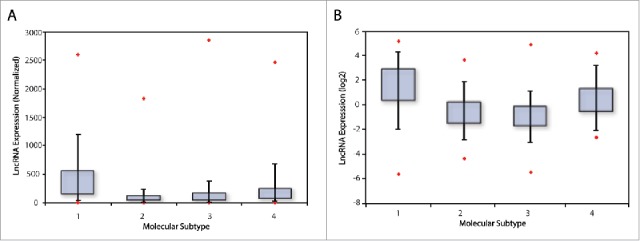
Figure 1.
Figure 1.
LncRNA expression in breast cancer patient populations which was acquired using an Affymetrix U133A array dataset, and is depicted by box-whisker-plots. In this analysis, ERRLR01 expression was stratified into 4 subpopulations, and the mean rank expression was reported (A). 1 = TNBC, n = 577; 2 = Luminal A, n = 1432; 3 = Luminal B, n = 632; 4 = HER2+, n = 301. ERRLR01 expression in the TCGA data set (B), and data are presented in a log(2) transformed format. 1 = TNBC, n = 154; 2 = Luminal A, n = 91; 3 = Luminal B, n = 538; 4 = HER2+, n = 53. *denotes significance at P < 1 × 10⁻¹⁶ as determined by Kruskal-Wallis one-way variance analysis testing.
Figure 2.
Figure 2.
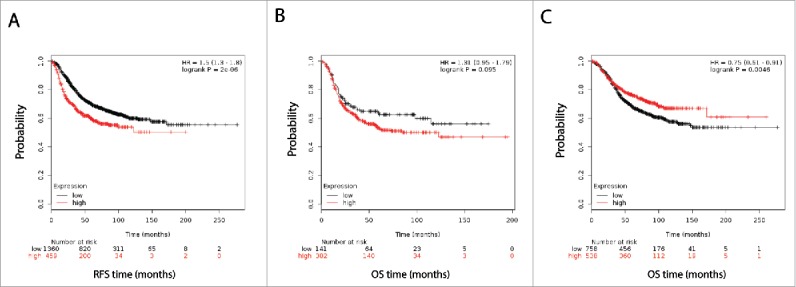
Kaplan-Meir and cox regression analysis of ERRLR01 levels and OS in breast cancer patients. Data was obtained from Affymetrix datasets, and analyzed on KM-Plotter software. (A) represents RFS in all breast cancer patients, (B) depicts OS in ER-negative breast cancer patients, and panel (C) depicts OS in ER-positive breast cancer patients. Hazard ratios and log- rank p values are reported for each analysis. ERRLR01 correlates with poor survival outcomes in “all patients” as well as “ER-negative patients,” while positively correlates with OS in “ER- positive patients.”
Figure 3.
Figure 3.
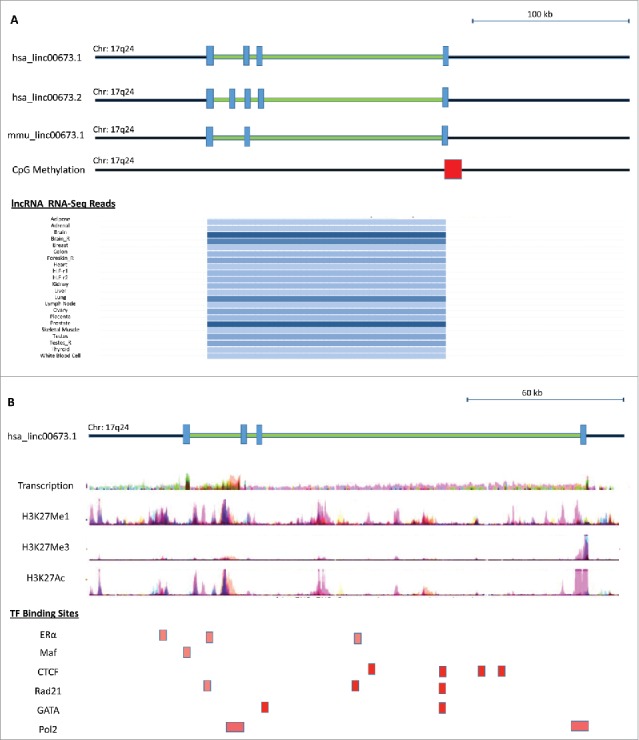
Genomic analysis of the ERRLR01 gene region and the regulatory factors that interact with ERRLR01 using the UCSC Genome browser. Transcription orientation is depicted from right (5’ end) to left (3’ end). (A) ERRLR01.1 is a 4-exon gene conserved between mouse and human, and is expressed at high levels in testis, placenta, and brain tissue. (B, Top Panel) Detectable transcription is present across a panel of cell lines with evidence of H3K4Me1 modification. (B, Bottom Panel) Potential estrogen-regulated transcription factor binding locations are denoted, such as the GATA family of transcription factors, CTCF, and ERα itself.
Figure 4.
Figure 4.
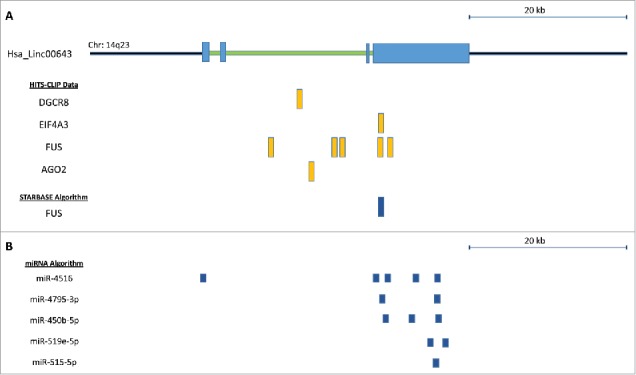
(A) In silico assessment of RNA binding proteins that interact with ERRLR01 as determined by HITS-CLIP experiments. StarBase 2.0 was used to confirm FUS binding to the ERRLR01 locus. To focus on the 3’ UTR-miRNA binding sites the ERRLR01 transcript is depicted from right (3’ end) to left (5’ end), and only includes the 3’ UTR through Exon 2. Orientation is depicted in this manner since ERRLR01 is transcribed in the anti-sense orientation (derived from the minus strand of the DNA). The ERRLR01 transcript is depicted in the 3’ to 5’ orientation, as it is transcribed in the anti-sense orientation (minus strand of the DNA).
Figure 5.
Figure 5.
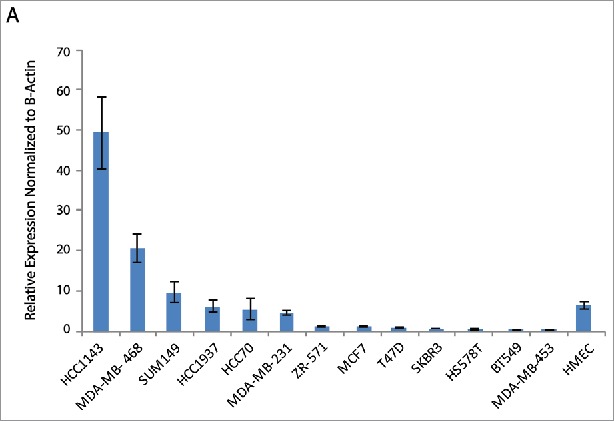
Quantitative PCR analysis of ERRLR01 expression across a panel of breast cancer cell lines. Analysis indicates a few TNBC cell lines express high levels of ERRLR01, as compared with normal HMEC lines, as well as ERα+ cell lines.
Figure 6.
Figure 6.
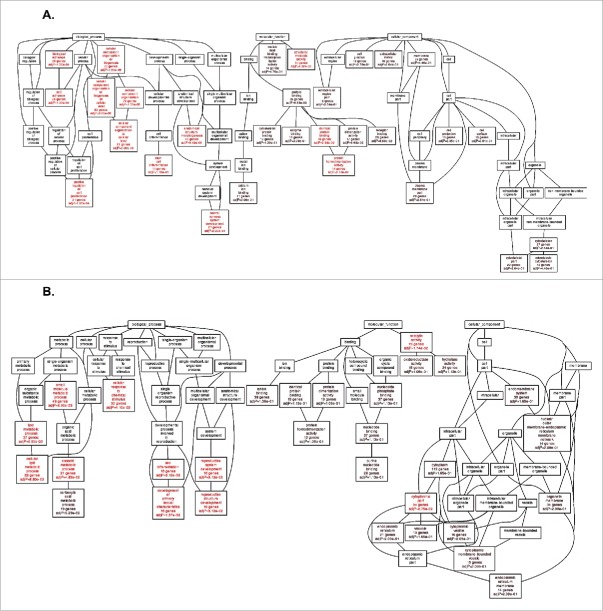
Go Term analysis of the top 200 positively correlated ERRLR01 genes via spearman rank analysis of the Affymetrix dataset (HGU133). (A) Analysis was performed in Basal-like breast tumors(n = 577), given ERRLR01 expression is high/detectable within those samples. Analysis indicated ERRLR01 levels correlated with “Central Nervous System Development,” “Stem Cell Differentiation,” “Protein Dimerization Activity,” and “Positive Regulation of Cell Proliferation.” (B) Go Term Analysis of the top 200 negatively correlated ERRLR01 genes via spearman rank analysis. Red Boxes highlight significant pathways and Black Boxes are highlighted as non-significant pathways.

References

    1. Rinn JL, Chang HY. Genome regulation by long noncoding RNAs. Annu Rev Biochem 2012; 81:145–66; PMID:22663078; https://doi.org/10.1146/annurev-biochem-051410-092902 - DOI - PMC - PubMed
    1. Rinn JL. LncRNAs: Linking RNA to chromatin. Cold Spring Harb Perspect Biol 2014; 6:a018614; PMID:25085913; https://doi.org/10.1101/cshperspect.a018614 - DOI - PMC - PubMed
    1. Huarte M. The emerging role of lncRNAs in cancer. Nat Med 2015; 21:1253–61; PMID:26540387; https://doi.org/10.1038/nm.3981 - DOI - PubMed
    1. Goff LA, Rinn JL. Linking RNA biology to lncRNAs. Genome Res 2015; 25:1456–65; PMID:26430155; https://doi.org/10.1101/gr.191122.115 - DOI - PMC - PubMed
    1. Morris KV. Long antisense non-coding RNAs function to direct epigenetic complexes that regulate transcription in human cells. Epigenetics 2009; 4:296–301; https://doi.org/10.4161/epi.4.5.9282 - DOI - PMC - PubMed

Publication types