


Results of the First Prospective Multi-institutional Treatment Study in Children With Bilateral Wilms Tumor (AREN0534): A Report From the Children's Oncology Group
- PMID: 28795993
- PMCID: PMC5629006
- DOI: 10.1097/SLA.0000000000002356
Results of the First Prospective Multi-institutional Treatment Study in Children With Bilateral Wilms Tumor (AREN0534): A Report From the Children's Oncology Group
Erratum in
-
Results of the First Prospective Multi-institutional Treatment Study in Children With Bilateral Wilms Tumor (AREN0534) A Report From the Children's Oncology Group: Erratum.Ann Surg. 2018 Mar;267(3):e64. doi: 10.1097/SLA.0000000000002696. Ann Surg. 2018. PMID: 29401136 No abstract available.
Abstract
Objective: The Children's Oncology Group study AREN0534 aimed to improve event-free survival (EFS) and overall survival (OS) while preserving renal tissue by intensifying preoperative chemotherapy, completing definitive surgery by 12 weeks from diagnosis, and modifying postoperative chemotherapy based on histologic response.
Background: No prospective therapeutic clinic trials in children with bilateral Wilms tumors (BWT) exist. Historical outcomes for this group were poor and often involved prolonged chemotherapy; on NWTS-5, 4-year EFS for all children with BWT was 56%.
Methods: Patients were enrolled and imaging studies were centrally reviewed to assess for bilateral renal lesions. They were treated with 3-drug induction chemotherapy (vincristine, dactinomycin, and doxorubicin) for 6 or 12 weeks based on radiographic response followed by surgery and further chemotherapy determined by histology. Radiation therapy was provided for postchemotherapy stage III and IV disease.
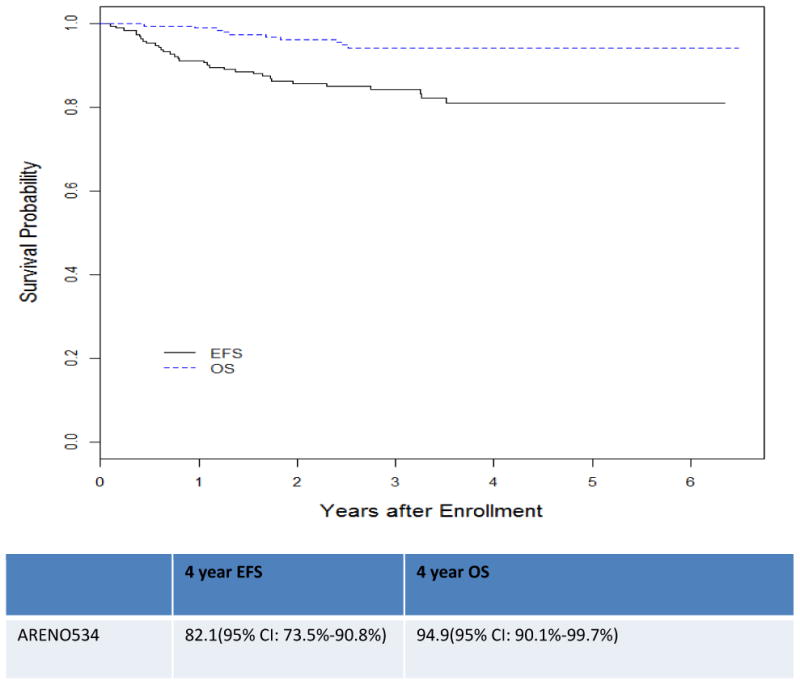
Results: One hundred eighty-nine of 208 patients were evaluable. Four-year EFS and OS were 82.1% (95% CI: 73.5%-90.8%) and 94.9% (95% CI: 90.1%-99.7%. Twenty-three patients relapsed and 7 had disease progression. After induction chemotherapy 163 of 189 (84.0%) underwent definitive surgical treatment in at least 1 kidney by 12 weeks and 39% retained parts of both kidneys. Surgical approaches included: unilateral total nephrectomy with contralateral partial nephrectomy (48%), bilateral partial nephrectomy (35%), unilateral total nephrectomy (10.5%), unilateral partial nephrectomy (4%), and bilateral total nephrectomies (2.5%).
Conclusion: This treatment approach including standardized 3-drug preoperative chemotherapy, surgical resection within 12 weeks of diagnosis and response and histology-based postoperative therapy improved EFS and OS and preservation of renal parenchyma compared with historical outcomes for children with BWT.
Conflict of interest statement
The authors have NO conflicts of interest
Figures
References
-
- Dome JS, Perlman EJ, ML R, et al. Renal Tumors. In: PA P, DG P, editors. Principles and Practice of Pediatric Oncology. Philadelphia: Lippincott Williams and Wilkins; 2015. pp. 753–772.
-
- Dome JS, Perlman EJ, Graf N. Risk stratification for wilms tumor: current approach and future directions. Am Soc Clin Oncol Educ Book. 2014:215–223. - PubMed
-
- Dome JS, Cotton CA, Perlman EJ. Treatment of anaplastic histology Wilms' tumor: results from the fifth National Wilms' Tumor Study. J Clin Oncol. 2006;24(15):2352–2358. - PubMed
Publication types
MeSH terms
Substances
Grants and funding
LinkOut - more resources
Full Text Sources
Other Literature Sources
Medical
