


Chemical Functionalization of Plasmonic Surface Biosensors: A Tutorial Review on Issues, Strategies, and Costs
- PMID: 28796479
- PMCID: PMC5593307
- DOI: 10.1021/acsami.7b01583
Chemical Functionalization of Plasmonic Surface Biosensors: A Tutorial Review on Issues, Strategies, and Costs
Abstract
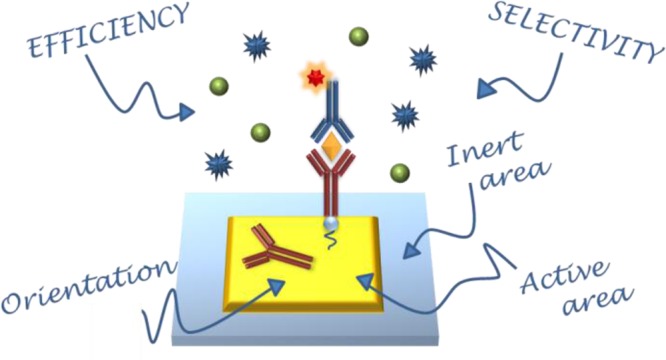
In an ideal plasmonic surface sensor, the bioactive area, where analytes are recognized by specific biomolecules, is surrounded by an area that is generally composed of a different material. The latter, often the surface of the supporting chip, is generally hard to be selectively functionalized, with respect to the active area. As a result, cross talks between the active area and the surrounding one may occur. In designing a plasmonic sensor, various issues must be addressed: the specificity of analyte recognition, the orientation of the immobilized biomolecule that acts as the analyte receptor, and the selectivity of surface coverage. The objective of this tutorial review is to introduce the main rational tools required for a correct and complete approach to chemically functionalize plasmonic surface biosensors. After a short introduction, the review discusses, in detail, the most common strategies for achieving effective surface functionalization. The most important issues, such as the orientation of active molecules and spatial and chemical selectivity, are considered. A list of well-defined protocols is suggested for the most common practical situations. Importantly, for the reported protocols, we also present direct comparisons in term of costs, labor demand, and risk vs benefit balance. In addition, a survey of the most used characterization techniques necessary to validate the chemical protocols is reported.
Keywords: biomolecule pattern; characterization; functionalization; nanostructures; plasmonic sensors.
Conflict of interest statement
The authors declare no competing financial interest.
Figures
References
-
- Maier S. a.Plasmonics: Fundamentals and Applications, Vol. 677; Springer Science+Business Media LLC: New York, 2004.
-
- Chirumamilla M.; Toma A.; Gopalakrishnan A.; Das G.; Zaccaria R. P.; Krahne R.; Rondanina E.; Leoncini M.; Liberale C.; De Angelis F.; Di Fabrizio E. 3D Nanostar Dimers with a Sub-10-nm Gap for Single-/Few-Molecule Surface-Enhanced Raman Scattering. Adv. Mater. 2014, 26, 2353–2358. 10.1002/adma.201304553. - DOI - PubMed
-
- Raether H.Surface Plasmons on Smooth and Rough Surfaces and on Gratings; Springer Tracts in Modern Physics, Vol. 111; Springer: Berlin, Heidelberg, 1988.
Publication types
MeSH terms
LinkOut - more resources
Full Text Sources
Other Literature Sources
Research Materials
