


Association of Hospital Volume and Quality of Care With Survival for Ovarian Cancer
- PMID: 28796677
- PMCID: PMC5650072
- DOI: 10.1097/AOG.0000000000002164
Association of Hospital Volume and Quality of Care With Survival for Ovarian Cancer
Abstract
Objective: To assess whether strict adherence to quality metrics by hospitals could explain the association between hospital volume and survival for ovarian cancer.
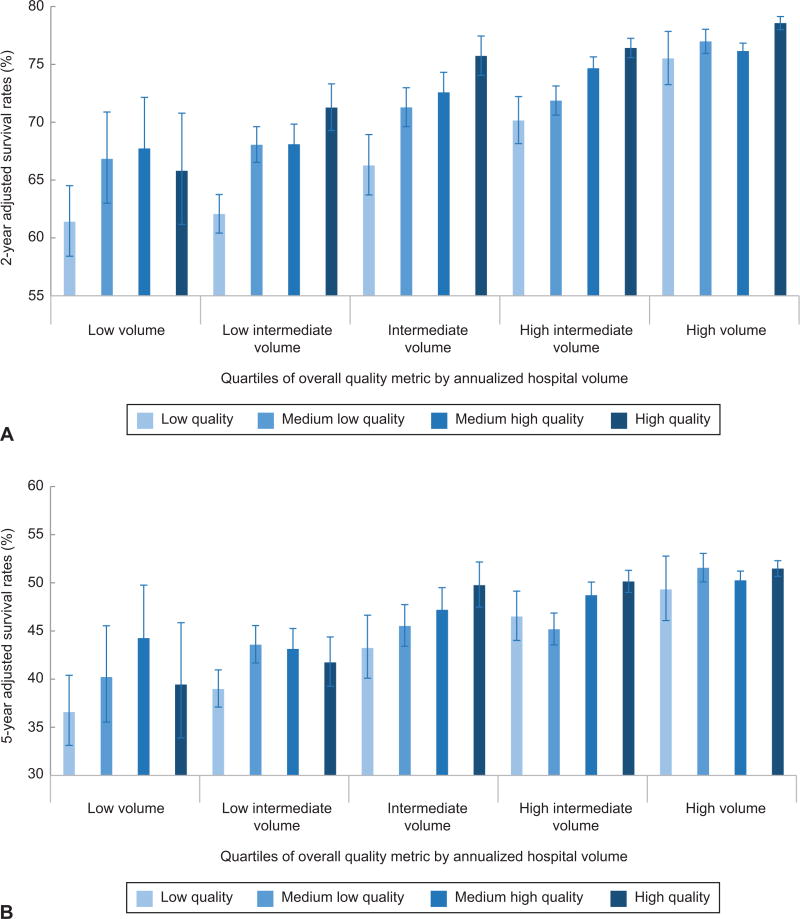
Methods: We used the National Cancer Database to perform a retrospective cohort study of women with ovarian cancer from 2004 to 2013. Hospitals were stratified by annual case volume into quintiles (2 or less, 2.01-5, 5.01-9, 9.01-19.9, 20 cases or greater) and by adherence to ovarian cancer quality metrics into quartiles. Hospital-level adjusted 2- and 5-year survival rates were compared based on volume and adherence to the quality metrics.
Results: A total of 100,725 patients at 1,268 hospitals were identified. Higher volume hospitals were more likely to adhere to the quality metrics. Both 2- and 5-year survival increased with hospital volume and with adherence to the measured quality metrics. For example, 2-year survival increased from 64.4% (95% CI 62.5-66.4%) at low-volume to 77.4% (95% CI 77.0-77.8%) at high-volume centers and from 66.5% (95% CI 65.5-67.5%) at low-quality to 77.3% (95% CI 76.8-77.7%) at high-quality hospitals (P<.001 for both). For each hospital volume category, survival increased with increasing adherence to the quality metrics. For example, in the lowest volume hospitals (two or less cases annually), adjusted 2-year survival was 61.4% (95% CI 58.4-64.5%) at hospitals with the lowest adherence to quality metrics and rose to 65.8% (95% CI 61.2-70.8%) at the hospitals with highest adherence to the quality metrics (P<.001). However, lower volume hospitals with higher quality scores still had survival that was lower than higher volume hospitals.
Conclusion: Although both hospital volume and adherence to quality metrics are associated with survival for ovarian cancer, low-volume hospitals that provide high-quality care still have survival rates that are lower than high-volume centers.
Conflict of interest statement
Financial Disclosure:
The other authors did not report any potential conflicts of interest.
Figures
References
-
- Birkmeyer JD, Siewers AE, Finlayson EV, et al. Hospital volume and surgical mortality in the United States. N Engl J Med. 2002;346:1128–37. - PubMed
-
- Birkmeyer JD, Stukel TA, Siewers AE, Goodney PP, Wennberg DE, Lucas FL. Surgeon volume and operative mortality in the United States. N Engl J Med. 2003;349:2117–27. - PubMed
-
- Ghaferi AA, Birkmeyer JD, Dimick JB. Variation in hospital mortality associated with inpatient surgery. N Engl J Med. 2009;361:1368–75. - PubMed
-
- Wright JD, Herzog TJ, Siddiq Z, et al. Failure to rescue as a source of variation in hospital mortality for ovarian cancer. J Clin Oncol. 2012;30:3976–82. - PubMed
-
- Vernooij F, Heintz AP, Witteveen PO, van der Heiden-van der Loo M, Coebergh JW, van der Graaf Y. Specialized care and survival of ovarian cancer patients in The Netherlands: nationwide cohort study. J Natl Cancer Inst. 2008;100:399–406. - PubMed
Publication types
MeSH terms
Grants and funding
LinkOut - more resources
Full Text Sources
Other Literature Sources
Medical
