


Growth of the hard palate in infants with Down syndrome compared with healthy infants-A retrospective case control study
- PMID: 28796822
- PMCID: PMC5552113
- DOI: 10.1371/journal.pone.0182728
Growth of the hard palate in infants with Down syndrome compared with healthy infants-A retrospective case control study
Erratum in
-
Correction: Growth of the hard palate in infants with Down syndrome compared with healthy infants-A retrospective case control study.PLoS One. 2018 Sep 7;13(9):e0203899. doi: 10.1371/journal.pone.0203899. eCollection 2018. PLoS One. 2018. PMID: 30192886 Free PMC article.
Abstract
Objective: To investigate morphological differences of the hard palate in infants with Down syndrome (DS) compared with a volumetric-matched control group (CG).
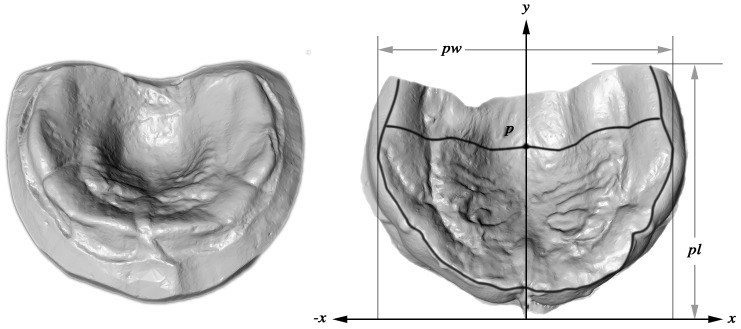
Methods: Trial design: retrospective case control study. Based on inclusion and exclusion criteria, plaster casts of edentulous maxillae of 40 DS infants (20 females and 20 males, aged 221.3 ± 132.4 days) and 40 CG infants (20 females and 20 males, aged 53.9 ± 87.2 days) were digitized and converted into 3-dimensional stereolithography data. An automated landmark- and investigator-independent method for assessing two-dimensional measurements such as width, depth, and length of palate, as well as palatal index and the 3-dimensional volume, were used.
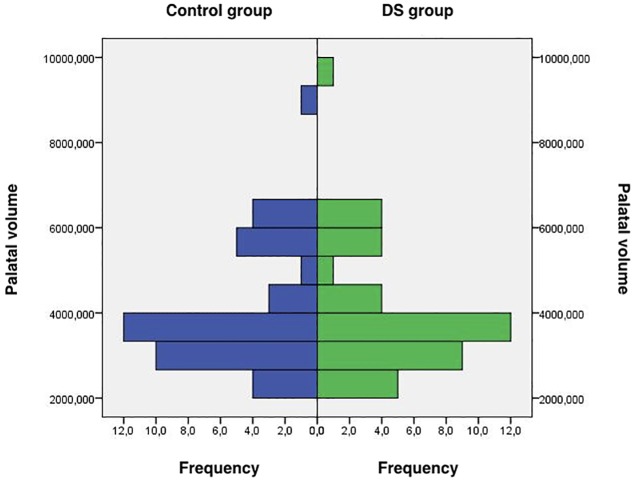
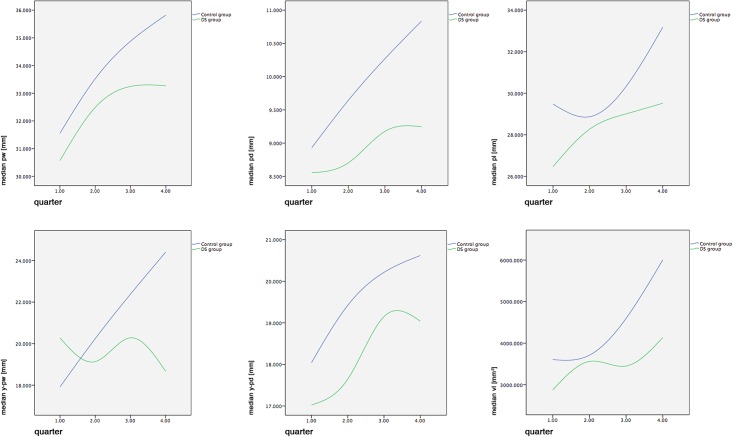
Results: Matching DS and healthy CG infants by age, we found reduced sizes in all linear and volumetric measurements in the DS group. Matching both groups by palatal volume, we found no differences between the groups according to palatal width (p = .93), palatal depth (p = .32), and palatal index (p = .31). Control infants with the same palatal volume compared with the DS infants were about 151 days younger, 95%-CI = [102, 200] (Hodges-Lehmann estimator). Except for palatal length and palatal volume, the growth pattern of DS palates decreased irregularly at age 6 to 9 months.
Conclusions: The palate of DS infants in the first 6 to 9 month of life is of normal shape but considerably smaller compared with healthy normals. From 6 to 9 months onward, the growth pattern of the hard palate in DS infants decreases irregularly. High-arch-constricted palates could, therefore, be interpreted as secondarily acquired in later life. We therefore speculate that it could be advantageous to begin oral muscular stimulating therapy between 6 and 9 months of age which may prevent palatal shape alterations and enhance oral function which also contributes to maxillary development.
Conflict of interest statement
Figures
References
-
- Cicero S, Curcio P, Rembouskos G, Sonek J, Nicolaides KH. Maxillary length at 11–14 weeks of gestation in fetuses with trisomy 21. Ultrasound Obstet Gynecol. 2004;24: 19–22. doi: 10.1002/uog.1077 - DOI - PubMed
-
- Lauridsen H, Hansen BF, Reintoft I, Keeling JW, Skovgaard LT, Kjr I. Short hard palate in prenatal trisomy 21. Orthod Craniofacial Res. 2005;8: 91–95. doi: 10.1111/j.1601-6343.2005.00318.x - DOI - PubMed
-
- Allanson JE, O’Hara P, Farkas LG, Nair RC. Anthropometric craniofacial pattern profiles in Down syndrome. Am J Med Genet. 1993;47: 748–752. doi: 10.1002/ajmg.1320470530 - DOI - PubMed
-
- Skrinjarić T, Glavina D, Jukić J. Palatal and dental arch morphology in Down syndrome. Coll Antropol. 2004;28: 841–847. - PubMed
-
- Bauer D, Evans CA, Begole EA, Salzmann L. Severity of occlusal disharmonies in Down syndrome. Int J Dent. 2012;2012: 0–5. doi: 10.1155/2012/872367 - DOI - PMC - PubMed
Publication types
MeSH terms
LinkOut - more resources
Full Text Sources
Other Literature Sources
Medical
