. 2017 Sep 5;117(6):813-825.
doi: 10.1038/bjc.2017.263. Epub 2017 Aug 10.

Regulation of hypoxia-induced autophagy in glioblastoma involves ATG9A

Affiliations

Regulation of hypoxia-induced autophagy in glioblastoma involves ATG9A

Siti Aminah Abdul Rahim et al. Br J Cancer. .

Abstract

Background: Hypoxia is negatively associated with glioblastoma (GBM) patient survival and contributes to tumour resistance. Anti-angiogenic therapy in GBM further increases hypoxia and activates survival pathways. The aim of this study was to determine the role of hypoxia-induced autophagy in GBM.

Methods: Pharmacological inhibition of autophagy was applied in combination with bevacizumab in GBM patient-derived xenografts (PDXs). Sensitivity towards inhibitors was further tested in vitro under normoxia and hypoxia, followed by transcriptomic analysis. Genetic interference was done using ATG9A-depleted cells.

Results: We find that GBM cells activate autophagy as a survival mechanism to hypoxia, although basic autophagy appears active under normoxic conditions. Although single agent chloroquine treatment in vivo significantly increased survival of PDXs, the combination with bevacizumab resulted in a synergistic effect at low non-effective chloroquine dose. ATG9A was consistently induced by hypoxia, and silencing of ATG9A led to decreased proliferation in vitro and delayed tumour growth in vivo. Hypoxia-induced activation of autophagy was compromised upon ATG9A depletion.

Conclusions: This work shows that inhibition of autophagy is a promising strategy against GBM and identifies ATG9 as a novel target in hypoxia-induced autophagy. Combination with hypoxia-inducing agents may provide benefit by allowing to decrease the effective dose of autophagy inhibitors.


Conflict of interest statement

The authors declare no conflict of interest.

Figures
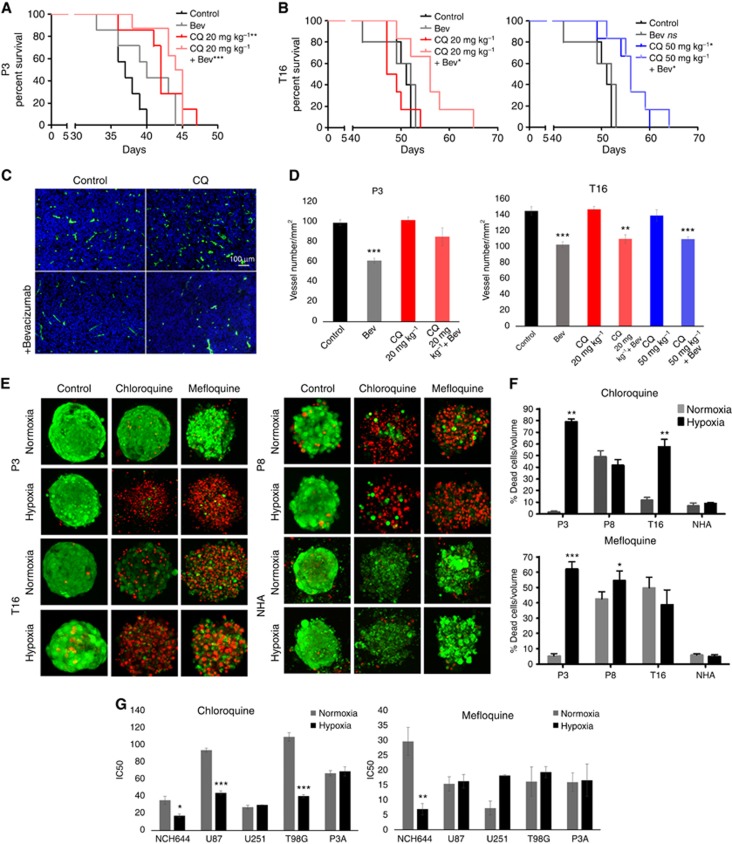
Figure 1
Figure 1
Hypoxia sensitises GBM cells to autophagy inhibitors. Chloroquine and bevacizumab were administered as single agents or simultaneously in P3 (A: 20 mg kg−1) and T16 (B: 20 and 50 mg kg−1) PDXs. Kaplan–Meier graphs show the survival of mice upon treatment. See Supplementary Table S1 for summary. Abbreviations: Bev=Bevacizumab; CQ=chloroquine; log-rank test, *P<0.05, **P<0.01, ***P<0.001. (C) Blood vessels from control and treated P3 PDXs were visualised by mouse-specific anti-CD31 (scale bars 100 μm). (D) Quantification of vessel number per mm2 upon treatment (mean±s.e.m., *P<0.05, **P<0.01, ***P<0.001). (E) The cytotoxic effect of inhibitors (chloroquine 20 μM, mefloquine 10 μM) was analysed for PDX-derived spheroids and NHA after 72 h treatment in normoxia and hypoxia. Representative images of treated spheroids are presented (‘green’=viable, ‘red’=dead). (F) Quantification of cell death upon treatment displayed as % of dead cells/volume (n⩾5, *P<0.05, **P<0.01, ***P<0.001). (G) Sensitivity of GBM cultures to chloroquine and mefloquine 72 h after treatment. Concentration gradients were used to determine the median inhibitory concentration (IC50). IC50 are expressed as mean±s.e.m. (n⩾3, *P<0.05, **P<0.01, ***P<0.001).
Figure 2
Figure 2
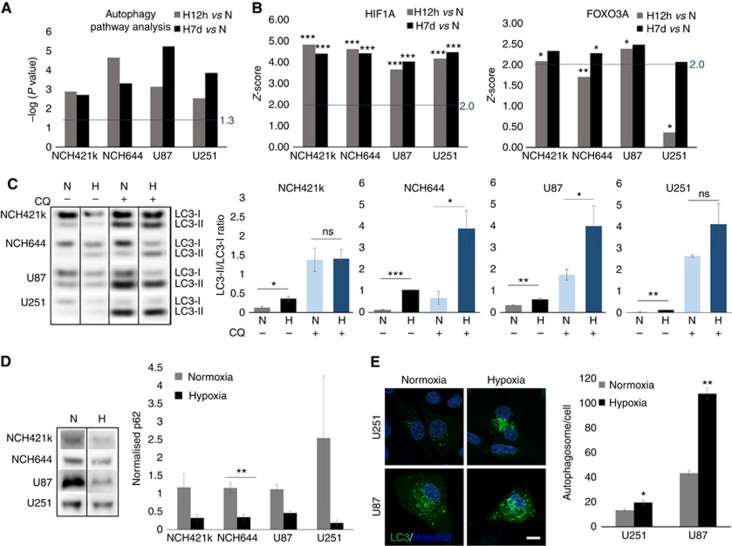
Hypoxia activates autophagy in GBM cells. (A) DEG lists between hypoxia 12 h vs normoxia and hypoxia 7 days vs normoxia (FDR<0.01; any FC, n=3–6) were subjected to IPA. Autophagy-associated genes (Moussay et al, 2011) were significantly altered (threshold: −log(P value) >1.3). (B) Upstream Regulator analysis (IPA) predicted activation of HIF1α and FOXO3 network upon hypoxia (threshold: z-score >2 and P value of overlap <0.05; *P<0.05 **P<0.01, ***P<0.001). (C) Western blot analysis showing LC3-I/II. Increase of autophagy in hypoxia is visualised by increased LC3-II (lower band)/LC3-I (upper band) ratio in the presence of chloroquine (mean±s.e.m., n=3; *P<0.05, **P<0.01, ***P<0.001). Representative images were cropped from the same blot (CQ=chloroquine, N=normoxia, H: 0.1–0.5% O2 48 h hypoxia). (D) Western blot analysis showing p62 degradation upon hypoxia (mean normalised to total protein content±s.e.m., n=3; **P<0.01). Representative images were cropped from the same blots. Control cells (normoxia, no chloroquine) were used as an internal calibration (value=‘1’). (E) Representative images show an increase in autophagosome formation upon hypoxia. Cells were exposed to hypoxia for 16 h in the presence of chloroquine. Autophagosomes were counted as LC3B–GFP-positive vacuoles 24 h after transfection; (mean±s.e.m.; n=34; *P<0.05, **P<0.01).
Figure 3
Figure 3
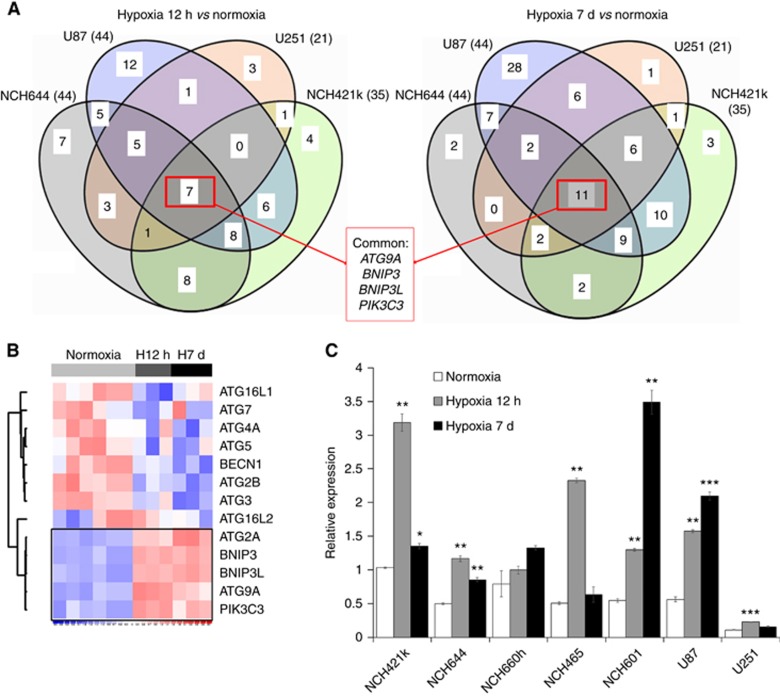
ATG9A is specifically activated upon autophagic response to hypoxia. (A) Genes directly related to autophagy (knowledge-driven selection) were extracted from DEG lists between hypoxia 12 h vs normoxia and hypoxia 7 days vs normoxia (FDR<0.01; any FC) for each culture (n=3–6). Venn diagrams reveal commonly deregulated genes. (B) Heatmap shows expression levels for selected genes in NCH421k in normoxia, 12 h and 7 days hypoxia. See Supplementary Table S3 for more autophagy-related genes. (C) QPCR confirmed increased ATG9A expression in hypoxia. EZRIN was used as a reference (mean±s.e.m.; n=3; *P<0.05, **P<0.01, ***P<0.001). NCH421k cells were used as an internal calibration (value=‘1’).
Figure 4
Figure 4
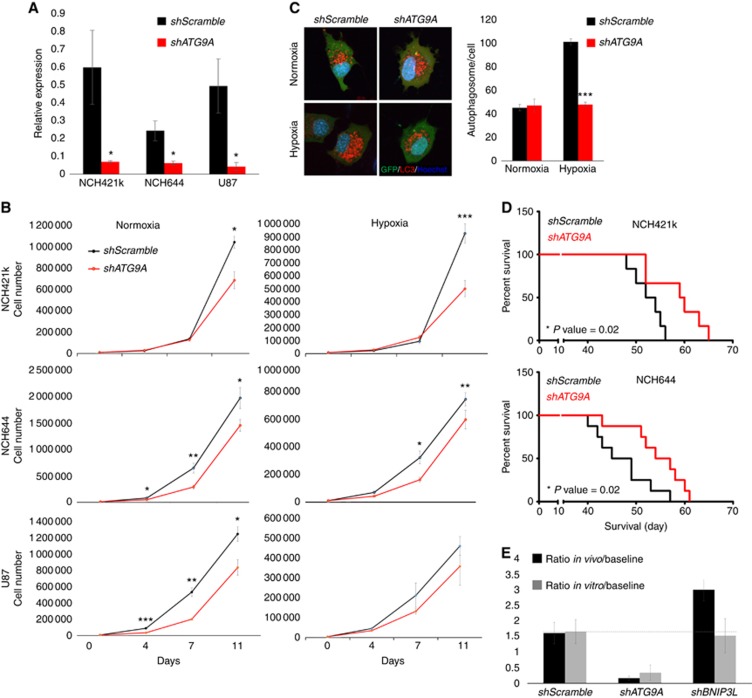
ATG9A knockdown decreases GBM cell proliferation and increases mouse survival. (A) QPCR confirmation of shATG9A knockdown (mean±s.e.m.; n=3; *P<0.05). (B) Proliferation of shATG9A cells was decreased significantly in normoxic and hypoxic conditions (mean±s.e.m.; n=3; *P<0.05, **P<0.01, ***P<0.001). (C) Representative images show lack of increased autophagosome formation upon hypoxia in shATG9 U87 cells. Cells were exposed to hypoxia for 16 h in the presence of chloroquine. Autophagosomes were counted as LC3B–Tomato-positive vacuoles 24 h after transfection; GFP positivity confirms shRNA expression (mean±s.e.m.; n=34; ***P value <0.001). (D) ATG9A depletion in NCH421k and NCH644 prolonged the survival of tumour-bearing mice (n=6–8). (E) Targeted in vivo shRNA screen in NCH421k cells. shRNA targeting ATG9A but not BNIP3L was depleted after in vivo (n=5) and in vitro (normoxia, n=3) growth. Relative representation of respective shRNAs after selection pressure is presented as ratios compared with the original shRNA pool before selection (baseline). For detailed experimental setup, see (Sanzey et al, 2015).

References

    1. Baginska J, Viry E, Berchem G, Poli A, Noman MZ, van Moer K, Medves S, Zimmer J, Oudin A, Niclou SP, Bleackley RC, Goping IS, Chouaib S, Janji B (2013) Granzyme B degradation by autophagy decreases tumor cell susceptibility to natural killer-mediated lysis under hypoxia. Proc Natl Acad Sci USA 110: 17450–17455. - PMC - PubMed
    1. Bellot G, Garcia-Medina R, Gounon P, Chiche J, Roux D, Pouyssegur J, Mazure NM (2009) Hypoxia-induced autophagy is mediated through hypoxia-inducible factor induction of BNIP3 and BNIP3L via their BH3 domains. Mol Cell Biol 29: 2570–2581. - PMC - PubMed
    1. Bertout JA, Patel SA, Simon MC (2008) The impact of O2 availability on human cancer. Nat Rev Cancer 8: 967–975. - PMC - PubMed
    1. Bougnaud S, Golebiewska A, Oudin A, Keunen O, Harter PN, Mader L, Azuaje F, Fritah S, Stieber D, Kaoma T, Vallar L, Brons NH, Daubon T, Miletic H, Sundstrøm T, Herold-Mende C, Mittelbronn M, Bjerkvig R, Niclou SP (2016) Molecular crosstalk between tumour and brain parenchyma instructs histopathological features in glioblastoma. Oncotarget. - PMC - PubMed
    1. Chen Y, Henson ES, Xiao W, Huang D, McMillan-Ward EM, Israels SJ, Gibson SB (2016) Tyrosine kinase receptor EGFR regulates the switch in cancer cells between cell survival and cell death induced by autophagy in hypoxia. Autophagy 12: 1029–1046. - PMC - PubMed

MeSH terms