


Use of biological priors enhances understanding of genetic architecture and genomic prediction of complex traits within and between dairy cattle breeds
- PMID: 28797230
- PMCID: PMC5553760
- DOI: 10.1186/s12864-017-4004-z
Use of biological priors enhances understanding of genetic architecture and genomic prediction of complex traits within and between dairy cattle breeds
Abstract
Background: A better understanding of the genetic architecture underlying complex traits (e.g., the distribution of causal variants and their effects) may aid in the genomic prediction. Here, we hypothesized that the genomic variants of complex traits might be enriched in a subset of genomic regions defined by genes grouped on the basis of "Gene Ontology" (GO), and that incorporating this independent biological information into genomic prediction models might improve their predictive ability.
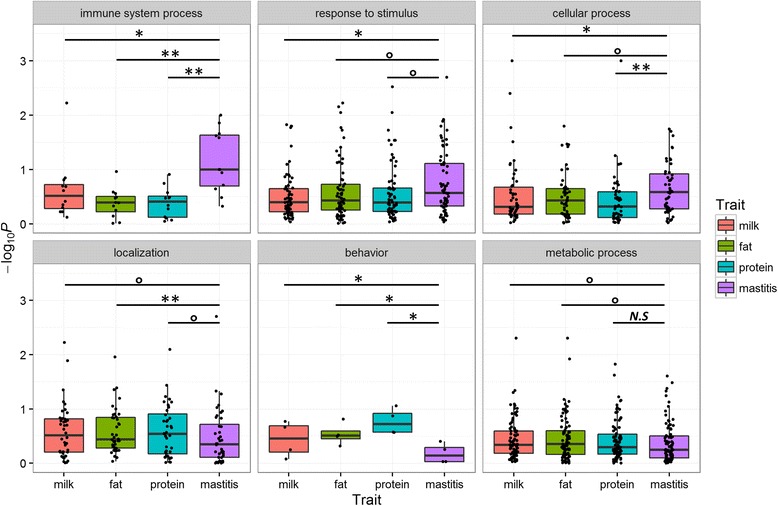
Results: Four complex traits (i.e., milk, fat and protein yields, and mastitis) together with imputed sequence variants in Holstein (HOL) and Jersey (JER) cattle were analysed. We first carried out a post-GWAS analysis in a HOL training population to assess the degree of enrichment of the association signals in the gene regions defined by each GO term. We then extended the genomic best linear unbiased prediction model (GBLUP) to a genomic feature BLUP (GFBLUP) model, including an additional genomic effect quantifying the joint effect of a group of variants located in a genomic feature. The GBLUP model using a single random effect assumes that all genomic variants contribute to the genomic relationship equally, whereas GFBLUP attributes different weights to the individual genomic relationships in the prediction equation based on the estimated genomic parameters. Our results demonstrate that the immune-relevant GO terms were more associated with mastitis than milk production, and several biologically meaningful GO terms improved the prediction accuracy with GFBLUP for the four traits, as compared with GBLUP. The improvement of the genomic prediction between breeds (the average increase across the four traits was 0.161) was more apparent than that it was within the HOL (the average increase across the four traits was 0.020).
Conclusions: Our genomic feature modelling approaches provide a framework to simultaneously explore the genetic architecture and genomic prediction of complex traits by taking advantage of independent biological knowledge.
Keywords: Dairy cattle; Gene ontology; Genetic architecture; Genomic feature model; Genomic prediction; Mastitis; Milk production; Post-GWAS.
Conflict of interest statement
Ethics approval and consent to participate
No animal experiments were performed in this study, and ethics committee approval was therefore not required. References are provided where animal data were used.
Consent for publication
Not applicable.
Competing interests
The authors declare that they have no competing interests.
Publisher’s Note
Springer Nature remains neutral with regard to jurisdictional claims in published maps and institutional affiliations.
Figures

References
Publication types
MeSH terms
LinkOut - more resources
Full Text Sources
Other Literature Sources
