. 2017 Aug 10;7(1):7821.
doi: 10.1038/s41598-017-07336-z.

Cross-species transmission potential between wild pigs, livestock, poultry, wildlife, and humans: implications for disease risk management in North America

Affiliations

Cross-species transmission potential between wild pigs, livestock, poultry, wildlife, and humans: implications for disease risk management in North America

Ryan S Miller et al. Sci Rep. .

Abstract

Cross-species disease transmission between wildlife, domestic animals and humans is an increasing threat to public and veterinary health. Wild pigs are increasingly a potential veterinary and public health threat. Here we investigate 84 pathogens and the host species most at risk for transmission with wild pigs using a network approach. We assess the risk to agricultural and human health by evaluating the status of these pathogens and the co-occurrence of wild pigs, agriculture and humans. We identified 34 (87%) OIE listed swine pathogens that cause clinical disease in livestock, poultry, wildlife, and humans. On average 73% of bacterial, 39% of viral, and 63% of parasitic pathogens caused clinical disease in other species. Non-porcine livestock in the family Bovidae shared the most pathogens with swine (82%). Only 49% of currently listed OIE domestic swine diseases had published wild pig surveillance studies. The co-occurrence of wild pigs and farms increased annually at a rate of 1.2% with as much as 57% of all farms and 77% of all agricultural animals co-occurring with wild pigs. The increasing co-occurrence of wild pigs with livestock and humans along with the large number of pathogens shared is a growing risk for cross-species transmission.


Conflict of interest statement

The authors declare that they have no competing interests.

Figures
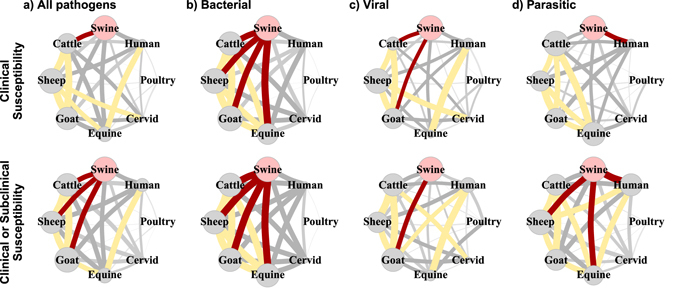
Figure 1
Figure 1
Transmission potential networks used in this study created by connecting two host species if they were susceptible to the same pathogen causing clinical or subclinical disease in swine. Top row are pathogens causing clinical disease in non-swine hosts and the bottom row are all pathogens affecting non-swine hosts. Edge weight between two species is the similarity in the parasites infecting a pair of individuals calculated with the Jaccard index. Red edges denote Jaccard index in the upper 75th quartile, while light gray are edges in the lower 25th quartile. Node size indicates the relative centrality of the species group in the transmission network, calculated using the eigenvalue centrality – more central nodes are larger.
Figure 2
Figure 2
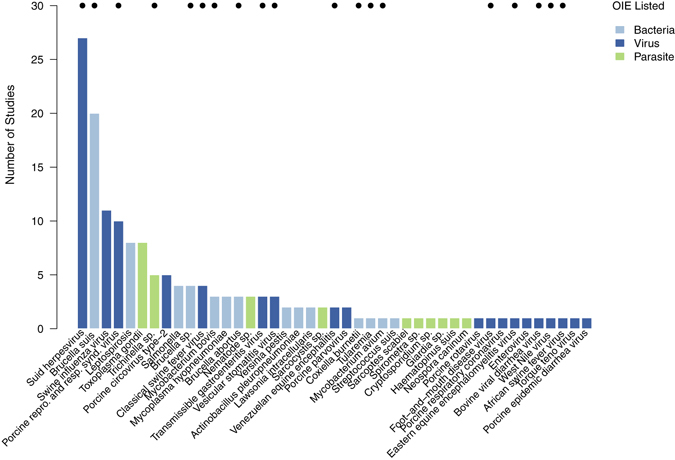
Number of scientific peer reviewed publications (n = 72) reporting results of prevalence studies for wild pigs in North America. Dots along top margin indicate OIE listed swine pathogens (n = 19) of the total number of pathogens (n = 48) with studies.
Figure 3
Figure 3
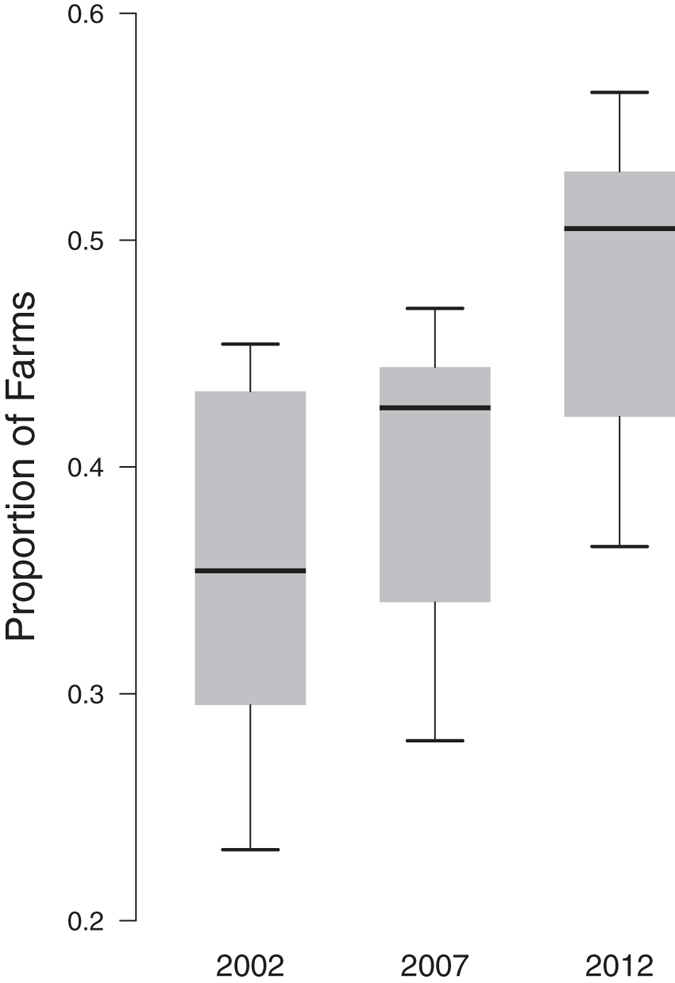
Increase in the proportion of United States farms co-occurring with wild pigs over the ten years we investigated. Boxplots represent the interquartile range (gray box) with the median noted as a solid line, and the whiskers indicate the minimum and maximum of the data.
Figure 4
Figure 4
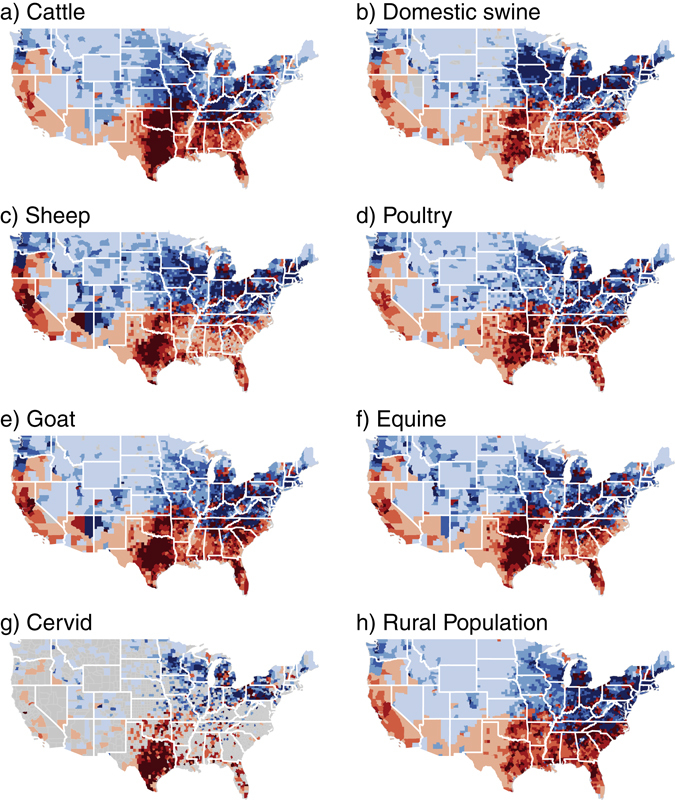
County level co-occurrence of wild pigs, agricultural commodities, and rural human populations in the contiguous United States for 2012. Red shading denotes by quartile the absolute farms density (farms per km2) or rural human population density (people per km2) within counties co-occurring with wild pigs while blue shading indicates counties without wild pigs. Maps were generated by combining publically available data (see methods) describing wild pig distribution from Southeast Cooperative Wildlife Disease Study (SCWDS), agriculture data from National Agricultural Statistics Service (NASS) Quick Stats database, and rural human population data available from the United States Census Bureau. Maps were created using the maptools package version 0.9.2 in R version 3.3.0.

References

    1. Miller RS, Sweeney SJ. Mycobacterium bovis (bovine tuberculosis) infection in north american wildlife: Current status and opportunities for mitigation of risks of further infection in wildlife populations. Epidemiology and infection. 2013;141:1357–1370. doi: 10.1017/S0950268813000976. - DOI - PMC - PubMed
    1. Jones BA, et al. Zoonosis emergence linked to agricultural intensification and environmental change. Proceedings of the National Academy of Sciences of the United States of America. 2013;110:8399. doi: 10.1073/pnas.1208059110. - DOI - PMC - PubMed
    1. Miller RS, Farnsworth ML, Malmberg JL. Diseases at the livestock–wildlife interface: Status, challenges, and opportunities in the united states. Preventive veterinary medicine. 2013;110:119–132. doi: 10.1016/j.prevetmed.2012.11.021. - DOI - PMC - PubMed
    1. Jones KE, et al. Global trends in emerging infectious diseases. Nature. 2008;451:990–993. doi: 10.1038/nature06536. - DOI - PMC - PubMed
    1. Taylor LH, Latham SM, Mark E. Risk factors for human disease emergence. Philosophical Transactions of the Royal Society of London B: Biological Sciences. 2001;356:983–989. doi: 10.1098/rstb.2001.0888. - DOI - PMC - PubMed