. 2009 Jul 30;6(3):201-211.
doi: 10.1007/s10433-009-0120-1. eCollection 2009 Sep.

Population ageing in Sweden: the effect of change in educational composition on the future number of older people suffering severe ill-health

Affiliations

Population ageing in Sweden: the effect of change in educational composition on the future number of older people suffering severe ill-health

Ilija Batljan et al. Eur J Ageing. .

Abstract

We investigate how expected changes in the educational level composition of the older population may affect future prevalence of severe ill-health among older people in Sweden. Previous research has indicated that the number of older people, given educational differentials in mortality and expected changes in educational composition during the next decades, may increase more than expected following official population projections in Sweden. Eight alternative scenario projections for the possible development in the number of people with severe ill-health in Sweden between 2000 and 2035 are presented. Scenario projections, where both morbidity and mortality inequalities by educational level are taken into account, are compared with scenarios in which only age and gender are modelled. The projections are made with both constant and decreasing mortality. The calculations show that the expected increases in severe ill-health as a result from the ageing of the population in the period 2000-2035 might, to a large extent, be counteracted by the increase in the educational level of the Swedish population. We recommend therefore that in projections of the prevalence of ill-health, in addition to the ageing of the population, also changes in educational level should be taken into account.

Keywords: Educational level; Future needs of long-term care; Inequalities; Morbidity; Population ageing.


Figures
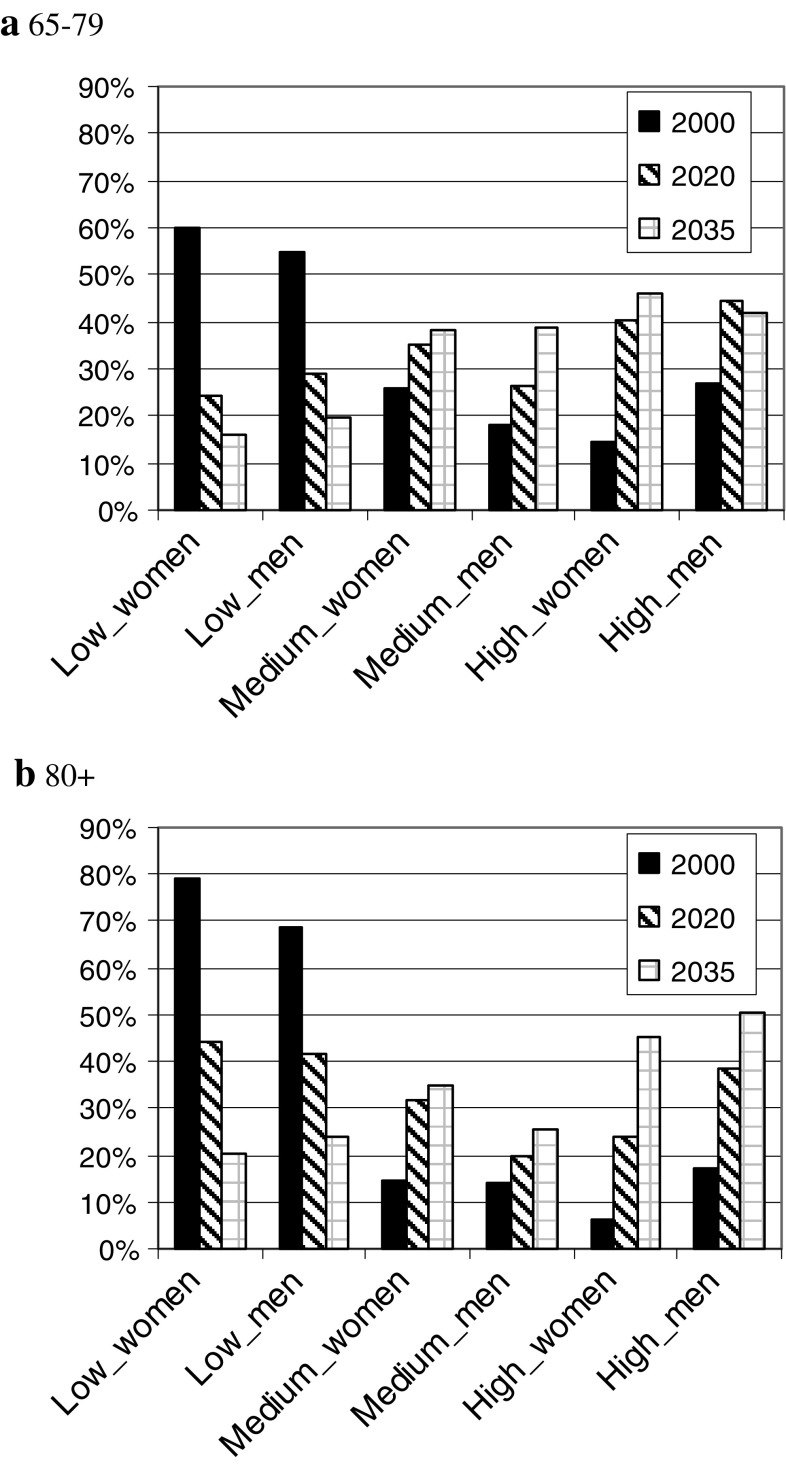
Fig. 1
Fig. 1
Educational composition of Swedish older population by age group, sex and educational level in 2000, 2020 and 2035. Source: Own calculations after projections by Batljan and Thorslund (2009)
Fig. 2
Fig. 2
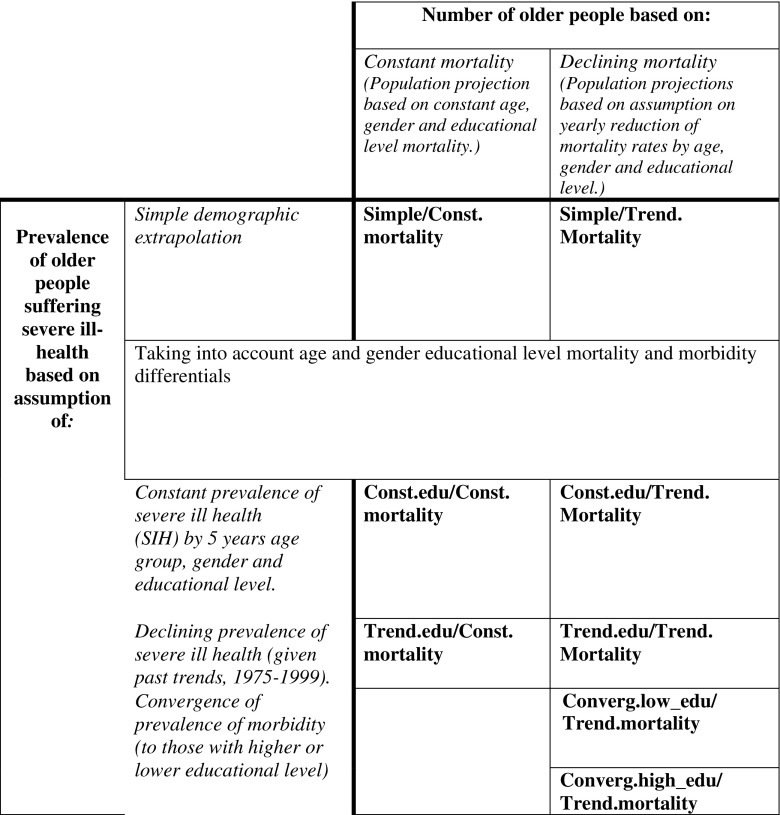
Eight scenarios on future number of older people suffering severe ill-health
Fig. 3
Fig. 3
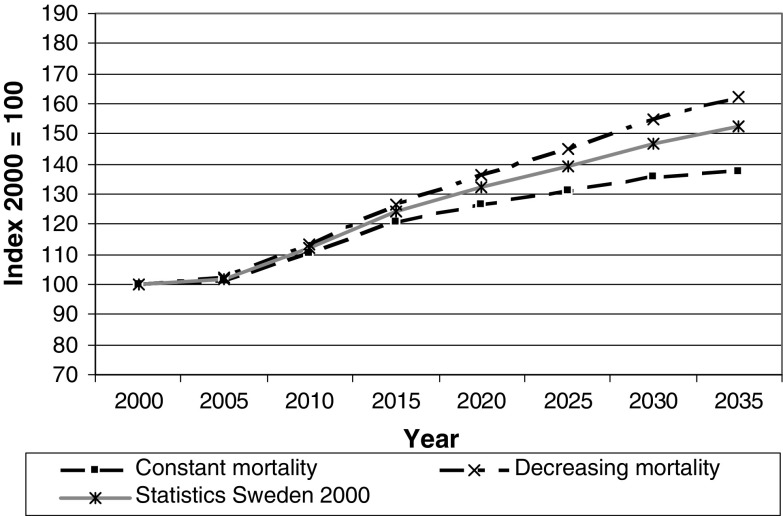
The development in projected number of older people in Sweden, two alternative projections according to Batljan and Thorslund (2009) and the projection by Statistics Sweden. Source: Batljan and Thorslund (2009)
Fig. 4
Fig. 4
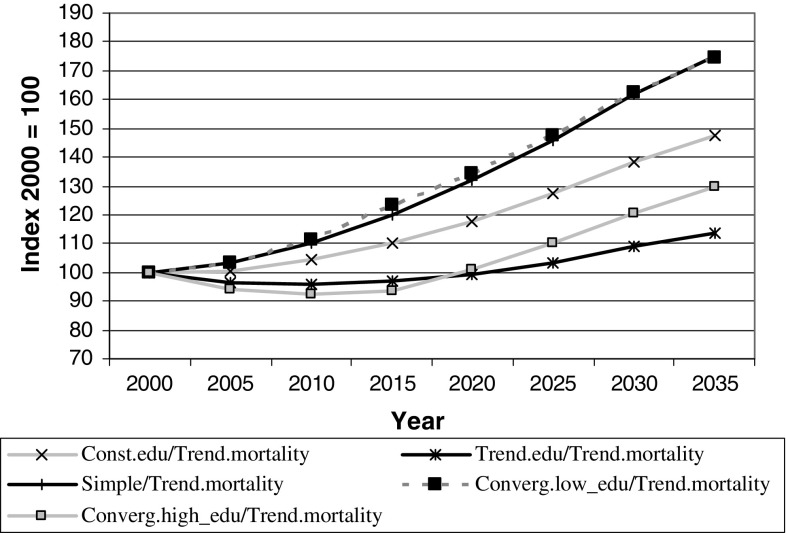
Development in the projected number of older people suffering severe ill-health 2000–2035, scenarios based on population projections with decreasing mortality. The population projections with declining mortality lead to an increase of 75% of the number of persons with severe ill-health with the simple scenario, of 48% with the scenario of constant prevalence, and of 14% with scenario of declining prevalence in educational groups according the trend. The scenarios of low and high converging prevalences result in 74 and 30% increase of the number of persons with severe ill-health
Fig. 5
Fig. 5
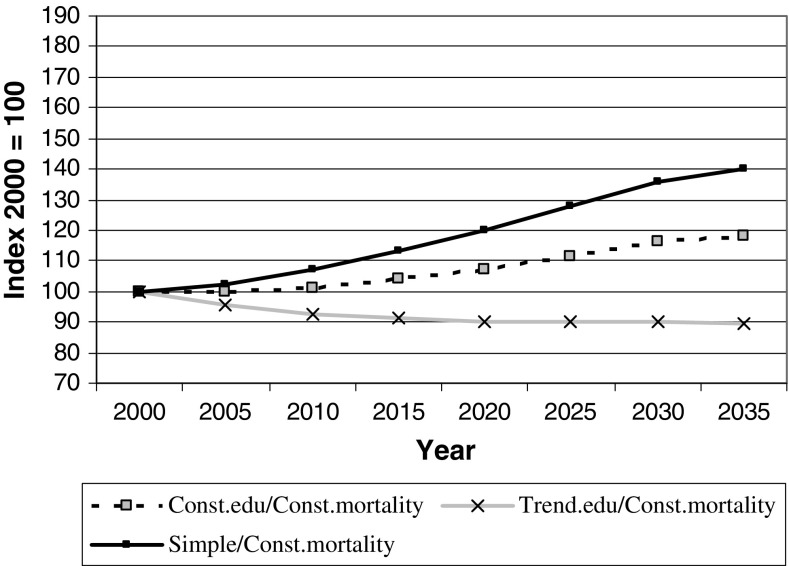
Development in the projected number of older people suffering severe ill-health 2000–2035, scenarios based on population projections with constant mortality. The population projections with constant mortality lead to an increase of 40% of the number of persons with severe ill-health with the simple scenario, of 18% with the scenario of constant prevalence of severe ill-health in educational groups and to a decrease of 11% with the scenario of declining prevalence in educational groups

References

    1. Alm Stenflo G (2002) Arbetskraft—framtida bristvara. In: Swedish: lack of labour force in the future. VälfärdsBulletinen Nr 2. Statistiska centralbyrån (SCB), Stockholm
    1. Batljan I, Lagergren M. Future demand for formal long-term care in Sweden. Eur J Ageing. 2005;2(3):216–224. doi: 10.1007/s10433-005-0002-0. - DOI - PMC - PubMed
    1. Batljan I, Thorslund M (2009) The effect of change in educational composition on population ageing. Eur J Ageing. doi:10.1007/s10433-009-0122-z - PMC - PubMed
    1. Ben-Shlomo Y, Kuh D. A life course approach to chronic disease epidemiology: conceptual models, empirical challenges and interdisciplinary perspectives. Int J Epidemiol. 2002;31:285–293. doi: 10.1093/ije/31.2.285. - DOI - PubMed
    1. Birch S. Health human resources planning for the new millenium: Inputs in the production of health, illness and recovery in populations. Can J Nurs Res. 2002;33:109–114. - PubMed

LinkOut - more resources