


Comment
doi: 10.3389/fpsyg.2017.01249.
eCollection 2017.
Commentary: Alignment in social interactions
Affiliations
- PMID: 28798704
- PMCID: PMC5526913
- DOI: 10.3389/fpsyg.2017.01249
Item in Clipboard
Comment
Commentary: Alignment in social interactions
Front Psychol.
.
No abstract available
Keywords: embodied cognition; enactive cognition; interpersonal coordination; social cognition; social interaction.
Figures
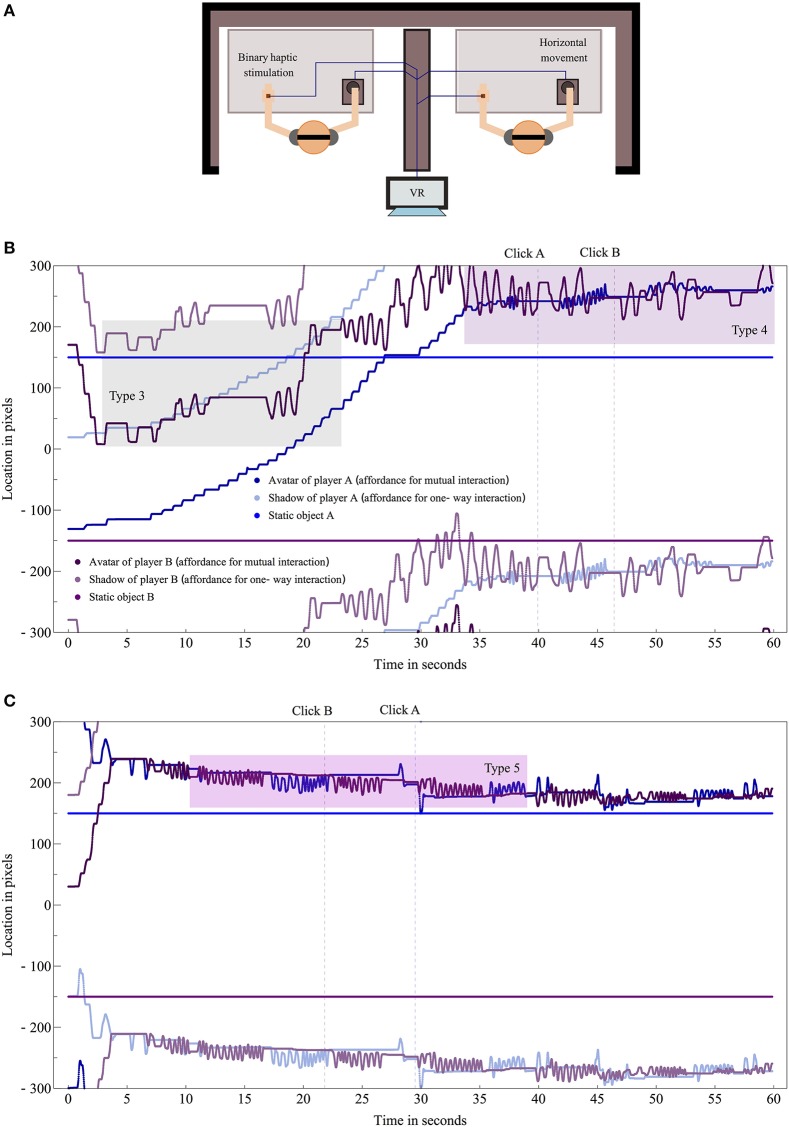
(A) Pairs of physically separated participants are embodied as avatars in an invisible virtual reality (VR) environment consisting of a line that wraps around. They can move their avatar and their hand will receive a tactile stimulation when it overlaps with another object. Each player can encounter a static object and two mobile objects: the other's avatar and a “shadow” that is copying the other's movements. The task for the players is to locate the other's avatar (and to mark this event by clicking). (B) Type 3: “on-line social cognition without mutual alignment” happens when A is moving and B is following A's shadow such that B's movements align with those of A but not vice versa (highlighted in gray). Type 4: “on-line social cognition with mutual alignment” happens when the avatars respond to each other's contact, e.g. by oscillating back and forth (highlighted in purple). Such perceptual crossing satisfies Gallotti et al.'s criterion for social interaction as reciprocal information exchange. A and B reported clear and almost clear awareness of the other, respectively, at the time of their click. (C) Type 5: type 4 situations in which it happens that one participant adapts more than another. Here A initially adapts more than B by imitating B's oscillatory movements (highlighted in pink). But the interaction then quickly gives rise to turn-taking and mutual imitation, which go beyond mere reciprocal dynamics because they depend on active co-regulation. Both participants reported clear awareness of the other at the time of their click.
Comment on
-
Alignment in social interactions.Conscious Cogn. 2017 Feb;48:253-261. doi: 10.1016/j.concog.2016.12.002. Epub 2016 Dec 26. Conscious Cogn. 2017. PMID: 28033550 Review.
References
-
- De Jaegher H., Di Paolo E. A. (2007). Participatory sense-making: an enactive approach to social cognition. Phenomenol. Cogn. Sci. 6, 485–507. 10.1007/s11097-007-9076-9 - DOI
-
- Di Paolo E. A., Rohde M., Iizuka H. (2008). Sensitivity to social contingency or stability of interaction? Modelling the dynamics of perceptual crossing. New Ideas Psychol. 26, 278–294. 10.1016/j.newideapsych.2007.07.006 - DOI
Publication types
LinkOut - more resources
Full Text Sources
Other Literature Sources
