


Buffering Impostor Feelings with Kindness: The Mediating Role of Self-compassion between Gender-Role Orientation and the Impostor Phenomenon
- PMID: 28798714
- PMCID: PMC5526963
- DOI: 10.3389/fpsyg.2017.01289
Buffering Impostor Feelings with Kindness: The Mediating Role of Self-compassion between Gender-Role Orientation and the Impostor Phenomenon
Abstract
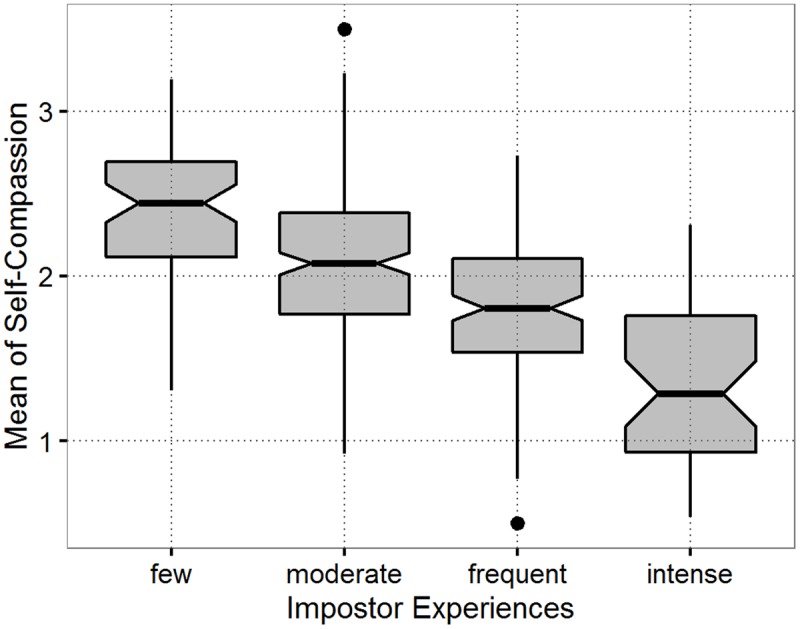
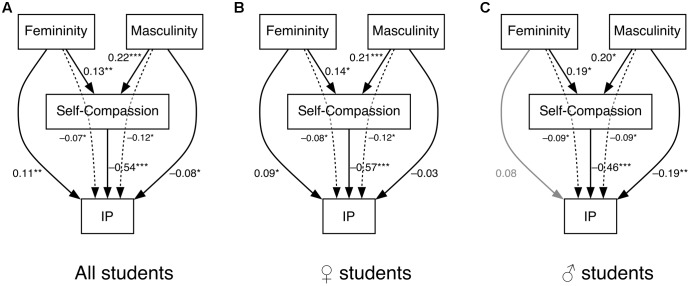
The impostor phenomenon (IP) refers to high-achievers who underestimate their abilities and thus fear being unmasked as impostors. IP sufferers attribute their success to factors other than their abilities, entailing negative emotions, unfavorable motivations, and reduced well-being. The IP was originally conceptualized as a predominantly female experience, and is thus seen as an important psychological barrier for female academic careers. Empirical findings of gender differences in the IP are equivocal, but sparse research on associations between gender-role orientation and the IP indicates that feminine students suffer more intensely from the IP than masculine students. Femininity and masculinity are also related to self-compassion, a rather young construct that enhances emotional resilience, well-being, and academic achievement. Self-compassion involves being kind to oneself when failing, perceiving one's inadequacies as part of the human condition, and being mindful about negative aspects of oneself. It reduces fear of failure, denial of competences, and self-doubts which are central components of the IP. However, relations between self-compassion and the IP have not been investigated to date. In this study, we examine self-compassion as a potential resilience factor against the IP, taking gender and gender-role orientation into account. In a cross-sectional online survey, we investigated 459 (315 female) high-achieving first-year undergraduate students. Results include: Female, feminine, and undifferentiated students score higher on measures of the IP and lower on measures of self-compassion than male, masculine, or androgynous students. Higher levels of the IP are associated with lower levels of self-compassion across all students tested. Self-compassion further mediates the relationship between gender-role orientation and the IP. Interventions to enhance self-compassion might thus be an effective way to overcome impostor feelings. Female, feminine, and undifferentiated students might benefit most from facilitation of self-compassion in education.
Keywords: academic achievement; gender differences; gender-role orientation; impostor phenomenon; self-compassion.
Figures
References
-
- American Psychological Association (2010). Publication Manual of the American Psychological Association, 6th Edn. Washington, DC: American Psychological Association.
-
- Baars G. A., Arnold I. M. (2014). Early identification and characterization of students who drop out in the first year at university. J. Coll. Stud. Ret. 16 95–109. 10.2190/CS.16.1.e - DOI
-
- Barnard L. K., Curry J. F. (2012). The relationship of clergy burnout to self-compassion and other personality dimensions. Pastoral Psychol. 61 149–163. 10.1007/s11089-011-0377-0 - DOI
-
- Bask M., Salmela-Aro K. (2013). Burned out to drop out: exploring the relationship between school burnout and school dropout. Eur. J. Psychol. Educ. 28 511–528. 10.1007/s10212-012-0126-5 - DOI
LinkOut - more resources
Full Text Sources
Other Literature Sources
