. 2017:2017:9217912.
doi: 10.1155/2017/9217912. Epub 2017 Jul 17.

Antidiabetic Micro-/Nanoaggregates from Ge-Gen-Qin-Lian-Tang Decoction Increase Absorption of Baicalin and Cellular Antioxidant Activity In Vitro

Affiliations

Antidiabetic Micro-/Nanoaggregates from Ge-Gen-Qin-Lian-Tang Decoction Increase Absorption of Baicalin and Cellular Antioxidant Activity In Vitro

Dai Lin et al. Biomed Res Int. 2017.

Abstract

The antidiabetic effects of Ge-Gen-Qin-Lian-Tang decoction (GQD) have been proven clinically. In a pharmacological study conducted on STZ-induced diabetic rats, the constitutive aggregates/sediments of Ge-Gen-Qin-Lian-Tang decoction exhibited stronger hypoglycemic and antioxidant activities compared to the soluble compositions. This study aims to demonstrate the pharmacological properties of aggregates derived from GQD by measuring permeability of the active monomer phytochemicals (e.g., baicalin) in a Caco-2 cell monolayer and determine the cellular viability, intracellular redox status (MDA and SOD), and insulin secretion of pancreatic β-cell line, INS-1, following STZ-induced oxidative stress. The aggregates were separated into three fractions, namely, "MA (microaggregates)," "400 g supernatant," and "MNA (micro-/nanoaggregates)," by centrifugation at 400 ×g and 15000 ×g, respectively. Aggregates in the sediment increased baicalin absorption, showed little toxicity to β-cells, elevated intracellular SOD levels, and significantly suppressed oxidative damage effects on cellular viability and functions. The "MA" fraction had a larger particle size and provided higher antioxidant cellular protection than "MNA" in vitro, implying that the sediments may be the active components in the herbal decoction. The actions of these micro-/nanoaggregates may provide a new perspective for understanding the antidiabetic effects of herbal decoctions and aid in interpretation of synergistic actions between the multiple components.


Figures
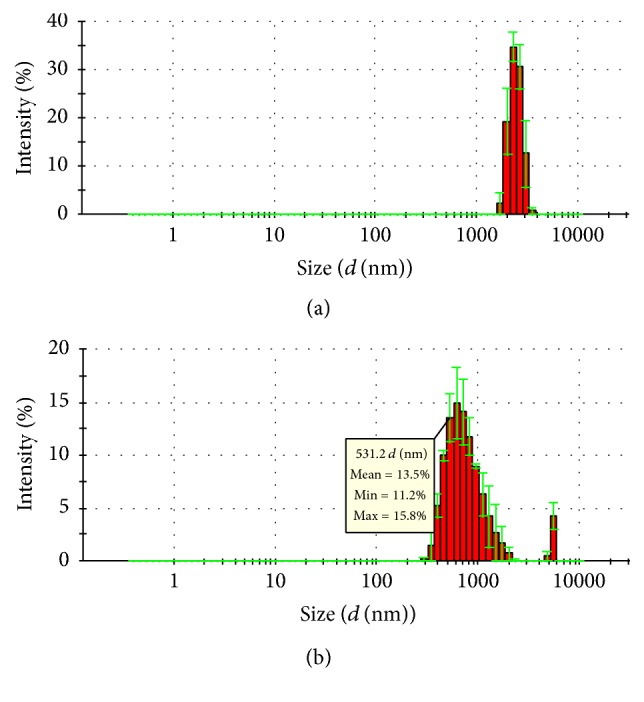
Figure 1
Figure 1
The particle size distribution of aggregates in GQD. (a) Particle size distribution of MA; (b) particle size distribution of MNA. Three duplicates were performed for each sample.
Figure 2
Figure 2
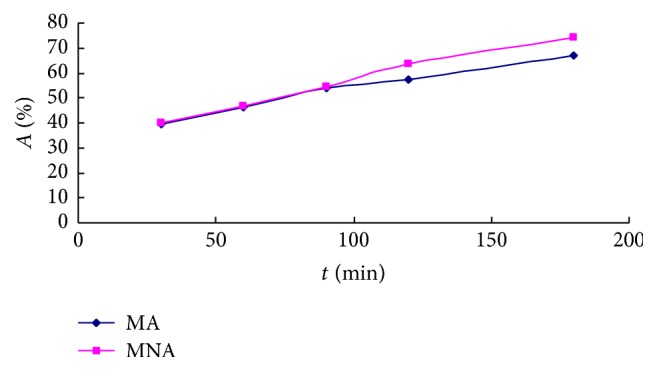
Absorption rate (A%) of baicalin in GQD aggregates on monolayers of Caco-2 cells. Baicalin concentrations in the basolateral side solutions were determined by HPLC at different time points (n = 4).
Figure 3
Figure 3
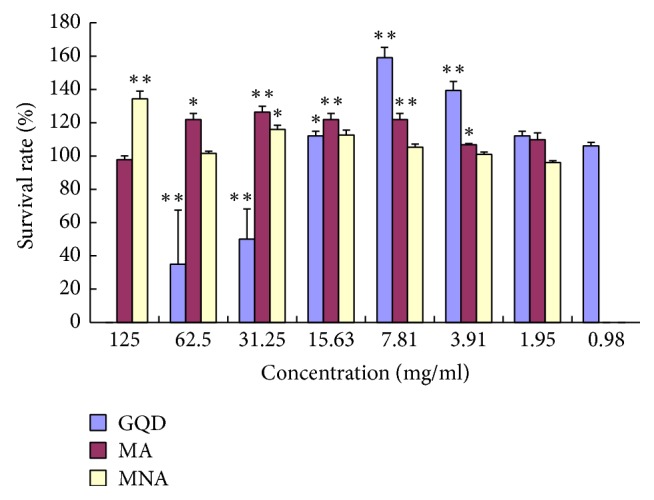
Effects of GQD and its aggregates on proliferation of INS-1 pancreatic β-cells. n = 5. GQD (in blue): compared with normal controls, 0.98~1.95 mg/mL (P > 0.05), 15.63 mg/mL (0.01 < P < 0.05, “”), and others (P < 0.01, “∗∗”); MA (in orange): 400 g sediment, compared with normal controls, 125.0 mg/mL and 1.95 mg/mL (P > 0.05), 62.50 and 3.91 mg/mL (0.01 < P < 0.05, “”), and others (P < 0.01, “∗∗”); MNA (in grey): 15000 g sediment, compared with normal controls, 125.0 mg/mL (P < 0.01, “∗∗”), 31.25 mg/mL (0.01 < P < 0.05, “”), and others (P > 0.05). Error bars + SEM. Differences are significant according to a one-way ANOVA indicated with an asterisk (P < 0.05; n = 4) or double asterisks (P < 0.01; n = 4).
Figure 4
Figure 4
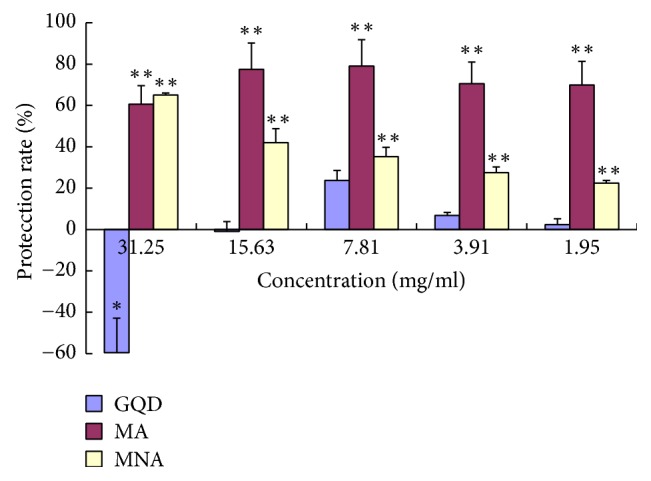
Protection of GQD and its aggregates against STZ-induced oxidative suppression of the growth of INS-1 β-cells. n = 5. Oxidative damage was induced with STZ at its IC50 (46.4 mM). GQD: compared with STZ controls, 31.25 mg/mL (0.01 < P < 0.05, labelled “”) and others (P > 0.05); MA: 400 g sediment, compared with STZ controls, at all concentrations, P < 0.01 (“∗∗”); MNA: 15000 g sediment, compared with STZ controls, at all concentrations, P < 0.01 (“∗∗”).
Figure 5
Figure 5
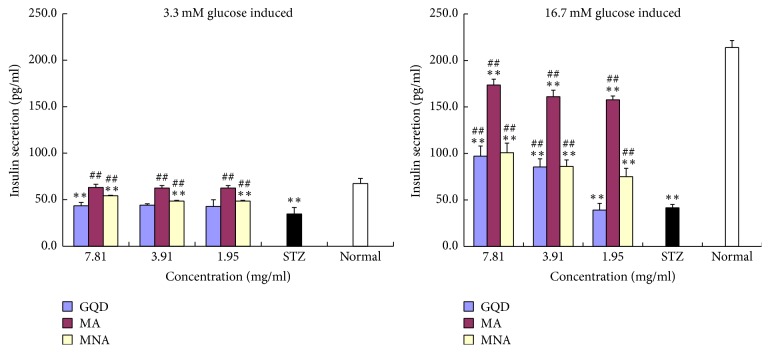
GQD and its aggregates restoration of insulin secretion in STZ-damaged INS-1 cells. “∗∗”: compared with normal cells, P < 0.01, n = 3; “##”: compared with STZ controls, P < 0.01, n = 3.
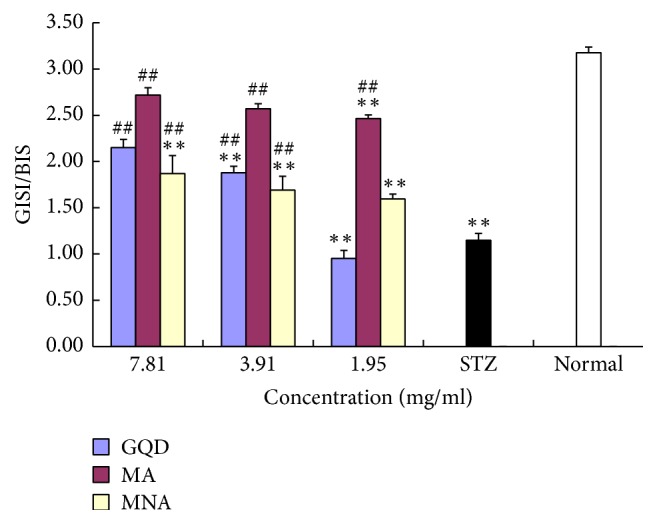
Figure 6
Figure 6
GQD and its constitutive aggregates elevation of insulin secretion index (ISI) of STZ-damaged INS-1 β-cells. “∗∗”: compared with normal cells, P < 0.01, n = 3; “##”: compared with STZ controls, P < 0.01, n = 3; ISI: GSIS/BIS.

References

    1. Wang Z., Wang J., Chan P. Treating type 2 diabetes mellitus with traditional chinese and indian medicinal herbs. Evidence-Based Complementary and Alternative Medicine. 2013;2013:17. doi: 10.1155/2013/343594.343594 - DOI - PMC - PubMed
    1. Zhong Y., Deng Y., Chen Y., Chuang P. Y., Cijiang He J. Therapeutic use of traditional Chinese herbal medications for chronic kidney diseases. Kidney International. 2013;84(6):1108–1118. doi: 10.1038/ki.2013.276. - DOI - PMC - PubMed
    1. Xie W., Zhao Y., Zhang Y. Traditional chinese medicines in treatment of patients with type 2 diabetes mellitus. Evidence-Based Complementary and Alternative Medicine. 2011;2011:13. doi: 10.1155/2011/726723.726723 - DOI - PMC - PubMed
    1. Liao H., Banbury L. K., Leach D. N. Antioxidant activity of 45 Chinese herbs and the relationship with their TCM characteristics. Evidence-based Complementary and Alternative Medicine. 2008;5(4):429–434. doi: 10.1093/ecam/nem054. - DOI - PMC - PubMed
    1. Liu H., Qiu N., Ding H., Yao R. Polyphenols contents and antioxidant capacity of 68 Chinese herbals suitable for medical or food uses. Food Research International. 2008;41(4):363–370. doi: 10.1016/j.foodres.2007.12.012. - DOI

MeSH terms

LinkOut - more resources