


Management of labyrinthine fistula: hearing preservation versus prevention of residual disease
- PMID: 28799140
- PMCID: PMC5591808
- DOI: 10.1007/s00405-017-4697-2
Management of labyrinthine fistula: hearing preservation versus prevention of residual disease
Abstract
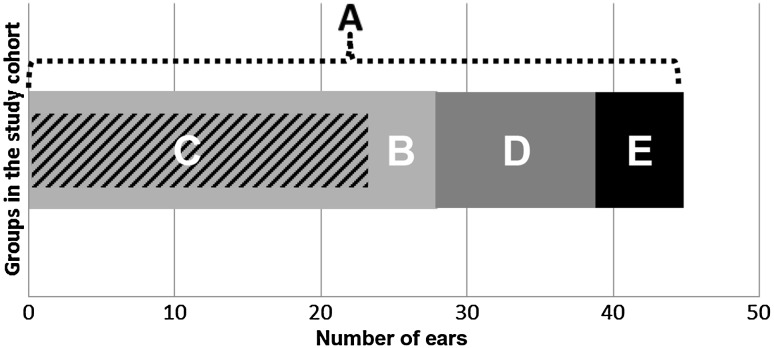
The objective of the study was to evaluate postoperative hearing and disease control after cholesteatoma surgery for labyrinthine fistulas. In a retrospective cohort study, we evaluated a consecutive cohort comprising 44 patients (45 ears) with labyrinthine fistulas associated with chronic otitis media with cholesteatoma who underwent surgery between 2002 and 2015. We looked at patient characteristics, pre- and postoperative bone conduction thresholds (BCT), operative approach and findings, extent of disease and the occurrence of residual disease. All deaf ears (24%) presented preoperatively with a large fistula. Opening the membranous labyrinth resulted in significantly worse postoperative BCT (p = 0.01). Neither the present study nor a literature search revealed a significant positive effect of corticosteroids on postoperative hearing preservation. Large fistulas were correlated with poorer preoperative BCTs, but not with poorer postoperative BCTs. Opening the membranous labyrinth during surgery is correlated with poorer postoperative BCTs and can be seen as a predictive parameter. The use of corticosteroids in the perioperative management of labyrinthine fistula was not found to result in any improvement in postoperative BCTs.
Keywords: Bone conduction threshold; Cholesteatoma; Computed tomography; Ear surgery; Labyrinthine fistula.
Conflict of interest statement
Funding
None.
Conflict of interest
The authors declare that they have no conflict of interest.
Informed consent
Since this is a retrospective study no informed consent was obtained.
Figures


References
MeSH terms
Substances
LinkOut - more resources
Full Text Sources
Other Literature Sources
Medical
