


Preconception care for diabetic women for improving maternal and infant health
- PMID: 28799164
- PMCID: PMC6483481
- DOI: 10.1002/14651858.CD007776.pub3
Preconception care for diabetic women for improving maternal and infant health
Abstract
Background: Infants born to mothers with pre-existing type 1 or type 2 diabetes mellitus are at greater risk of congenital anomalies, perinatal mortality and significant morbidity in the short and long term. Pregnant women with pre-existing diabetes are at greater risk of perinatal morbidity and diabetic complications. The relationship between glycaemic control and health outcomes for both mothers and infants indicates the potential for preconception care for these women to be of benefit. This is an update of the original review, which was first published in 2010.
Objectives: To assess the effects of preconception care in women with diabetes on health outcomes for mothers and their infants.
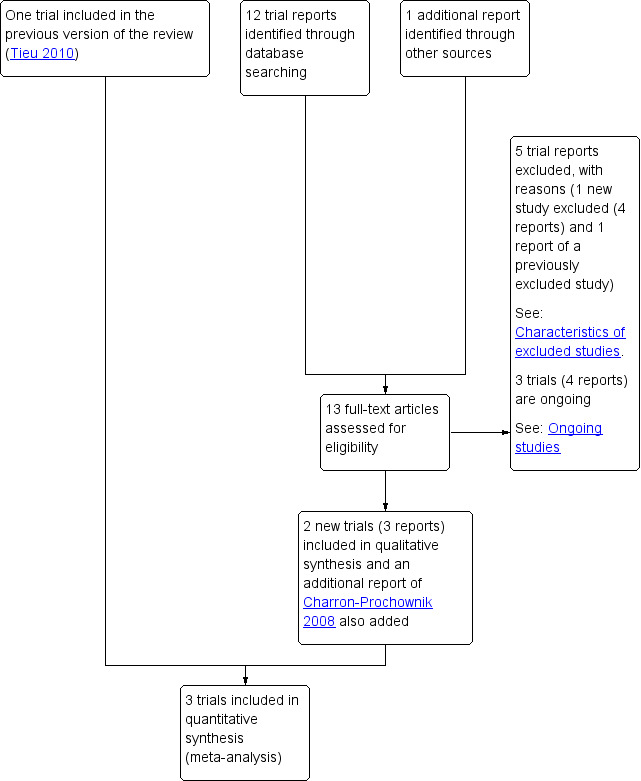
Search methods: We searched Cochrane Pregnancy and Childbirth's Trials Register (31 January 2017) and reference lists of retrieved articles.
Selection criteria: Randomised controlled trials (RCTs) assessing the effects of preconception care for diabetic women. Cluster-RCTs and quasi-RCTs were eligible for inclusion but none were identified.
Data collection and analysis: Two reviewers independently assessed study eligibility, extracted data and assessed the risk of bias of the included studies. We checked data for accuracy and assessed the quality of the evidence using the GRADE approach.
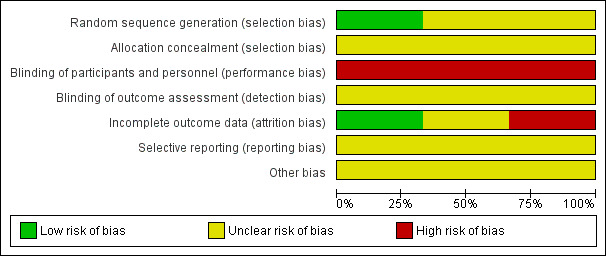
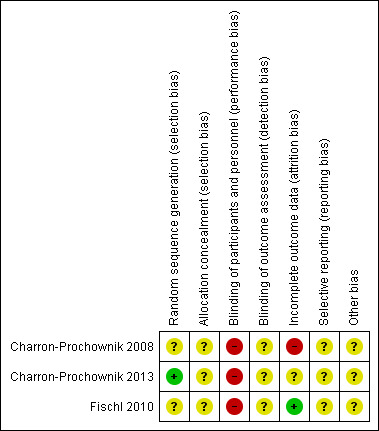
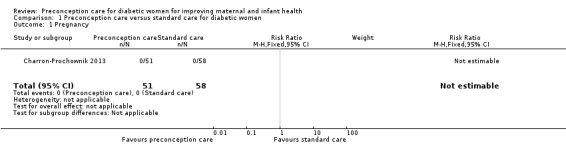
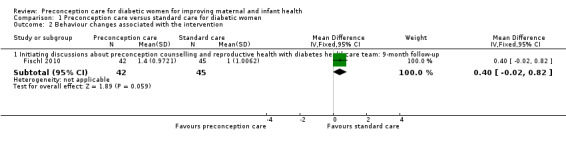
Main results: We included three trials involving 254 adolescent girls with type 1 or type 2 diabetes, with an overall unclear to high risk of bias. The three trials were conducted at diabetes clinics in the USA, and assessed the READY-Girls (Reproductive-health Education and Awareness of Diabetes in Youth for Girls) programme versus standard care.Considering primary outcomes, one trial reported no pregnancies in the trial period (12 months) (very low-quality evidence, with downgrading based on study limitations (risk of bias) and imprecision); in the other two trials, pregnancy was an exclusion criterion, or was not clearly reported on. None of the trials reported on the other primary maternal outcomes, hypertensive disorders of pregnancy and caesarean section; or primary infant outcomes, large-for-gestational age, perinatal mortality, death or morbidity composite, or congenital malformations. Similarly, none of the trials reported on the secondary outcomes, for which we had planned to assess the quality of the evidence using the GRADE approach (maternal: induction of labour; perineal trauma; gestational weight gain; long-term cardiovascular health; infant: adiposity; type 1 or 2 diabetes; neurosensory disability).The majority of secondary maternal and infant outcomes, and outcomes relating to the use and costs of health services were not reported by the three included trials. Regarding behaviour changes associated with the intervention, in one trial, participants in the preconception care group had a slightly higher score for the actual initiation of discussion regarding preconception care with healthcare providers at follow-up (nine months), compared with those in the standard care group (mean difference 0.40, 95% confidence interval -0.02 to 0.82 (on a scale of 0 to 4 points); participants = 87) (a summation of four dichotomous items; possible range 0 to 4, with 0 being no discussion).
Authors' conclusions: There are insufficient RCT data available to assess the effects of preconception care for diabetic women on health outcomes for mothers and their infants.More high-quality evidence is needed to determine the effects of different protocols of preconception care for diabetic women. Future trials should be powered to evaluate effects on short- and long-term maternal and infant outcomes, and outcomes relating to the use and costs of health services. We have identified three ongoing studies that we will consider in the next review update.
Conflict of interest statement
Joanna Tieu: is supported by an NHMRC postgraduate scholarship and Arthritis Australia Ken Muirden fellowship (jointly funded by the Australian Rheumatology Association and Roche).
Philippa Middleton: none known.
Caroline A Crowther: none known.
Emily Shepherd: none known.
Figures
Update of
-
Preconception care for diabetic women for improving maternal and infant health.Cochrane Database Syst Rev. 2010 Dec 8;(12):CD007776. doi: 10.1002/14651858.CD007776.pub2. Cochrane Database Syst Rev. 2010. Update in: Cochrane Database Syst Rev. 2017 Aug 11;8:CD007776. doi: 10.1002/14651858.CD007776.pub3. PMID: 21154385 Updated.
References
References to studies included in this review
Charron‐Prochownik 2008 {published and unpublished data}
-
- Thurheimer J, Sereika SM, Founds S, Downs J, Charron‐Prochownik D. Efficacy of the READY‐girls program on general risk‐taking behaviors, condom use, and sexually transmitted infections among young adolescent females with type 1 diabetes. Diabetes Educator 2016;42(6):712‐20. - PubMed
Charron‐Prochownik 2013 {published data only}
-
- Charron‐Prochownik DC. Preconception counseling starting at puberty: Providing evidence with "Reproductive‐health Education and Awareness of Diabetes in Youth for Girls" (READYGirls) program. Pediatric Diabetes 2011;12(Suppl 15):5.
Fischl 2010 {published data only}
References to studies excluded from this review
DCCT 1996 {published data only}
-
- Diabetes Complications and Control Trial research group. Pregnancy outcomes in the diabetes control and complications trial. American Journal of Obstetrics and Gynecology 1996;174(4):1343‐53. - PubMed
Mathiesen 2007 {published data only}
-
- Hod M, Damm P, Kaaja R, Visser GH, Dunne F, Demidova I, et al. Fetal and perinatal outcomes in type 1 diabetes pregnancy: a randomized study comparing insulin aspart with human insulin in 322 subjects. American Journal of Obstetrics and Gynecology 2008;198(2):186.e1‐186.e7. - PubMed
-
- Kaaja R, Hod M, Wisser G, Damm P, Dunne F, Hansen A, et al. Safety and perinatal outcome in pregnancy: a randomised trial comparing insulin aspart with human insulin in 322 subjects with type 1 diabetes. Diabetologia 2006; Vol. 49, issue Suppl 1:577.
-
- Mathiesen E, Kinsley B, McCance D, Duran S, Heller S. Maternal hypoglycemia and glycemic control in pregnancy: a randomized trial comparing insulin aspart with human insulin in 322 subjects with type 1 diabetes. Diabetes 2006;55(Suppl 1):A40. - PubMed
-
- Mathiesen E, McCance D, Damm P, Kaaja R, Hod M, Dunne F, et al. No increase to insulin antibodies during pregnancy in type 1 diabetes treated with insulin aspart. Diabetologia 2007; Vol. 50, issue Suppl 1:S110.
Mathiesen 2012 {published data only}
-
- Hod M, McCance DR, Ivanisevic M, Garcia S, Jovanovic L, Mathiesen ER, et al. Perinatal outcomes in pregnancy: a randomised trial comparing insulin detemir with NPH insulin in 310 subjects with type 1 diabetes. Diabetologia 2011;54(Suppl 1):S487.
-
- Mathiesen ER, Damm P, Hod M, McCance DR, Ivanisevic M, Garcia S, et al. Maternal glycaemic control and hypoglycaemia in pregnancy: A randomised trial comparing insulin detemir with NPH insulin in 310 subjects with type 1 diabetes. Diabetologia 2011;54(Suppl 1):S486.
-
- Mathiesen ER, Damm P, Jovanovic L, Mccance DR, Thyregod C, Jensen AB, et al. Basal insulin analogues in diabetic pregnancy: a literature review and baseline results of a randomised, controlled trial in type 1 diabetes. Diabetes/Metabolism Research and Reviews 2011;27(6):543‐51. - PubMed
References to ongoing studies
NCT01788527 {published data only}
-
- Farrell A, Mergler S, Mason D, Sanchez J, Feig DS, Asztalos E. The use of logs and forms for the tracking of RT‐CGM devices in the CONCEPTT Trial. Clinical Trials 2013;10:S80.
-
- NCT01788527. Continuous glucose monitoring in women with type 1 diabetes in pregnancy trial (CONCEPTT). clinicaltrials.gov/ct2/show/NCT01788527 Date first received: 19 December 19 2012.
NCT02508779 {published data only}
-
- NCT02508779. Blood glucose training for women with type 1 diabetes contemplating pregnancy. clinicaltrials.gov/ct2/show/NCT02508779 Date first received: 21 July 2015.
NTR2742 {published data only}
-
- NTR2742. Improving preconceptional suboptimal glycaemic control in type 1 diabetes using RealTime Continuous Glucose Monitoring (RT‐CGMS): a randomised clinical trial. trialregister.nl/trialreg/admin/rctview.asp?TC=2742 Date first received: 8 February 2011.
Additional references
Abell 2016
-
- Abell SK, Nankervis A, Khan KS, Teede HJ. Type 1 and type 2 diabetes preconception and in pregnancy: health impacts, influence of obesity and lifestyle, and principles of management. Seminars in Reproductive Medicine 2016;34(2):110‐20. - PubMed
Abell 2017
-
- Abell SK, Boyle JA, Courten B, Soldatos G, Wallace EM, Zoungas S. Impact of type 2 diabetes, obesity and glycaemic control on pregnancy outcomes. Australian and New Zealand Journal of Obstetrics and Gynaecology 2017;57(3):308‐14. - PubMed
ADA 2017
-
- American Diabetes Association. Management of diabetes in pregnancy. Diabetes Care 2017;40(Suppl 1):S114‐S119. - PubMed
ADIPS 2005
-
- McElduff A, Cheung NW, McIntyre HD, Lagstrom JA, Oats JJN, Ross GP, et al. The Australasian Diabetes in Pregnancy Society consensus guidelines for the management of patients with type 1 and type 2 diabetes in relation to pregnancy. Sydney: ADIPS, 2005. - PubMed
Deeks 2011
-
- Deeks JJ, Higgins JPT, Altman DG (editors). Chapter 9: Analysing data and undertaking meta‐analyses. In: Higgins JPT, Green S (editors). Cochrane Handbook for Systematic Reviews of Interventions Version 5.1.0 (updated March 2011). The Cochrane Collaboration, 2011. Available from handbook.cochrane.org.
Higgins 2003
Higgins 2011
-
- Higgins JPT, Altman DG, Sterne JAC (editors). Chapter 8: Assessing risk of bias in included studies. In: Higgins JPT, Green S (editors). Cochrane Handbook for Systematic Reviews of Interventions Version 5.1.0 (updated March 2011). The Cochrane Collaboration, 2011. Available from handbook.cochrane.org.
Kekäläinen 2016
-
- Kekäläinen P, Juuti M, Walle T, Laatikainen T. Pregnancy planning in type 1 diabetic women improves glycemic control and pregnancy outcomes. The Journal of Maternal‐Fetal and Neonatal Medicine 2016;29(14):2252‐8. - PubMed
Kitzmiller 2010
-
- Kitzmiller JL, Wallerstein R, Correa A, Kwan S. Preconception care for women with diabetes and prevention of major congenital malformations. Birth Defects Research 2010;88(10):791‐803. - PubMed
Mahmud 2010
Negrato 2012
NICE 2015
-
- National Institute for Health and Clinical Excellence. Diabetes in pregnancy: management from preconception to the postnatal period. London: NICE, 2015. - PubMed
Ornoy 2015
-
- Ornoy A, Reece EA, Pavlinkova G, Kappen C, Miller RK. Effect of maternal diabetes on the embryo, fetus, and children: congenital anomalies, genetic and epigenetic changes and developmental outcomes. Birth Defects Research Part C: Embryo Today: Reviews 2015;105(1):53‐72. - PubMed
Pearson 2007
-
- Pearson DW, Kernaghan D, Lee R, Penney GC, Scottish Diabetes in Pregnancy Study Group. The relationship between pre‐pregnancy care and early pregnancy loss, major congenital anomaly or perinatal death in type I diabetes mellitus. BJOG 2007;114(1):104‐7. - PubMed
Peterson 2015
RevMan 2014 [Computer program]
-
- Nordic Cochrane Centre, The Cochrane Collaboration. Review Manager 5 (RevMan 5). Version 5.3. Copenhagen: Nordic Cochrane Centre, The Cochrane Collaboration, 2014.
Thompson 2013
-
- Thompson D, Berger H, Feig D, Gagnon R, Kader T, Keely E, et al. Canadian Diabetes Association 2013 Clinical Practice Guidelines for the Prevention and Management of Diabetes in Canada: diabetes and pregnancy. Canadian Journal of Diabetes 2013;37(Suppl 1):S1‐212. - PubMed
Thurheimer 2016
-
- Thurheimer J, Sereika SM, Founds S, Downs J, Charron‐Prochownik D. Efficacy of the READY‐girls program on general risk‐taking behaviors, condom use, and sexually transmitted infections among young adolescent females with type 1 diabetes. Diabetes Educator 2016;42(6):712‐20. - PubMed
Tieu 2013
Wahabi 2010
Publication types
MeSH terms
Substances
Grants and funding
LinkOut - more resources
Full Text Sources
Other Literature Sources
Medical
