


The efficacy of medical masks and respirators against respiratory infection in healthcare workers
- PMID: 28799710
- PMCID: PMC5705692
- DOI: 10.1111/irv.12474
The efficacy of medical masks and respirators against respiratory infection in healthcare workers
Abstract
Objective: We aimed to examine the efficacy of medical masks and respirators in protecting against respiratory infections using pooled data from two homogenous randomised control clinical trials (RCTs).
Methods: The data collected on 3591 subjects in two similar RCTs conducted in Beijing, China, which examined the same infection outcomes, were pooled. Four interventions were compared: (i) continuous N95 respirator use, (ii) targeted N95 respirator use, (iii) medical mask use and (iv) control arm. The outcomes were laboratory-confirmed viral respiratory infection, influenza A or B, laboratory-confirmed bacterial colonisation and pathogens grouped by mode of transmission.
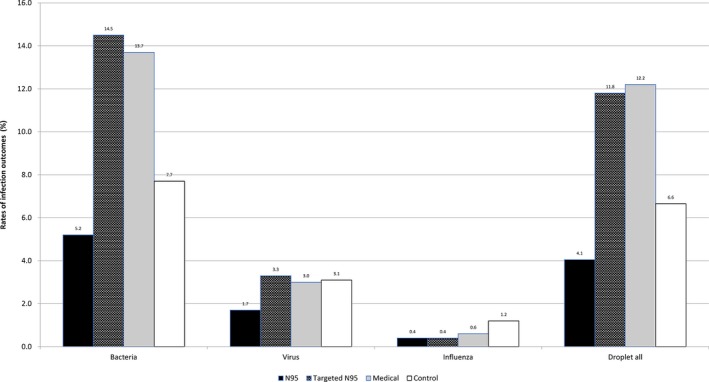
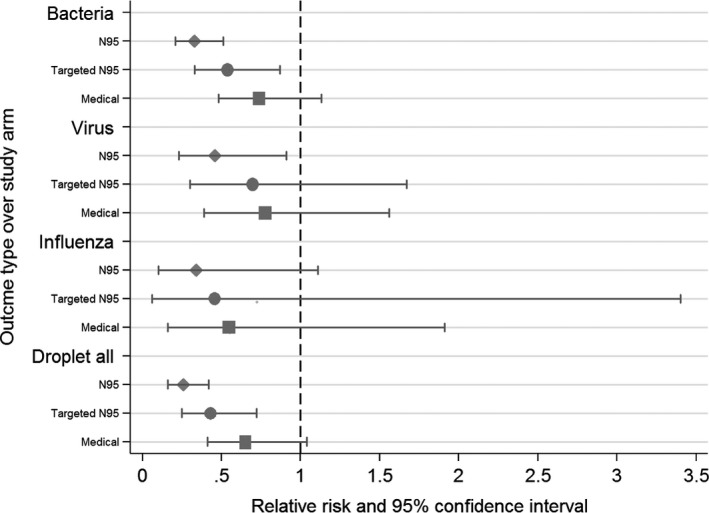
Results: Rates of all outcomes were consistently lower in the continuous N95 and/or targeted N95 arms. In adjusted analysis, rates of laboratory-confirmed bacterial colonisation (RR 0.33, 95% CI 0.21-0.51), laboratory-confirmed viral infections (RR 0.46, 95% CI 0.23-0.91) and droplet-transmitted infections (RR 0.26, 95% CI 0.16-0.42) were significantly lower in the continuous N95 arm. Laboratory-confirmed influenza was also lowest in the continuous N95 arm (RR 0.34, 95% CI 0.10-1.11), but the difference was not statistically significant. Rates of laboratory-confirmed bacterial colonisation (RR 0.54, 95% CI 0.33-0.87) and droplet-transmitted infections (RR 0.43, 95% CI 0.25-0.72) were also lower in the targeted N95 arm, but not in medical mask arm.
Conclusion: The results suggest that the classification of infections into droplet versus airborne transmission is an oversimplification. Most guidelines recommend masks for infections spread by droplets. N95 respirators, as "airborne precautions," provide superior protection for droplet-transmitted infections. To ensure the occupational health and safety of healthcare worker, the superiority of respirators in preventing respiratory infections should be reflected in infection control guidelines.
Keywords: droplet infections; healthcare workers; influenza; masks; medical masks; respirators.
© 2017 The Authors. Influenza and Other Respiratory Viruses Published by John Wiley & Sons Ltd.
Figures
References
-
- Jacobs JL, Ohde S, Takahashi O, et al. Use of surgical face masks to reduce the incidence of the common cold among health care workers in Japan: a randomized controlled trial. Am J Infect Control. 2009;37:417‐419. - PubMed
-
- Loeb M, Dafoe N, Mahony J, et al. Surgical mask vs N95 respirator for preventing influenza among health care workers: a randomized trial. JAMA. 2009;302:1865‐1871. - PubMed
-
- MacIntyre CR, Wang Q, Seale H, et al. A randomized clinical trial of three options for N95 respirators and medical masks in health workers. Am J Respir Crit Care Med. 2013;187:960‐966. - PubMed
Publication types
MeSH terms
Associated data
LinkOut - more resources
Full Text Sources
Other Literature Sources
Medical
