


Social exposure and emotion dysregulation: Main effects in relation to nonsuicidal self-injury
- PMID: 28800438
- PMCID: PMC5609452
- DOI: 10.1016/j.adolescence.2017.07.015
Social exposure and emotion dysregulation: Main effects in relation to nonsuicidal self-injury
Abstract
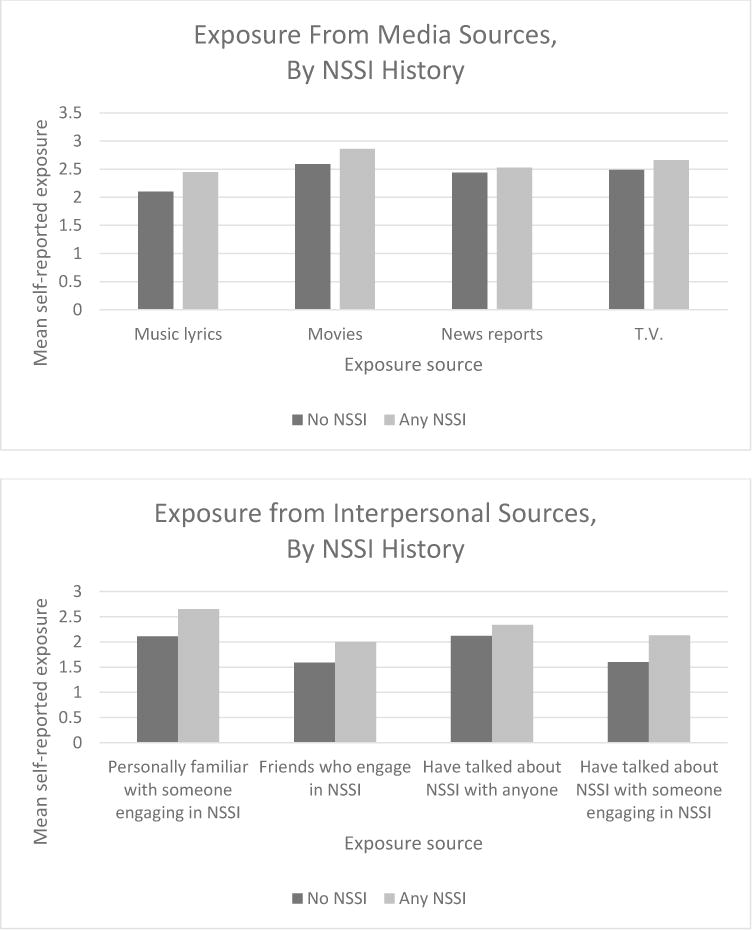
We examined the relation of interpersonal and media exposure to nonsuicidal self-injury (NSSI) among 340 university students in the southeastern United States (73.5% female, M age = 19.38 years, SD = 1.15). We also assessed interactions and main effects of each exposure and emotion dysregulation in relation to NSSI, testing the social learning hypothesis of NSSI. Most participants endorsed medium to high levels of exposure to NSSI via media sources. More than one-third of participants were somewhat or very familiar with someone who engaged in NSSI. Almost half reported occasional or frequent conversations about NSSI. Both exposure forms were significantly related to NSSI history. However, hurdle regression analyses revealed that interpersonal exposure and emotion dysregulation, but not media exposure, were significantly associated with NSSI history and frequency. We did not find evidence for an emotion dysregulation-by-interpersonal-exposure interaction. We discuss implications for theoretical models of NSSI, limitations, and future directions.
Keywords: Emotion regulation; NSSI; Self-injurious behavior; Social learning.
Copyright © 2017. Published by Elsevier Ltd.
Figures
References
-
- Akers RL. Deviant behavior: A social learning approach. 2-nd. Belmont, CA: Wadsworth; 1977.
-
- Bandura A. Social learning theory. Oxford, England: Prentice-Hall; 1977.
MeSH terms
Grants and funding
LinkOut - more resources
Full Text Sources
Other Literature Sources
Medical
