Review
. 2017 Aug 11;48(1):42.
doi: 10.1186/s13567-017-0447-0.

Bovine cryptosporidiosis: impact, host-parasite interaction and control strategies

Affiliations
Review

Bovine cryptosporidiosis: impact, host-parasite interaction and control strategies

Sarah Thomson et al. Vet Res. .

Abstract

Gastrointestinal disease caused by the apicomplexan parasite Cryptosporidium parvum is one of the most important diseases of young ruminant livestock, particularly neonatal calves. Infected animals may suffer from profuse watery diarrhoea, dehydration and in severe cases death can occur. At present, effective therapeutic and preventative measures are not available and a better understanding of the host-pathogen interactions is required. Cryptosporidium parvum is also an important zoonotic pathogen causing severe disease in people, with young children being particularly vulnerable. Our knowledge of the immune responses induced by Cryptosporidium parasites in clinically relevant hosts is very limited. This review discusses the impact of bovine cryptosporidiosis and describes how a thorough understanding of the host-pathogen interactions may help to identify novel prevention and control strategies.


Figures

Figure 1
Figure 1
Pathogens causing diarrhoea in young calves. Cryptosporidium is the most commonly detected pathogen causing diarrhoea in calves less than 1 month of age as a proportion of diagnosable submissions 2007–2011 (veterinary investigation diagnosis analysis [VIDA]).
Figure 2
Figure 2
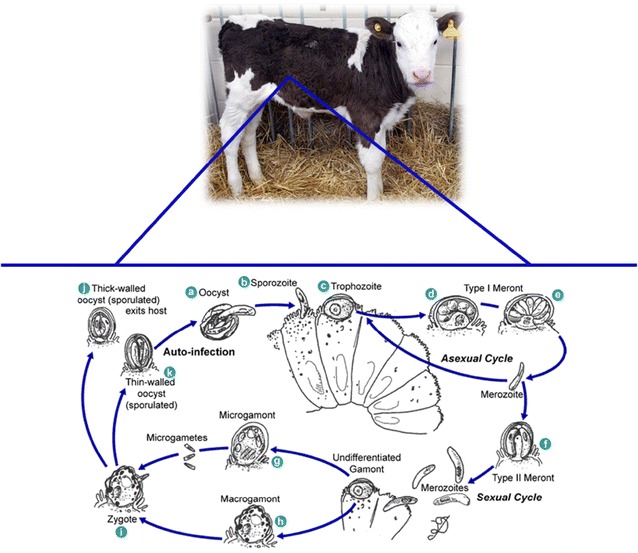
Life cycle of Cryptosporidium. Ingested sporulated oocysts release four sporozoites that invade host epithelial cells and develop into trophozoites, before undergoing asexual and sexual reproduction, resulting in the generation of both thin and think walled oocysts. Thin-walled oocysts auto-infect epithelial cells and thick-walled oocysts are excreted in the faeces of the host. Reproduced from [9].
Figure 3
Figure 3
Parasite invasion in host cells. Images illustrate a Cryptosporidium sporozoite invading host epithelial cells (left) and a Cryptosporidium trophozoite within the parasitophorous vacuole (right). Images by kind permission of Saul Tzipori.
Figure 4
Figure 4
Model of the immune response to C. parvum. C. parvum oocysts are ingested by the host where they target the ileum of the small intestine and undergo excystation. Excysted sporozoites invade epithelial cells of the ileum where they complete asexual and sexual replication cycles. Infected epithelial cells produce pro-inflammatory cytokines, chemokines and anti-microbial peptides, which together orchestrate the immune response and recruit immune cell populations such as NK cells and γδ T cells to the site of infection. APCs such as DCs and macrophages sample antigen at the site of infection and following uptake, migrate to the draining mesenteric lymph nodes where they present antigen to CD4+ T cells. Antigen presentation together with the presence of IL-12 and IFNγ from APCs and NK cells/γδ T cells respectively, result in the generation of a Th1 CD4+ T cell response that is thought to be important during the immune response to C. parvum in humans, cattle and mice.

References

    1. Tyzzer EE. Cryptosporidium parvum (sp. nov.), a coccidium found in the small intestine of the common mouse. Arch fur Protistenkunde. 1912;26:394–418.
    1. Chalmers RM, Katzer F. Looking for Cryptosporidium: the application of advances in detection and diagnosis. Trends Parasitol. 2013;29:237–251. doi: 10.1016/j.pt.2013.03.001. - DOI - PMC - PubMed
    1. Panciera RJ, Thomassen RW, Garner FM. Cryptosporidial infection in a calf. Vet Pathol. 1971;8:479–484. doi: 10.1177/0300985871008005-00610. - DOI
    1. Tzipori S, Smith M, Halpin C, Angus KW, Sherwood D, Campbell I. Experimental cryptosporidiosis in calves: clinical manifestations and pathological findings. Vet Rec. 1983;112:116–120. doi: 10.1136/vr.112.6.116. - DOI - PubMed
    1. Cho YI, Yoon KJ. An overview of calf diarrhea—infectious etiology, diagnosis, and intervention. J Vet Sci. 2014;15:1–17. doi: 10.4142/jvs.2014.15.1.1. - DOI - PMC - PubMed

Publication types

MeSH terms