


Prenatal fine particulate exposure and early childhood asthma: Effect of maternal stress and fetal sex
- PMID: 28801196
- PMCID: PMC5803480
- DOI: 10.1016/j.jaci.2017.07.017
Prenatal fine particulate exposure and early childhood asthma: Effect of maternal stress and fetal sex
Abstract
Background: The impact of prenatal ambient air pollution on child asthma may be modified by maternal stress, child sex, and exposure dose and timing.
Objective: We prospectively examined associations between coexposure to prenatal particulate matter with an aerodynamic diameter of less than 2.5 microns (PM2.5) and maternal stress and childhood asthma (n = 736).
Methods: Daily PM2.5 exposure during pregnancy was estimated using a validated satellite-based spatiotemporally resolved prediction model. Prenatal maternal negative life events (NLEs) were dichotomized around the median (high: NLE ≥ 3; low: NLE < 3). We used Bayesian distributed lag interaction models to identify sensitive windows for prenatal PM2.5 exposure on children's asthma by age 6 years, and determine effect modification by maternal stress and child sex.
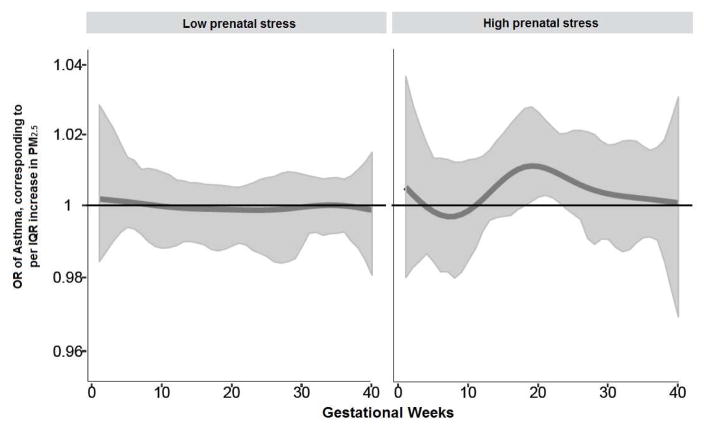
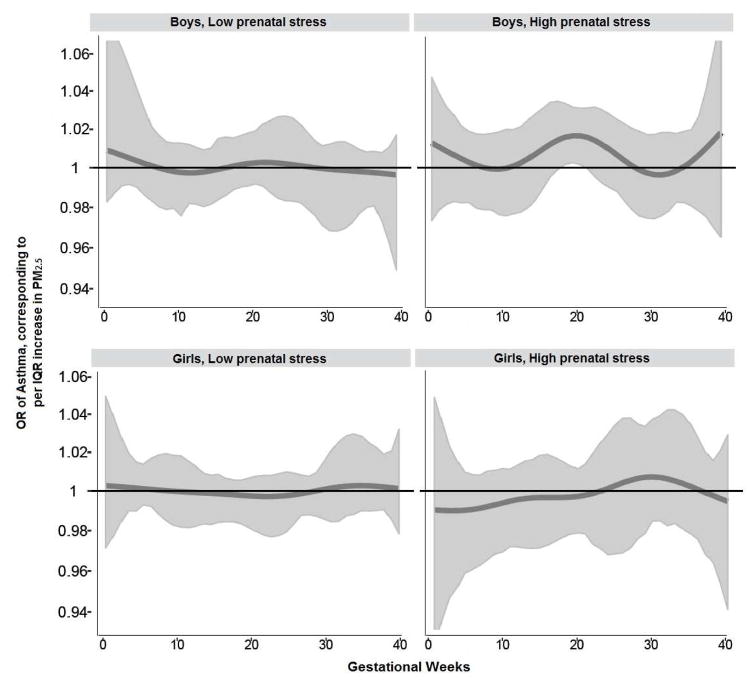
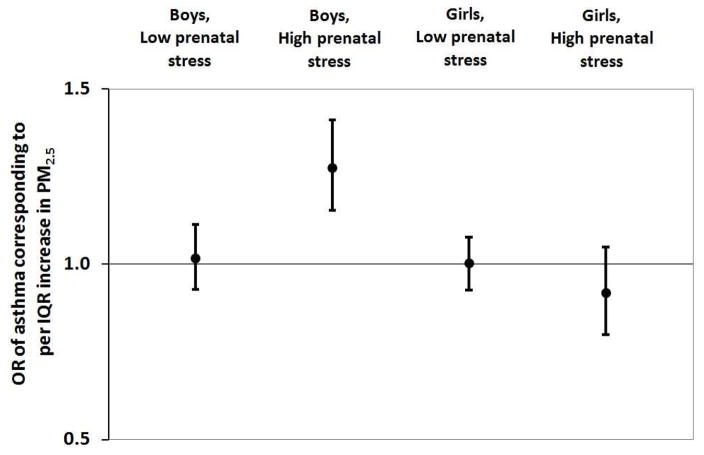
Results: Bayesian distributed lag interaction models identified a critical window of exposure (19-23 weeks' gestation, cumulative odds ratio, 1.15; 95% CI, 1.03-1.26; per interquartile range [1.7 μg/m3] increase in prenatal PM2.5 level) during which children concomitantly exposed to prenatal PM2.5 and maternal stress had increased risk of asthma. No significant association was seen in children born to women reporting low prenatal stress. When examining modifying effects of prenatal stress and fetal sex, we found that boys born to mothers with higher prenatal stress were most vulnerable (19-21 weeks' gestation; cumulative odds ratio, 1.28; 95% CI, 1.15-1.41; per interquartile range increase in PM2.5).
Conclusions: Prenatal PM2.5 exposure during sensitive windows is associated with increased risk of child asthma, especially in boys concurrently exposed to elevated maternal stress.
Keywords: Particulate matter; ambient air pollution; childhood asthma; negative life events; prenatal stress; sex- and temporal-specific effects.
Copyright © 2017 American Academy of Allergy, Asthma & Immunology. Published by Elsevier Inc. All rights reserved.
Conflict of interest statement
Figures
References
-
- Wright RJ, Brunst KJ. Programming of respiratory health in childhood: influence of outdoor air pollution. Current opinion in pediatrics. 2013;25(2):232–9. - PubMed
-
- Jedrychowski WA, Perera FP, Maugeri U, Majewska R, Mroz E, Flak E, et al. Long term effects of prenatal and postnatal airborne PAH exposures on ventilatory lung function of non-asthmatic preadolescent children. Prospective birth cohort study in Krakow. The Science of the total environment. 2015;502:502–9. - PMC - PubMed
-
- Latzin P, Roosli M, Huss A, Kuehni CE, Frey U. Air pollution during pregnancy and lung function in newborns: a birth cohort study. The European respiratory journal. 2009;33(3):594–603. - PubMed
-
- Copland I, Post M. Lung development and fetal lung growth. Paediatric respiratory reviews. 2004;5(Suppl A):S259–64. - PubMed
Publication types
MeSH terms
Substances
Grants and funding
LinkOut - more resources
Full Text Sources
Other Literature Sources
Medical
