


Patient experience of NHS health checks: a systematic review and qualitative synthesis
- PMID: 28801437
- PMCID: PMC5724113
- DOI: 10.1136/bmjopen-2017-017169
Patient experience of NHS health checks: a systematic review and qualitative synthesis
Abstract
Objective: To review the experiences of patients attending NHS Health Checks in England.
Design: A systematic review of quantitative and qualitative studies with a thematic synthesis of qualitative studies.
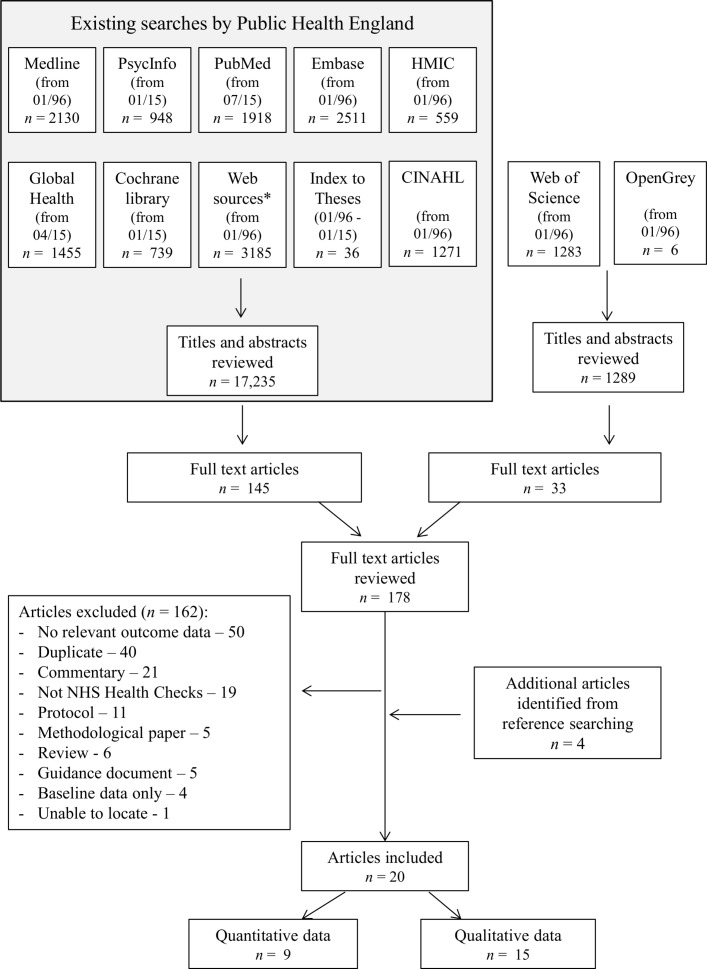
Data sources: An electronic literature search of Medline, Embase, Health Management Information Consortium, Cumulative Index of Nursing and Allied Health Literature, Global Health, PsycInfo, Web of Science, OpenGrey, the Cochrane Library, National Health Service (NHS) Evidence, Google Scholar, Google, Clinical Trials.gov and the ISRCTN registry to 09/11/16 with no language restriction and manual screening of reference lists of all included papers.
Inclusion criteria: Primary research reporting experiences of patients who have attended NHS Health Checks.
Results: 20 studies met the inclusion criteria, 9 reporting quantitative data and 15 qualitative data. There were consistently high levels of reported satisfaction in surveys, with over 80% feeling that they had benefited from an NHS Health Check. Data from qualitative studies showed that the NHS Health Check had been perceived to act as a wake-up call for many who reported having gone on to make substantial lifestyle changes which they attributed to the NHS Health Check. However, some had been left with a feeling of unmet expectations, were confused about or unable to remember their risk scores, found the lifestyle advice too simplistic and non-personalised or were confused about follow-up.
Conclusions: While participants were generally very supportive of the NHS Health Check programme and examples of behaviour change were reported, there are a number of areas where improvements could be made. These include greater clarity around the aims of the programme within the promotional material, more proactive support for lifestyle change and greater appreciation of the challenges of communicating risk and the limitations of relying on the risk score alone as a trigger for facilitating behaviour change.
Keywords: NHS Health Check; patient experience; qualitative synthesis; systematic review.
© Article author(s) (or their employer(s) unless otherwise stated in the text of the article) 2017. All rights reserved. No commercial use is permitted unless otherwise expressly granted.
Conflict of interest statement
Competing interests: None declared.
Figures
References
-
- Public Health England. NHS Health check: best practice guidance. 2017. http://www.healthcheck.nhs.uk/commissioners_and_providers/guidance/natio....
-
- Department of Health. Economic Modelling for vascular checks. 2008. www.healthcheck.nhs.uk/document.php?o=225.
Publication types
MeSH terms
Grants and funding
LinkOut - more resources
Full Text Sources
Other Literature Sources
Medical
Miscellaneous
