Review
. 2018 Feb 1;24(3):511-520.
doi: 10.1158/1078-0432.CCR-16-3001. Epub 2017 Aug 11.

Breast Cancer Immunotherapy: Facts and Hopes

Affiliations
Review

Breast Cancer Immunotherapy: Facts and Hopes

Leisha A Emens. Clin Cancer Res. .

Abstract

Immunotherapy is revolutionizing the management of multiple solid tumors, and early data have revealed the clinical activity of programmed cell death-1/programmed death ligand-1 (PD-1/PD-L1) antagonists in small numbers of patients with metastatic breast cancer. Clinical activity appears more likely if the tumor is triple negative, PD-L1+, and/or harbors higher levels of tumor-infiltrating leukocytes. Responses to atezolizumab and pembrolizumab appear to be durable in metastatic triple-negative breast cancer (TNBC), suggesting that these agents may transform the lives of responding patients. Current clinical efforts are focused on developing immunotherapy combinations that convert nonresponders to responders, deepen those responses that do occur, and surmount acquired resistance to immunotherapy. Identifying biomarkers that can predict the potential for response to single-agent immunotherapy, identify the best immunotherapy combinations for a particular patient, and guide salvage immunotherapy in patients with progressive disease are high priorities for clinical development. Smart clinical trials testing rational immunotherapy combinations that include robust biomarker evaluations will accelerate clinical progress, moving us closer to effective immunotherapy for almost all patients with breast cancer. Clin Cancer Res; 24(3); 511-20. ©2017 AACR.


Conflict of interest statement

Conflict of Interest

Dr. Emens reports receiving research support from Genentech, Roche, EMD Serono, Astrazeneca, Aduro Biotech, Corvus, and Merck. She has served as a consultant to Astrazeneca, Syndax, Peregrine, Bayer, Molecuvax, Celgene, Vaccinex, eTHeRNA, Amgen, and Gritstone. Under a licensing agreement between Johns Hopkins University and Aduro Biotech, Dr. Emens and the University are entitled to milestone payments and royalty on the sales of the GM-CSF-secreting breast cancer vaccine. The terms of these arrangements are being managed by the Johns Hopkins university in accordance with its conflict of interest policies.

Figures
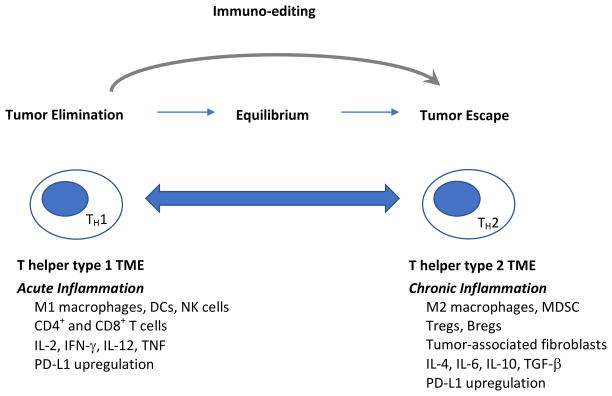
Figure 1
Figure 1. The immune system plays a role in breast tumor growth and progression, and also in breast tumor elimination
Early in breast tumor development, the acute inflammatory response results in the production of interleukin-12 (IL-12) and interferon-γ (IFN-γ), establishing a T helper type 1 environment at the tumor site. During this phase, DCs mature, process tumor-associated antigens, and migrate to the tumor-draining lymph nodes to present antigen to naïve CD4+ and CD8+ T cells, resulting in an immune response that ultimately lyses tumor cells. This immune response initially results in complete tumor rejection. However, the pressure it imposes leads to the selection of tumor cell variants that escape the immune response. This process of immuno-editing establishes a state of equilibrium, or dormancy. As inflammation at the tumor site shifts from acute to chronic, the tumor microenvironment evolves to a T helper type 2 profile. A suppressive tumor microenvironment comprised of a complex community of tumor cells, immune cells and host stromal cells is established, and breast tumors grow and metastasize unchecked by the immune system. Abbreviations: TH1= T helper type 1; TH2=T helper type 2; TME= tumor microenvironment; DCs=dendritic cells, NK=natural killer, IL-2=interleukin-2; IFN-γ=interferon-γ; IL-12=interleukin-12; TNF=tumor necrosis factor; PD-L1=programmed death ligand-1; MDSC=myeloid-derived suppressor cells; IL-4=interleukin-4; IL-6=interleukin-6; IL-10=interleukin-10; TGF-β=transforming growth factor-β.
Figure 2
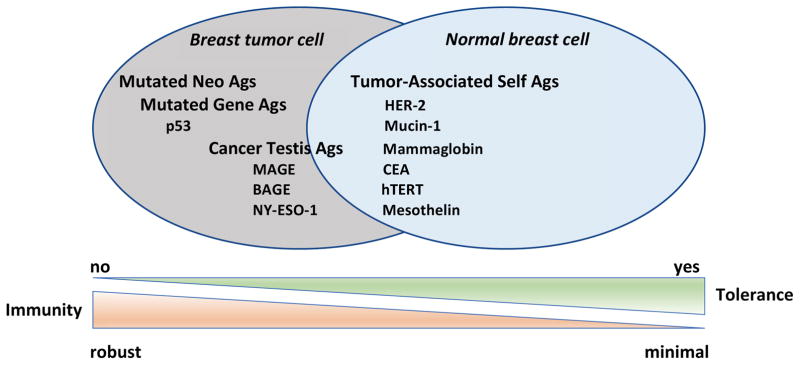
Figure 2. Breast tumor antigens and immune recognition
Tumor antigens expressed by normal cells and tumors partially overlap. Historically, tumor antigens targeted by immunotherapy have been proteins shared by normal host tissue and tumor cells for which there is established immune tolerance. Specific mutations in these proteins and/or their over-expression by tumors relative to normal tissue facilitates the preferential recognition of tumor cells relative to normal cells by the immune system. More recently, the importance of tumor neoantigens unique to a given tumor relative to other tumors or normal tissue has emerged. These neoantigens result from the genomic instability of tumors. Tumors with a high mutational load (more neoantigens) tend to have a higher response rate to immune checkpoint blockade, and are thought to be more readily recognized by the immune system due to lack of antigen-specific immune tolerance to the expressed neoantigens. Abbreviations: Ags=antigens; MAGE=melanoma associated antigen; BAGE=B melanoma antigen; HER-2=human epidermal growth factor receptor-2; CEA=carcinoembryonic antigen; hTERT=human telomerase reverse transcriptase.
Figure 3
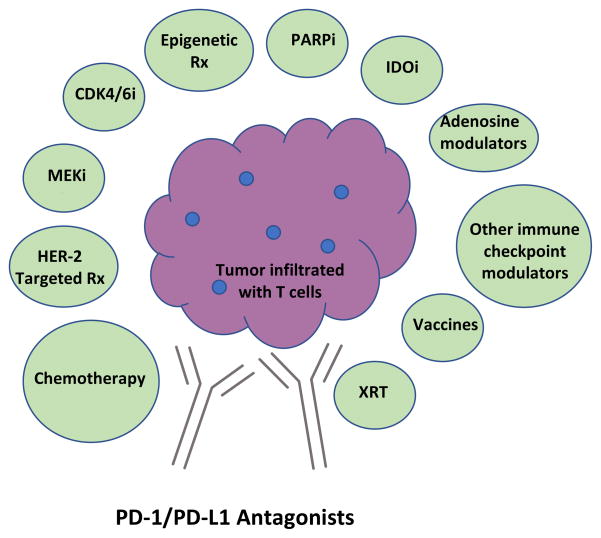
Figure 3. Summary of selected immunotherapy combinations for breast cancer treatment with strong mechanistic rationale
Because blockade of the PD-1/PD-L1 pathway has clear activity in multiple cancer, many regard it as a fundamental component of future cancer immunotherapies. Current clinical efforts are focused on developing immunotherapy combinations, many based on PD-1/PD-L1 blockade, that convert nonresponders to responders, deepen responses that do occur, and surmount acquired immunotherapy resistance. Other combinations, some of which include PD-1/PD-L1 blockade, are also in development. Abbreviations: PD-1=programmed death receptor-1; PD-L1=programmed death ligand-1; chemo=chemotherapy; HER-2=human epidermal growth factor receptor-2; Rx=therapy; MEKi=mitogen-activated protein kinase (MAPK) kinase (MEK) inhibitor; CDK4/6i=cyclin-dependent kinase 4/6 inhibitor; PARPi=poly (adenosine diphosphate (ADP)-ribose polymerase inhibitor; IDOi=indoleamine 2,3 dioxygenase inhibitor, XRT=radiotherapy.

References

    1. Siegel RL, Miller KD, Jemal A. Cancer Statistics, 2017. CA Cancer J Clin. 2017;67:7–30. - PubMed
    1. Savas P, Salgado R, Denkert C, Sotiriou C, Darcy PK, Smyth MJ, et al. Clinical relevance of host immunity in breast cancer: from TILs to clinic. Nat Rev Clin Oncol. 2016;13:228–41. - PubMed
    1. Lipson EJ, Forde PM, Hammers HJ, Emens LA, Taube JM, Topalian SM. Antagonists of PD-1 and PD-L1 in Cancer Treatment. Semin Oncol. 2015;42:587–600. - PMC - PubMed
    1. Emens LA, Ascierto PA, Darcy PK, Demaria S, Eggermont AMM, Redmond RL, Seliger B, Marincola FM. Cancer immunotherapy: opportunities and challenges in the rapidly evolving clinical landscape. Eur J Cancer. 2017 in press. - PubMed
    1. Emens LA. Breast cancer immunobiology driving immunotherapy: vaccines and immune checkpoint blockade. Expert Rev Anticancer Ther. 2012;12:1597–1611. - PMC - PubMed

Publication types

Substances