. 2017 Oct 5;7(10):3295-3303.
doi: 10.1534/g3.117.300141.

Intricate and Cell Type-Specific Populations of Endogenous Circular DNA (eccDNA) in Caenorhabditis elegans and Homo sapiens

Affiliations

Intricate and Cell Type-Specific Populations of Endogenous Circular DNA (eccDNA) in Caenorhabditis elegans and Homo sapiens

Massa J Shoura et al. G3 (Bethesda). .

Abstract

Investigations aimed at defining the 3D configuration of eukaryotic chromosomes have consistently encountered an endogenous population of chromosome-derived circular genomic DNA, referred to as extrachromosomal circular DNA (eccDNA). While the production, distribution, and activities of eccDNAs remain understudied, eccDNA formation from specific regions of the linear genome has profound consequences on the regulatory and coding capabilities for these regions. Here, we define eccDNA distributions in Caenorhabditis elegans and in three human cell types, utilizing a set of DNA topology-dependent approaches for enrichment and characterization. The use of parallel biophysical, enzymatic, and informatic approaches provides a comprehensive profiling of eccDNA robust to isolation and analysis methodology. Results in human and nematode systems provide quantitative analysis of the eccDNA loci at both unique and repetitive regions. Our studies converge on and support a consistent picture, in which endogenous genomic DNA circles are present in normal physiological states, and in which the circles come from both coding and noncoding genomic regions. Prominent among the coding regions generating DNA circles are several genes known to produce a diversity of protein isoforms, with mucin proteins and titin as specific examples.

Keywords: 3D genome architecture; C. elegans; circular DNAs; circulome; eccDNA; mucin.


Figures

Figure 1
Figure 1
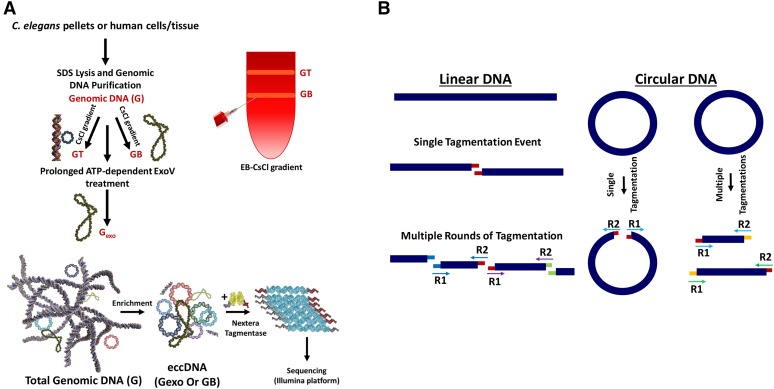
Workflow. (A) Genomic DNA is isolated from the organism/tissue of interest. Tissue is homogenized and treated with sodium dodecyl sulfate (SDS) and proteinase K. To enrich for circular DNAs, total genomic DNA (G) is treated with exonuclease V (exoV) (Palas and Kushner 1990) to produce Gexo or banded in a cesium chloride (CsCl) gradient to separate G into GT and GB (Grossman et al. 1974). GT is the upper band of the gradient and includes linear DNAs and nicked circular DNAs. GB, the bottom band, consists of covalently closed-circular DNAs. After enrichment for circular DNA with either method (or both), eccDNA (extrachromosomal circular DNA) is minimally sheared by attenuated treatment with Nextera tagmentase. (B) Transposition creates a 9-bp sequence duplication flanking the transposon insertion site. Tn5 randomly binds and cuts DNA, leaving a staggered, nine-nucleotide single-stranded overhang. DNA on either side of the cut is filled by DNA polymerase in the first polymerase chain reaction (PCR) cycle, thereby creating 9-bp duplications flanking the genomic DNA sequence. Matching overhangs in the figure have matching colors. Also, paired reads (R1 and R2, indicated by arrows) share the same color. If a circular DNA molecule gets cut only once by Tn5, paired-end sequencing will reveal a unique 9-bp duplication at the beginning of each read (designated by colored overhangs), thereby providing a bioinformatic mark for circular DNAs.
Figure 2
Figure 2
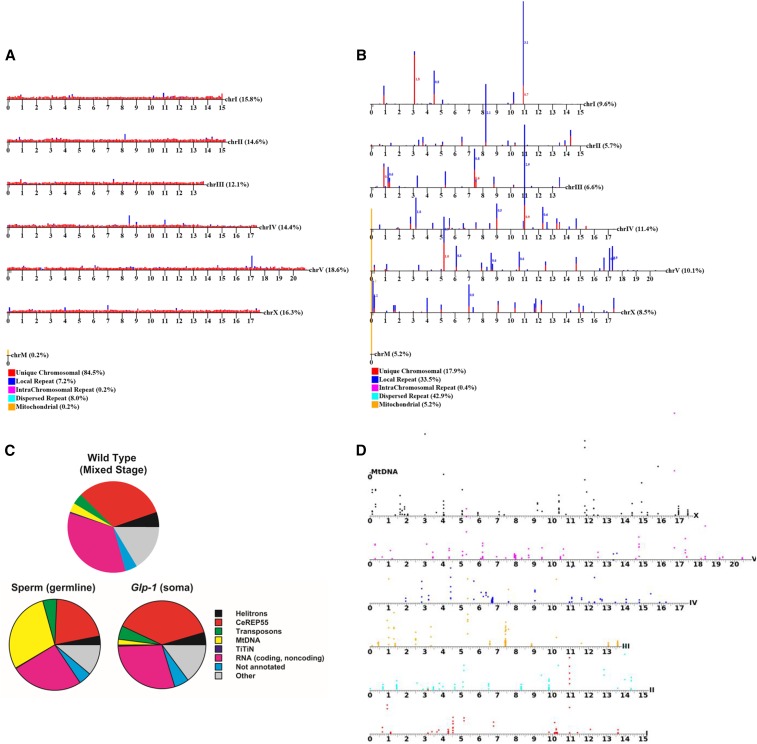
Data analysis. (A and B) are chromosomal maps of aligned reads in total genomic DNA (G) and eccDNA (Gexo, extrachromosomal circular DNA), respectively. Reads are categorized as: unique, local repeats, intrachromosomal repeats, and dispersed repeats. The graphs show unique reads and focal repeats only, as dispersed repeats cannot be mapped to one location. (C) Whole-genome distribution of sequence classes in eccDNA fractions from WT animals, C. elegans sperm, and animals lacking germline cells. (D) Our methodology applied to glp-1 animals (somatic adults). This map shows uniquely mapped areas on each chromosome that are significantly enriched in the circular pool {1-kbp intervals with enrichment assessed through Bayes maximum-likelihood [minimum of twofold enrichment with a default false discovery rate of 0.05/(2*number of genes)]}. This plot shows only reads that map uniquely to the genome. Position of the colored circle on the y-axis for each interval is proportional to the degree of enrichment.
Figure 3
Figure 3
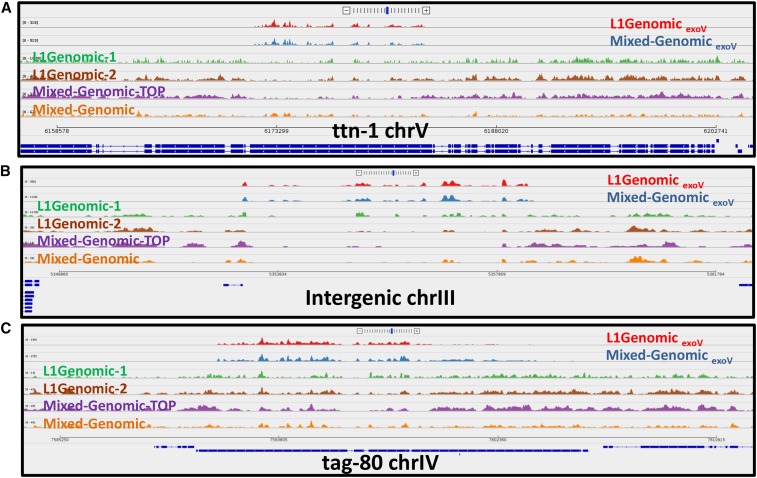
Sequence coverage of three eccDNA (extrachromosomal circular DNA)-enriched regions in different C. elegans populations. (A–C) show three distinct regions in the genome where eccDNA is generated. Red: exonuclease V (exoV)-treated DNA from synchronized young larvae, L1; blue: exoV-treated DNA from a mixed-stage population. Green, brown, and orange tracks are untreated genomic DNAs (L1 Genomic-1 and L1 Genomic-2 are independent biological replicas). (A) Hyper-enriched eccDNAs isolated from exoV-treated C. elegans genomic DNA map precisely to a coding exon of the titin gene in the eccDNA pool. Unique mapping of untreated genomic DNA from the top band of a cesium chloride-ethidium bromide gradient is shown in purple. (B and C) show similar profiles for eccDNAs corresponding to an intergenic repeat and the tag-80 gene, respectively.
Figure 4
Figure 4
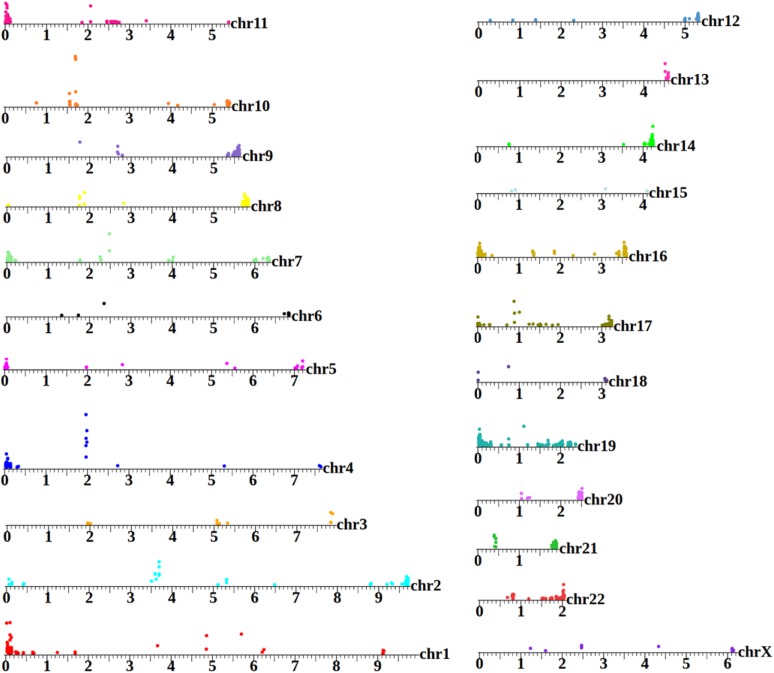
A human extrachromosomal circular DNA (eccDNA) map. GA12878 is the canonical cell line used by the National Institutes of Standards and Technology as a benchmark for high-throughput genome analysis (Zook et al. 2014). However, to date, published analysis of this sample to has been focused on the linear genome. This map shows areas on each chromosome that are significantly enriched in the circular pool (25-kbp intervals with enrichment assessed through Bayes maximum-likelihood). Position of the colored circle on the y-axis for each interval is proportional to the degree of enrichment. The eccDNA profile of each chromosome is distinctive, with enriched regions aligning to coding segments, repetitive, and subtelomeric sequences. This plot shows only reads that map uniquely to the genome.
Figure 5
Figure 5
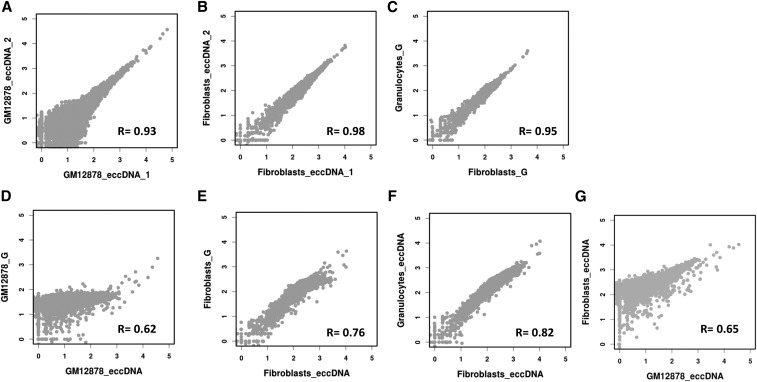
Analysis, reproducibility, and cell-type specificity of human extrachromosomal circular DNAs (eccDNAs). (A–G) showing log10 of read coverage for each chromosome with a bin size of 100 kbp. (A and B) show that eccDNA from the same tissue type is captured reproducibly. (C) Similar reproducibility is obtained for total genomic DNA (G) from different tissue types (normal fibroblasts vs. myeloproliferative neoplasm granulocytes from the same individual). Distinct differences are evident when eccDNAs are compared to their reference total genomic DNAs (D and E) as well as when eccDNAs from different cell types are compared (F and G).

References

    1. Albertson D. G., Collins C., McCormick F., Gray J. W., 2003. Chromosome aberrations in solid tumors. Nat. Genet. 34: 369–376. - PubMed
    1. Allen S. E., Hug I., Pabian S., Rzeszutek I., Hoehener C., et al. , 2017. Circular concatemers of ultra-short DNA segments produce regulatory RNAs. Cell 168: 990–999.e7. - PMC - PubMed
    1. Assum G., Bockle B., Fink T., Dmochewitz U., Krone W., 1989. Restriction analysis of chromosomal sequences homologous to single-copy fragments cloned from small polydisperse circular DNA (spcDNA). Hum. Genet. 82: 249–254. - PubMed
    1. Austin J., Kimble J., 1987. glp-1 is required in the germ line for regulation of the decision between mitosis and meiosis in C. elegans. Cell 51: 589–599. - PubMed
    1. Barton M. K., Schedl T. B., Kimble J., 1987. Gain-of-function mutations of fem-3, a sex-determination gene in Caenorhabditis elegans. Genetics 115: 107–119. - PMC - PubMed

Publication types