. 2017 Oct;207(2):593-607.
doi: 10.1534/genetics.117.300139. Epub 2017 Aug 11.

Rhythmic Behavior Is Controlled by the SRm160 Splicing Factor in Drosophila melanogaster

Affiliations

Rhythmic Behavior Is Controlled by the SRm160 Splicing Factor in Drosophila melanogaster

Esteban J Beckwith et al. Genetics. 2017 Oct.

Abstract

Circadian clocks organize the metabolism, physiology, and behavior of organisms throughout the day-night cycle by controlling daily rhythms in gene expression at the transcriptional and post-transcriptional levels. While many transcription factors underlying circadian oscillations are known, the splicing factors that modulate these rhythms remain largely unexplored. A genome-wide assessment of the alterations of gene expression in a null mutant of the alternative splicing regulator SR-related matrix protein of 160 kDa (SRm160) revealed the extent to which alternative splicing impacts on behavior-related genes. We show that SRm160 affects gene expression in pacemaker neurons of the Drosophila brain to ensure proper oscillations of the molecular clock. A reduced level of SRm160 in adult pacemaker neurons impairs circadian rhythms in locomotor behavior, and this phenotype is caused, at least in part, by a marked reduction in period (per) levels. Moreover, rhythmic accumulation of the neuropeptide PIGMENT DISPERSING FACTOR in the dorsal projections of these neurons is abolished after SRm160 depletion. The lack of rhythmicity in SRm160-downregulated flies is reversed by a fully spliced per construct, but not by an extra copy of the endogenous locus, showing that SRm160 positively regulates per levels in a splicing-dependent manner. Our findings highlight the significant effect of alternative splicing on the nervous system and particularly on brain function in an in vivo model.

Keywords: Drosophila melanogaster; SRm160 Splicing Factor; alternative splicing; behavior; circadian rhythms; locomotor activity.


Figures

Figure 1
Figure 1
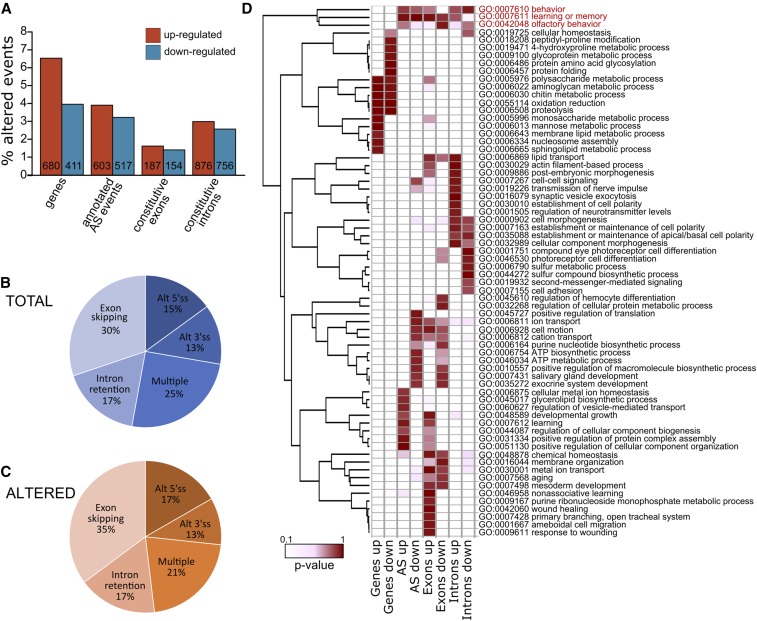
Genome-wide analysis of the impact of SRm160 on the transcriptome. (A) Percentage of genes and alternative splicing (AS) events identified as being up- or downregulated in the RNA sequencing (RNA-seq) data set. The total number for each category are: genes = 10,412, annotated AS events = 4791, evaluated exons = 54,046, and evaluated introns = 20,166. (B) Distribution of the different types of AS events measured in the RNA-seq data set. In 25% of the genomic regions analyzed, multiple AS events were simultaneously detected and it was not possible to reliably determine the type of events affected individually. 5′ splice site (5′ss), 3′splice site (3′ss). (C) Distribution of the different types of AS events altered in the SRm16018603 mutant. (D) The top 10 gene ontology (GO) terms enriched (P-value < 0.1) in each category were sorted by dendrogram analysis. This analysis illustrates the clustering of GO terms by their P-values between the different categories. One particular cluster of terms with enrichment in all the splicing categories is highlighted in red, note that this small cluster is exclusively integrated by terms specifically related to nervous system function.
Figure 2
Figure 2
SRm160 supports a functional clock. (A) Representative locomotor activity profiles of the indicated genotypes showing 3 days in 12 hr light:12 hr darkness and 10 days in constant darkness. Gray shading indicates darkness. White bars indicate light, dark bars indicate dark, and gray bars indicate subjective day. (B) Percentage of rhythmic flies for each genotype. Statistical analysis included one-way ANOVA (P < 0.0001, F(9,27) = 47.26). (C) Quantitation of rhythmic power for the indicated genotypes, calculated as the amplitude of the peak over significance in a periodogram analysis. Statistical analysis included one-way ANOVA (P < 0.0001, F(9,27) = 29.23). Error bars represent SEM and averages of at least three independent experiments; different letters indicate significant differences according to Tukey comparisons, α = 0.05. RFP, red fluorescent protein.
Figure 3
Figure 3
SRm160 expression in the adult sLNvs is necessary for a wild-type circadian behavior. (A) Representative locomotor activity profiles of the indicated genotypes showing 3 days in LD 12:12 and 10 days in constant darkness. Gray shading indicates darkness. White bars indicate light, dark bars indicate dark, and gray bars indicate subjective day. (B) Percentage of rhythmic flies for each genotype. Error bars represent SEM and averages of at least three independent experiments; different letters indicate significant differences according to Tukey comparisons, α = 0.05. LD 12:12, 12 hr light:12 hr darkness; RU, mifepristone; sLNvs, small Lateral Neurons Ventral.
Figure 4
Figure 4
SRm160 is expressed in central pacemaker neurons. (A) Low magnification of the expression pattern of SRm160 reported by a GAL construct. A dim signal is observed across the brain. It is important to note that GAL reporters do not necessarily represent a complete description of the endogenous expression pattern. (B) Spatial expression of SRm160 in the accessory medulla was visualized using a RFP reporter (red), while pacemaker cells were identified by immunostaining with anti-PDF antibody (black). The image represents the maximal intensity projection of a gallery of single-plane images spanning (A) the entire brain or (B) all sLNvs somas. PDF, PIGMENT DISPERSING FACTOR; RFP, red fluorescent protein; sLNvs, small Lateral Neurons Ventral.
Figure 5
Figure 5
SRm160 sustains Per oscillations in the central pacemaker. (A) Control (left) or SRm160-interfered (right) brains were dissected during the second day of constant darkness at CT02 and CT14. Brains were stained with anti-RFP (red) and anti-PDF (black) antibodies and images from the dorsal projections of sLNvs were acquired with the same settings. The image depicts representative confocal images. (B) Quantitation of PDF intensity at the sLNv dorsal projections for the indicated genotypes and time points. The different genotypes show different variances (Levene test, P = 0.0162, F(3,8) = 6.38), precluding parametric comparisons. PDF levels oscillate in control flies (* P = 0.0011, Student’s t-test T = 8.49), but the oscillation is lost in the RNAi-treated flies (P = 0.9363 Student t-test T = 0.09). (C) Whole-mount brain immunofluorescence was performed to monitor PDF (black) and Per (red) accumulation on the third day of exposure to constant darkness. Representative single-plane confocal images of sLNvs at the indicated time points and genotypes are shown. Images were taken using the same confocal settings throughout the time course. (D) Quantitation of Per nuclear intensity. Between 9 and 10 brains were analyzed per time point; the average of two to four neurons was used for each determination. Three independent experiments were analyzed by two-way ANOVA (genotype P = 0.1239, F(1,16) = 2.64; CT P > 0.0001, F(3,16) = 35.00; and interaction P = 0.0009, F(2,16) = 9.29). A simple effect comparison was used to analyze differences between genotypes at different CT. CT05 * P = 0.0029, F(1,16) = 12.33; CT11 P = 0.0672, F(1,16) = 3.85; CT17 P = 0.1233, F(1,16) = 2.65; and CT23 * P = 0.0047, F(1,16) = 10.73. CT, circadian time; PDF, PIGMENT DISPERSING FACTOR; RNAi, RNA interference; RFP, red fluorescent protein; sLNvs, small Lateral Neurons Ventral.
Figure 6
Figure 6
SRm160 impacts per splicing. (A) Representative locomotor activity profiles of the indicated genotypes after 3 days in LD 12:12 and 9 days in constant darkness. (B) Percentage of rhythmic flies for each genotype. Statistical analysis included one-way ANOVA (P < 0.0001, F(11,38) = 15). Different letters indicate significant differences according to Tukey’s comparisons, α = 0.05. Gray, negative control; black, positive control; blue, rescue; and red, lack of rescue. LD 12:12, 12 hr light:12 hr darkness; RFP, red fluorescent protein.

References

    1. Allada R., White N. E., So W. V., Hall J. C., Rosbash M., 1998. A mutant Drosophila homolog of mammalian clock disrupts circadian rhythms and transcription of period and timeless. Cell 93: 791–804. - PubMed
    1. Bae K., Edery I., 2006. Regulating a circadian clock’s period, phase and amplitude by phosphorylation: insights from Drosophila. J. Biochem. 140: 609–617. - PubMed
    1. Baylies M. K., Bargiello T. A., Jackson F. R., Young M. W., 1987. Changes in abundance or structure of the per gene product can alter periodicity of the Drosophila clock. Nature 326: 390–392. - PubMed
    1. Beckwith E. J., Yanovsky M. J., 2014. Circadian regulation of gene expression: at the crossroads of transcriptional and post-transcriptional regulatory networks. Curr. Opin. Genet. Dev. 27: 35–42. - PubMed
    1. Beckwith E. J., Gorostiza E. A., Berni J., Rezaval C., Perez-Santangelo A., et al. , 2013. Circadian period integrates network information through activation of the BMP signaling pathway. PLoS Biol. 11: e1001733. - PMC - PubMed

Publication types