


Closure of Secundum Atrial Septal Defects With the AMPLATZER Septal Occluder: A Prospective, Multicenter, Post-Approval Study
- PMID: 28801537
- PMCID: PMC5559192
- DOI: 10.1161/CIRCINTERVENTIONS.116.004212
Closure of Secundum Atrial Septal Defects With the AMPLATZER Septal Occluder: A Prospective, Multicenter, Post-Approval Study
Abstract
Background: Prospective data on the medium-term safety and effectiveness of the AMPLATZER Septal Occluder in clinical practice are not available. The objective of this study was to prospectively evaluate the risk of hemodynamic compromise and obtain medium-term survival data on patients implanted with the AMPLATZER Septal Occluder for percutaneous closure of secundum atrial septal defects.
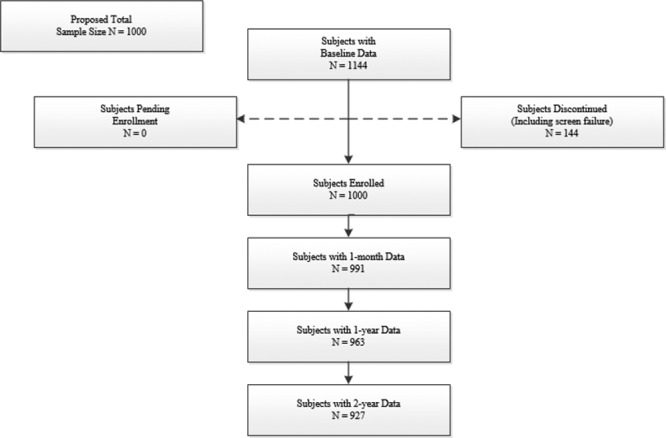
Methods and results: Subjects were enrolled prospectively at 50 US sites and followed for 2 years. Between 2008 and 2012, atrial septal defect closure with the AMPLATZER Septal Occluder was attempted in 1000 patients (aged 0.3-83.6 years, mean 21±22 years). Procedural closure occurred in 97.9%, with 1-month and 2-year closure 98.5% and 97.9%, respectively. Hemodynamic compromise occurred in 6 subjects (0.65%), because of dysrhythmia in 2, device embolization in 1, and cardiac erosion in 3. The rate of cardiac erosion was 0.3% (average 83, range 12-171 days from implant).
Conclusions: Closure of atrial septal defect with the AMPLATZER Septal Occluder is safe and effective. The rate of hemodynamic compromise and cardiac erosion is rare. The risk factors for cardiac erosion after device closure are not yet clear.
Clinical trial registration: URL: http://www.clinicaltrials.gov. Unique identifier: NCT00650936.
Keywords: catheterization; echocardiography; heart; heart septal defects; risk factors.
© 2017 The Authors.
References
-
- Crawford GB, Brindis RG, Krucoff MW, Mansalis BP, Carroll JD. Percutaneous atrial septal occluder devices and cardiac erosion: a review of the literature. Catheter Cardiovasc Interv. 2012;80:157–167. doi: 10.1002/ccd.24347. - PubMed
-
- Amin Z, Hijazi ZM, Bass JL, Cheatham JP, Hellenbrand WE, Kleinman CS. Erosion of Amplatzer septal occluder device after closure of secundum atrial septal defects: review of registry of complications and recommendations to minimize future risk. Catheter Cardiovasc Interv. 2004;63:496–502. doi: 10.1002/ccd.20211. - PubMed
-
- Amin Z. Echocardiographic predictors of cardiac erosion after Amplatzer septal occluder placement. Catheter Cardiovasc Interv. 2014;83:84–92. doi: 10.1002/ccd.25175. - PubMed
-
- US Food and Drug Administration. Rare serious erosion events associated with St. Jude AMPLATZER™ atrial septal occluder (ASO): FDA safety communication. 2013. https://www.fda.gov/MedicalDevices/Safety/AlertsandNotices/ucm371145.htm.
-
- Roberts WT, Parmar J, Rajathurai T. Very late erosion of Amplatzer septal occluder device presenting as pericardial pain and effusion 8 years after placement. Catheter Cardiovasc Interv. 2013;82:E592–E594. doi: 10.1002/ccd.24755. - PubMed
Publication types
MeSH terms
Supplementary concepts
Associated data
LinkOut - more resources
Full Text Sources
Other Literature Sources
Medical
