


Visceral adiposity index, lipid accumulation product and intracranial atherosclerotic stenosis in middle-aged and elderly Chinese
- PMID: 28801558
- PMCID: PMC5554161
- DOI: 10.1038/s41598-017-07811-7
Visceral adiposity index, lipid accumulation product and intracranial atherosclerotic stenosis in middle-aged and elderly Chinese
Abstract
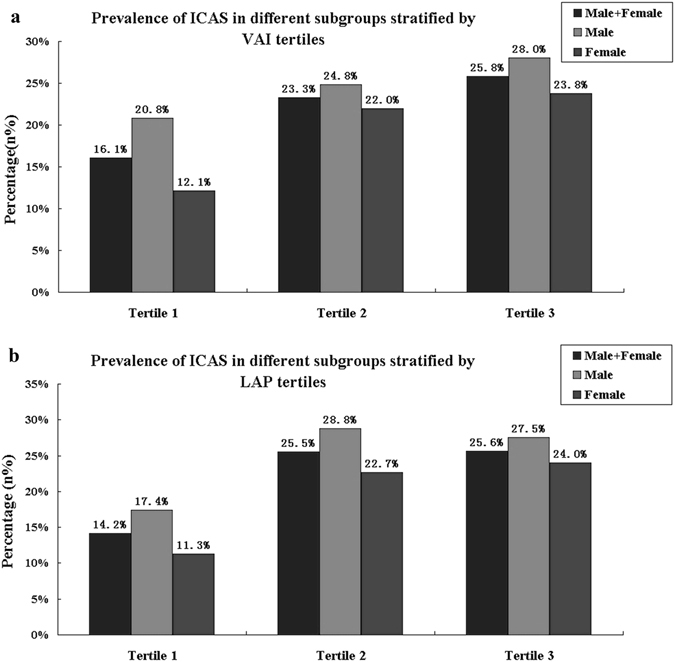
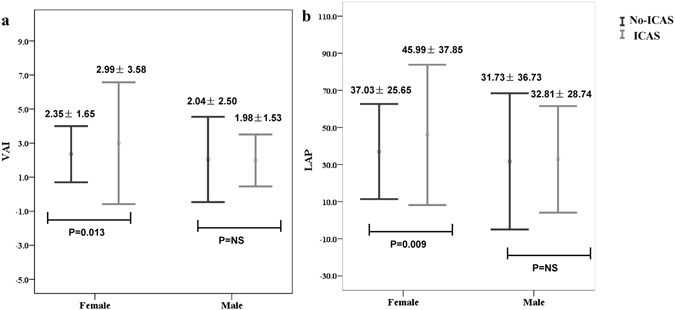
We investigated the association of the newly established lipid accumulation product (LAP) and visceral adiposity index (VAI) with intracranial atherosclerotic stenosis (ICAS) in middle-aged and elderly Chinese. From June 2012 to January 2013, consecutive patients ≥40 years of age who underwent cerebral vascular imaging for various medical reasons were enrolled in this study. Multivariate logistic regression models were used to evaluate the correlation of VAI and LAP with the risk of ICAS. In total, 845 patients were included in the study. The prevalence of ICAS gradually increased in females and in all patients with advancing tertiles of VAI or LAP. After adjusting for potential risks, both the VAI and LAP were related to ICAS in females [VAI: odds ratio (OR) = 3.25, 95% confidence interval (95%CI) = 1.17-9.03, P = 0.024; LAP: OR = 4.11, 95%CI = 1.39-12.12, P = 0.011; tertiles 3 vs. 1]. The sensitivity, specificity, and positive predictive value (PPV) were 74.7%, 45.5%, and 84.4% for VAI (cut-off: 1.71) and 79.3%, 40.5%, and 84.1% for LAP (cut-off: 23.99). The same relationships in males were not significant. Both VAI and LAP were closely associated with an increased risk of ICAS in middle-aged and elderly Chinese females.
Conflict of interest statement
The authors declare that they have no competing interests.
Figures
References
Publication types
MeSH terms
LinkOut - more resources
Full Text Sources
Other Literature Sources
Research Materials
