. 2017 Aug 11;7(1):7995.
doi: 10.1038/s41598-017-08405-z.

Effect of X-ray irradiation on hepatocarcinoma cells and erythrocytes in salvaged blood

Affiliations

Effect of X-ray irradiation on hepatocarcinoma cells and erythrocytes in salvaged blood

Feng-Jiang Zhang et al. Sci Rep. .

Abstract

The broad clinical acceptance of intraoperative blood salvage and its applications in cancer surgery remain controversial. Until now, a method that can safely eliminate cancer cells while preserving erythrocytes does not exist. Here, we investigated whether X-ray generated from linear accelerator irradiation at a certain dose can kill hepatocarcinoma cells while preserving erythrocytes. HepG2, SK-Hep1 or Huh7 cells were mixed into the aliquots of erythrocytes obtained from healthy volunteers. After the mixed cells were exposed to 30 Gy and 50 Gy X-rays irradiation, the viability, clonogenicity, DNA synthesis and tumorigenicity of the tumor cells were determined by the MTT assay, plate colony formation, 5-ethynyl-2'-deoxyuridine incorporation, and subcutaneous xenograft implantation into immunocompromised mice. The ATP, 2,3-DPG, free Hb, osmotic fragility, blood gas variables in erythrocytes and morphology of erythrocytes at 0 h, 12 h, 24 h, 48 h, 72 h after irradiation were analyzed. X-ray irradiation at 30 Gy effectively inhibited the viability, proliferation, and tumorigenicity of HepG2, SK-Hep1 and Huh7 cells without noticeably damaging the ability of oxygen-carrying, membrane integrity and morphology of erythrocytes. Theses results suggest that X-ray at 30 Gy irradiation might be safe to eliminate hepatocarcinoma cells while preserving erythrocytes in salvaged blood.


Conflict of interest statement

The authors declare that they have no competing interests.

Figures
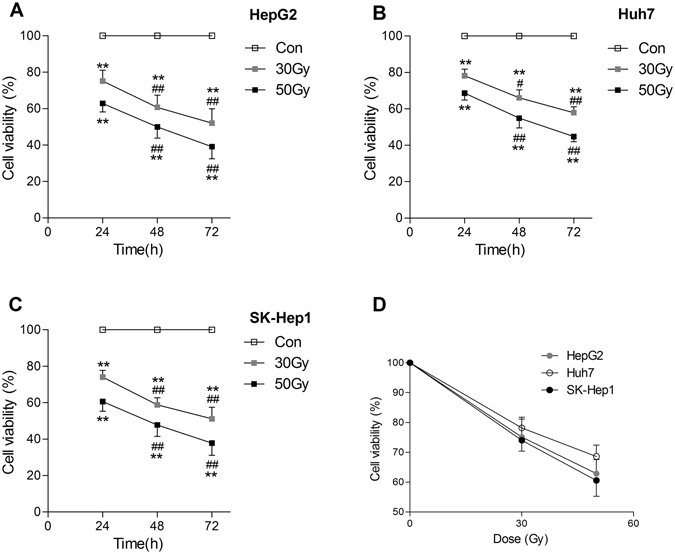
Figure 1
Figure 1
X-ray irradiation inhibited the viability of tumor cell lines in vitro. After X-ray irradiation, cell viability was determined using MTT assay in separated HepG2 (A), Huh7 (B), and SK-Hep1 (C) cells after culturing for 24 h, 48 h and 72 h. The cell viability in these three cell lines exposed to 30 Gy and 50 Gy X-rays irradiation after culturing for 24 h is shown in panel D. Date are means ± SEM; n = 6. Con: the dose of irradiation was 0 Gy. **p < 0.01 vs. the control group at the same culture time; # p < 0.05, ## p < 0.01 vs. the same treated group cultured for 24 h.
Figure 2
Figure 2
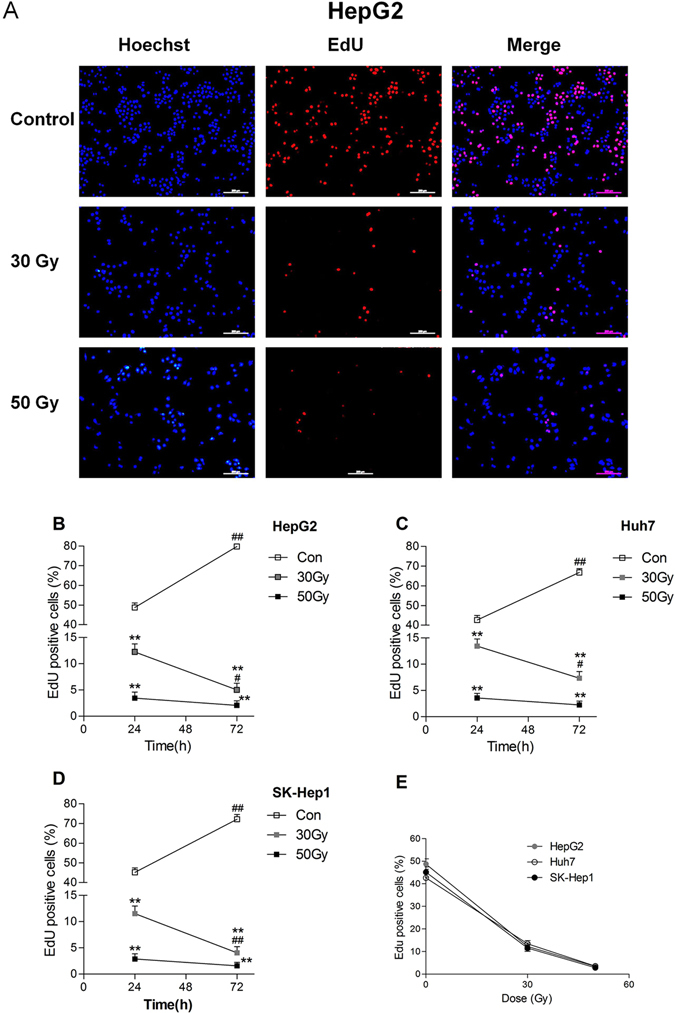
X-ray irradiation inhibited DNA synthesis in tumor cell lines in vitro. DNA synthesis (scale bar = 200 μm) was detected by 5-ethynyl-2′-deoxyuridine incorporation (EdU) incorporation assay in X-ray irradiated HepG2 cells after culturing for 24 h (A). DNA synthesis was detected by EdU incorporation assay in X-ray irradiated HepG2 (B), Huh7 (C), and SK-Hep1 (D) cells after culturing for 24 h and 72 h. DNA synthesis in these three cell lines exposed to 30 Gy and 50 Gy X-ray irradiation after culturing for 24 h is shown in panel E. Date are means ± SEM; n = 6. Con: the dose of irradiation was 0 Gy. **p < 0.01 vs. the control group at the same culture time; # p < 0.05, ## p < 0.01 vs. the same treated group cultured for 24 h.
Figure 3
Figure 3
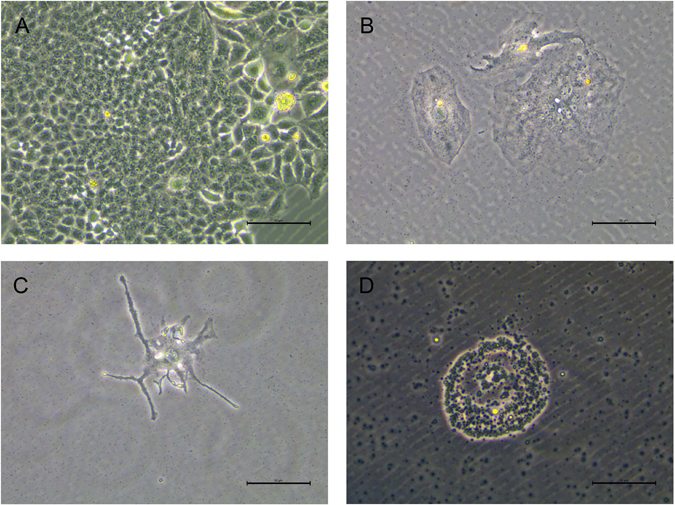
X-ray irradiation induced death in HepG2 cells in vitro. After 0 Gy (A), 30 Gy (B) and 50 Gy (C) X-rays irradiation, HepG2 cells were cultured for 7 d. HepG2 cells were cultured for 14 d after exposure to 30 Gy X-ray irradiation (D). Scale bar = 50 μm.
Figure 4
Figure 4
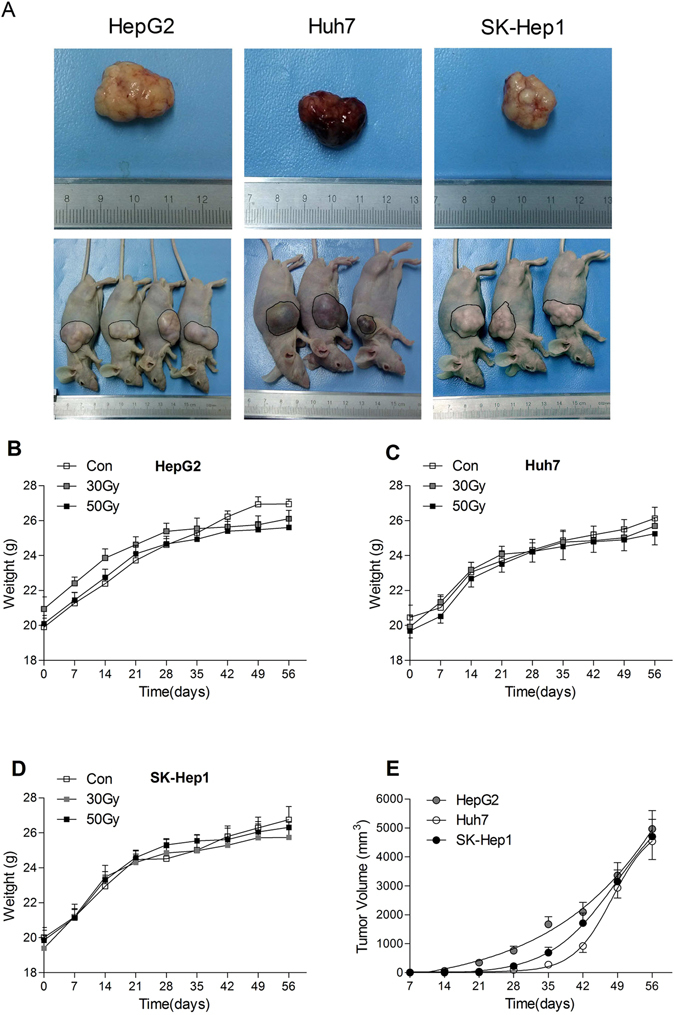
X-ray irradiation inhibited the growth of xenograft tumors in immunocompromised mice. The subcutaneous xenograft tumors developed by non-irradiated HepG2, Huh7 and SK-Hep1 cells in immunocompromised mice (A). The body weights of immunocompromised mice subcutaneously xenotransplanted with HepG2 (B), Huh7 (C) and SK-Hep1 (D) cells. The volume of xenograft tumors in immunocompromised mice subcutaneously xenotransplanted with non-irradiated tumor cells (E). Date are means ± SEM; n = 8 mice in each group.
Figure 5
Figure 5
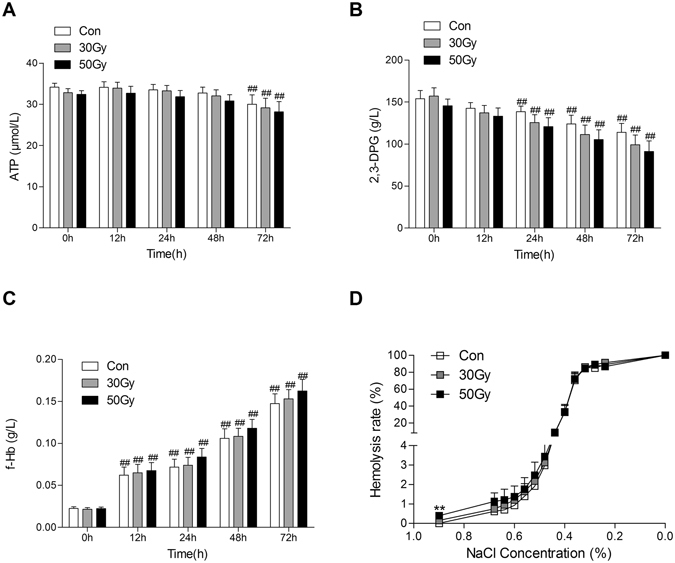
Effects of X-ray irradiation on erythrocytes in vitro. ATP (A), 2,3-DPG (B), and free Hb (C) were detected in X-ray irradiated erythrocytes after culturing for 0 h, 12 h, 24 h, 48 h and 72 h. Osmotic fragility (D) was assayed in X-ray irradiated erythrocytes after culturing for 0 h. Data are means ± SEM; n = 14. ** p < 0.01 vs. Con (0 Gy at 0 h after irradiation).

References

    1. Zhou J. A review of the application of autologous blood transfusion. Braz J Med Biol Res. 2016;49:e5493. doi: 10.1590/1414-431X20165493. - DOI - PMC - PubMed
    1. Kumar N, et al. Use of intraoperative cell-salvage for autologous blood transfusions in metastatic spine tumour surgery: a systematic review. Lancet Oncol. 2014;15:e33–41. doi: 10.1016/S1470-2045(13)70245-6. - DOI - PubMed
    1. Han S, et al. Safety of the Use of Blood Salvage and Autotransfusion During Liver Transplantation for Hepatocellular Carcinoma. Ann Surg. 2016;264:339–343. doi: 10.1097/SLA.0000000000001486. - DOI - PubMed
    1. Hansen E, Knuechel R, Altmeppen J, Taeger K. Blood irradiation for intraoperative autotransfusion in cancer surgery: demonstration of efficient elimination of contaminating tumor cells. Transfusion. 1999;39:608–615. doi: 10.1046/j.1537-2995.1999.39060608.x. - DOI - PubMed
    1. Gong M, et al. Irirradiation Can Selectively Kill Tumor Cells while Preserving Erythrocyte Viability in a Co-Culture System. PloS One. 2015;10:e0127181. doi: 10.1371/journal.pone.0127181. - DOI - PMC - PubMed

Publication types

MeSH terms