. 2017 Aug 11;7(1):7947.
doi: 10.1038/s41598-017-08478-w.

Investigation into the stability and culturability of Chinese enterotypes

Affiliations

Investigation into the stability and culturability of Chinese enterotypes

Yeshi Yin et al. Sci Rep. .

Abstract

Although many gut microbial enterotypes have been reported in Europe, Africa and the U.S., their effects on human health are still not yet clear. Culturing gut microbial enterotypes in vitro will be helpful to study their effects and applications. Here, fecal samples from 13 healthy Chinese volunteers were collected and subjected to next-generation sequencing. The results showed that seven of these samples belong to the Bacteroides enterotype and another six to the Prevotella enterotype. Stability of these Chinese gut microbial enterotypes was also evaluated. Results showed that most of the tested volunteer gut microbiota to be very stable. For one volunteer, the bacterial community returned to the state it was in before intestinal lavage and antibiotics treatment after four months. XP medium was found effective for simulating the Bacteroides enterotype independent of the original gut microbial community in an in vitro chemostat culture system. Although, the Prevotella enterotype was not very well simulated in vitro, different culture elements selectively enriched different gut bacteria. Pectin and xylan were found to be related to the enrichment of the genera Bacteroides, Sutterella, and Flavonifractor in this chemostat culture system.


Conflict of interest statement

The authors declare that they have no competing interests.

Figures
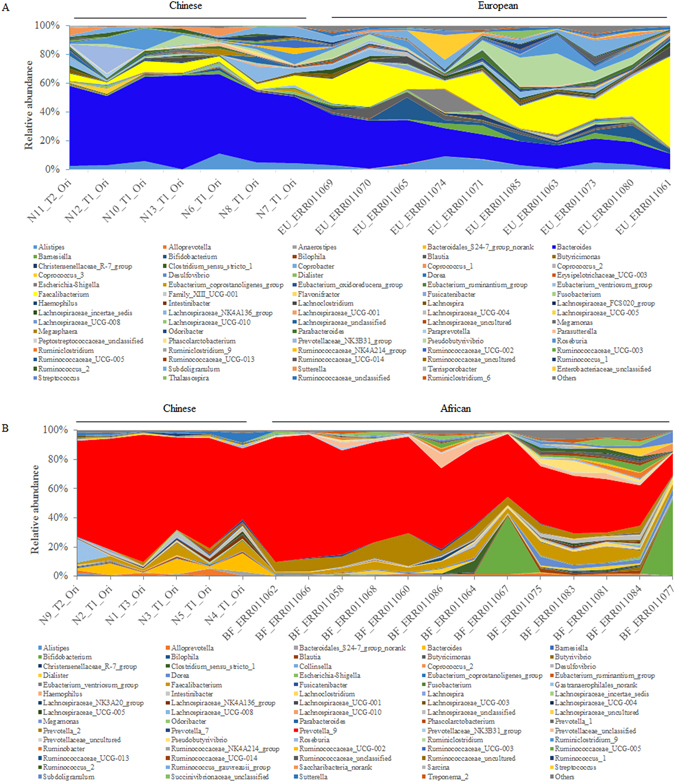
Figure 1
Figure 1
A comparison of the Chinese bacterial community to the European and African communities. Seven Bacteroides and six Prevotella enterotypes were used in this analysis of Chinese bacterial 16S rRNA gene sequencing data. For European and African bacterial 16 S rRNA gene sequencing data, ten Bacteroides and 13 Prevotella enterotypes were downloaded from http://www.ebi.ac.uk/ena/data/view/ERP000133. (A) Bacterial community of Bacteroides enterotype in Chinese and European people. (B) Bacterial community of Prevotella enterotype in Chinese and African hosts.
Figure 2
Figure 2
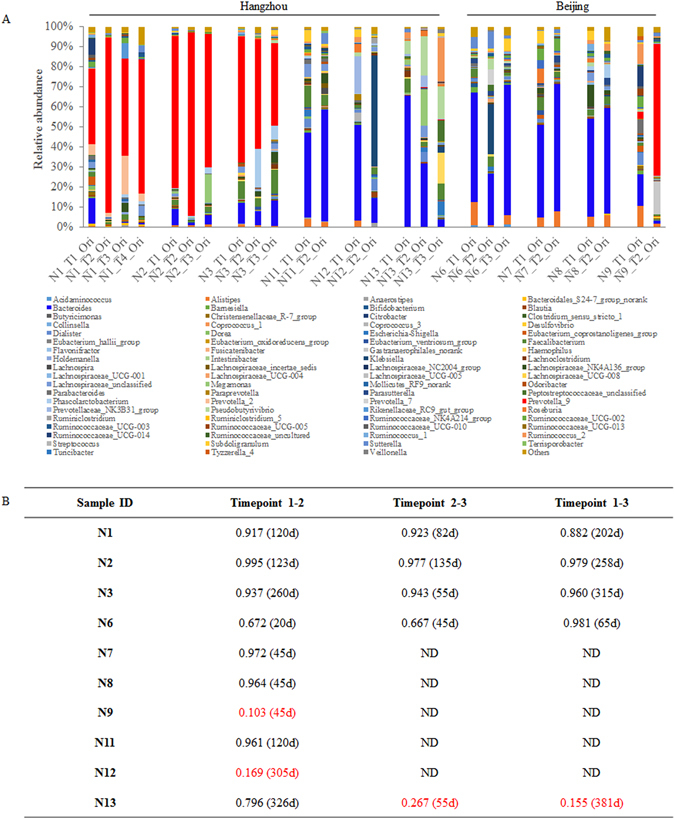
Stability of gut microbial enterotypes in Chinese hosts. Fecal samples were collected from ten healthy volunteers at different points in time. The bacterial community at the genus level is listed in Fig. 3A. The correlation coefficients of gut microbiota at different points in time are listed in Fig. 3B. The number in parentheses represents the number of days between two time points.
Figure 3
Figure 3
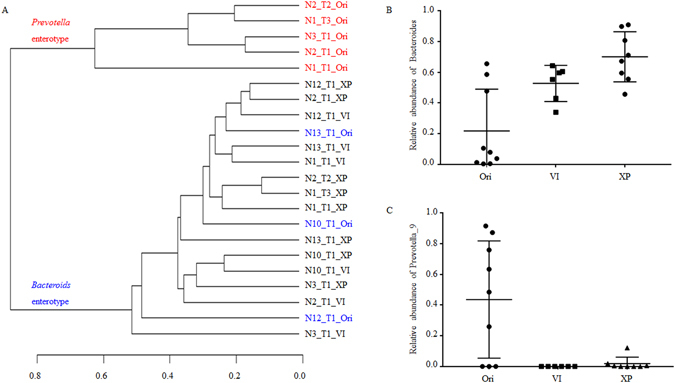
Chemostat simulation of cultures of Bacteroides and Prevotella enterotypes. Culture media VI, XP, MD1, and MD2 were used to simulate the bacterial communities of Bacteroides and Prevotella enterotypes in vitro. (A) Cluster analysis of the relationship among fecal samples and chemostat cultured samples according to the percentage of each genus. (B) The percentage of genera Bacteroides and Prevotella in fecal and chemostat cultured samples.
Figure 4
Figure 4
Analyses of the number of genera cultured in chemostats. 16 S rRNA gene high-through put sequencing data was classified using the rdp classifier method and silva123 database. At the genus level, Venn diagrams were then drawn by R package.
Figure 5
Figure 5
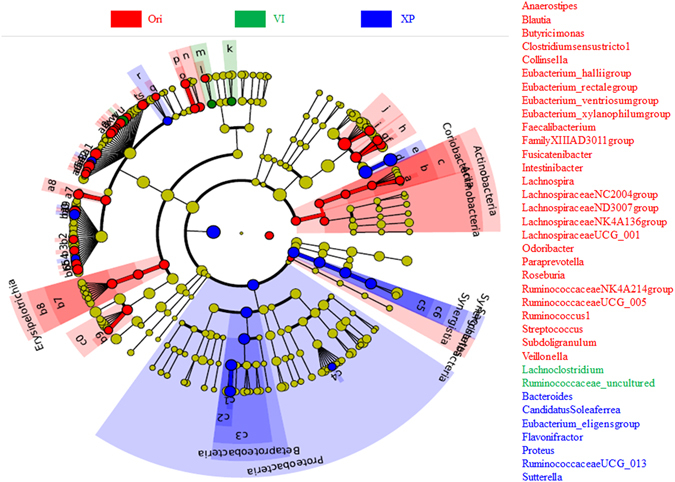
Analysis of different abundant bacterial taxa using LefSe. The bacterial percentage of original fecal samples and fermentation samples was used for LefSe analysis. The p value < 0.05 was identified as significantly different among these groups. Significantly enriched genera are listed on the right side.
Figure 6
Figure 6
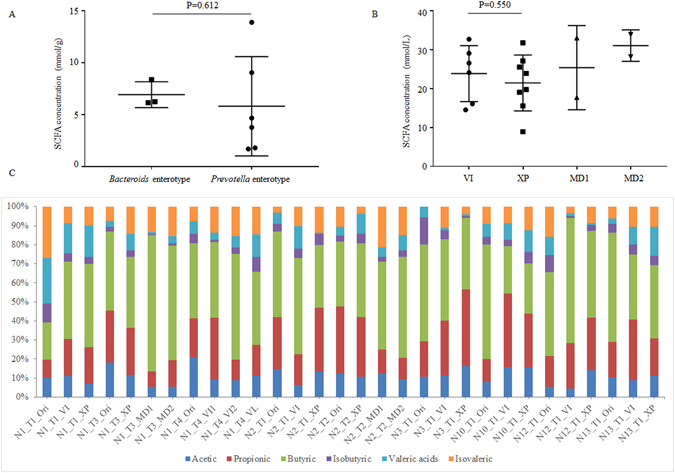
Total SCFA concentrations and relative percentages of SCFAs in fecal and fermentation samples. Acetic, propionic, isobutyric, butyric, isovaleric, and valeric acids were detected in the present study, and the total SCFA represents all SCFAs. The concentrations of SCFAs in the original fecal samples and batch chemostat were assessed using gas chromatography (GC). (A) Total concentration of SCFAs in original fecal samples (mmol/g). (B) Total concentration of SCFAs in fermentation samples (mmol/L). (C) The relative percentage of these SCFAs in each sample.

References

    1. Sonnenburg JL, Backhed F. Diet-microbiota interactions as moderators of human metabolism. Nature. 2016;535:56–64. doi: 10.1038/nature18846. - DOI - PMC - PubMed
    1. Honda K, Littman DR. The microbiota in adaptive immune homeostasis and disease. Nature. 2016;535:75–84. doi: 10.1038/nature18848. - DOI - PubMed
    1. van Nood E, et al. Duodenal infusion of donor feces for recurrent Clostridium difficile. The New England journal of medicine. 2013;368:407–415. doi: 10.1056/NEJMoa1205037. - DOI - PubMed
    1. Kelly CR, et al. Update on Fecal Microbiota Transplantation 2015: Indications, Methodologies, Mechanisms, and Outlook. Gastroenterology. 2015;149:223–237. doi: 10.1053/j.gastro.2015.05.008. - DOI - PMC - PubMed
    1. De Filippo C, et al. Impact of diet in shaping gut microbiota revealed by a comparative study in children from Europe and rural Africa. Proceedings of the National Academy of Sciences of the United States of America. 2010;107:14691–14696. doi: 10.1073/pnas.1005963107. - DOI - PMC - PubMed

Publication types

MeSH terms