Review
. 2017 Jul;473(2203):20170257.
doi: 10.1098/rspa.2017.0257. Epub 2017 Jul 26.

Mathematical and computational modelling of skin biophysics: a review

Affiliations
Review

Mathematical and computational modelling of skin biophysics: a review

Georges Limbert. Proc Math Phys Eng Sci. 2017 Jul.

Abstract

The objective of this paper is to provide a review on some aspects of the mathematical and computational modelling of skin biophysics, with special focus on constitutive theories based on nonlinear continuum mechanics from elasticity, through anelasticity, including growth, to thermoelasticity. Microstructural and phenomenological approaches combining imaging techniques are also discussed. Finally, recent research applications on skin wrinkles will be presented to highlight the potential of physics-based modelling of skin in tackling global challenges such as ageing of the population and the associated skin degradation, diseases and traumas.

Keywords: biophysics; constitutive modelling; continuum mechanics; skin; soft tissues; wrinkle.


Conflict of interest statement

I declare I have no competing interests.

Figures
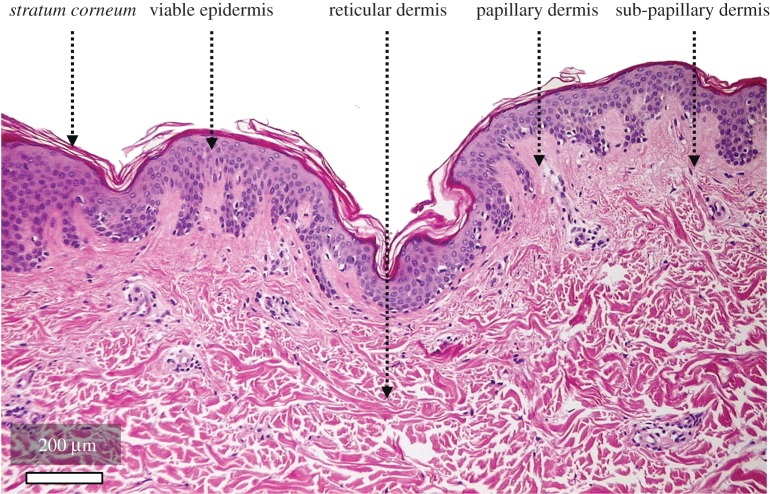
Figure 1.
Figure 1.
Histological section of haematoxylin and eosin stained back human skin sample obtained from a 30-year-old healthy White Caucasian female volunteer following biopsy (10 × magnification, image resolution: 1600 × 1200 pixels, imaged using a modified Nikon E950 camera). Image courtesy of Dr Maria-Fabiola Leyva-Mendivil (University of Southampton, UK).
Figure 2.
Figure 2.
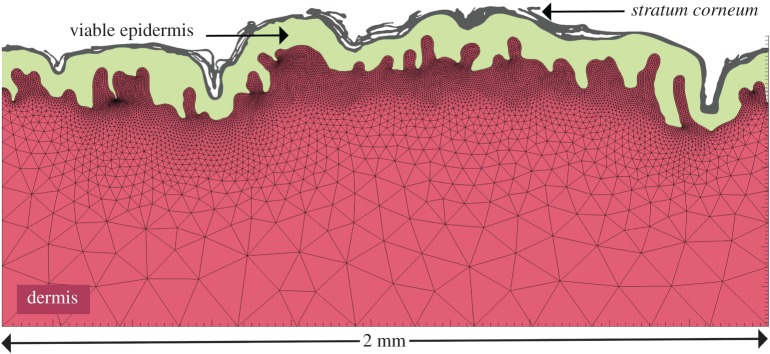
Image-based microstructural finite-element model of a cross section of human abdominal skin obtained from a 30-year-old healthy white Caucasian female patient following biopsy (adapted from Leyva-Mendivil et al. [20]). Series of digital images of histological sections that had been stained with haematoxylin and eosin were acquired using Nikon E950 camera (Nikon UK Ltd, Kingston Upon Thames, UK) mounted on an optical microscope at 10 times magnification (digital sensor resolution 1600 × 1200 pixels). Each histological section was imaged several times by moving the plate. The series of images were subsequently stitched together in a software environment (GIMP, www.gimp.org) by aligning each image with the next one, ensuring correct overlapping and alignment. The resulting composite image was then exported as a single PNG file into the image processing environment of ScanIP® 6.0 (Simpleware, Synopsys, Exeter, UK) where three regions of interest (stratum corneum, viable epidermis and dermis) were identified and segmented using a simple threshold-based algorithm. The three masks corresponding to the segmented anatomical regions were then meshed using bilinear triangular finite elements within ScanIP®. To capture the geometrically complex microstructures as well as the large aspect ratio between the largest and smallest dimensions, while ensuring a minimum number of finite elements, an adaptive mesh refinement algorithm was used. Because of their high densities, the meshes of the stratum corneum and viable epidermis layer are not plotted.
Figure 3.
Figure 3.
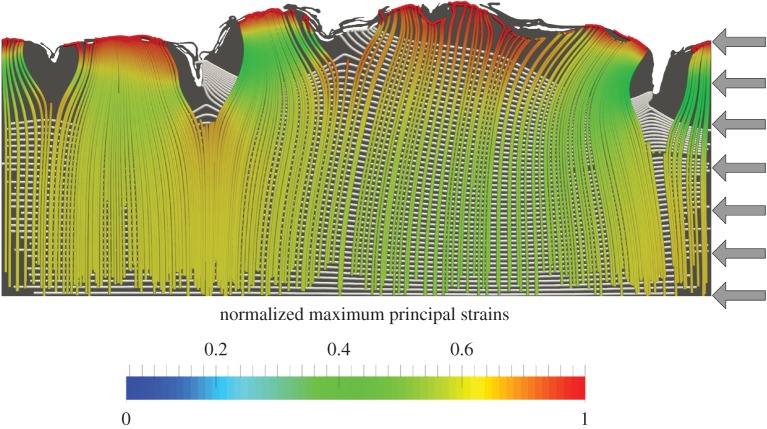
Streamline plots representing the maximum (coloured) and minimum (white) principal strain vectors in a finite deformation 2D plane-strain image-based finite-element model of the skin subjected to 20% in-plane compression (adapted from [20]). Grey arrows indicate the direction and location of the applied load. Streamlines, which are here overlaid over the undeformed geometry of the cross section of skin, allow direct visualization of load/strain paths within the skin as a result of any type of applied load. They are therefore very valuable, for example, to understand how deep and in which directions, loads are transmitted/deflected from the skin surface to/from the underlying layers in response to contact interaction with an external object.
Figure 4.
Figure 4.
Colour plots of minimum principal strains after 25% uniform in-plane compression as a function of the stiffness ratio α=Estratumcorneum/Esubstrate. The undeformed skin geometry is plotted in white to highlight the significant surface topography alterations arising from wrinkling instabilities which strongly depend on α. Adapted from Limbert & Kuhl [189].

References

    1. Burns T, Breathnach S, Cox N, Griffiths C.. 2004. Rook's textbook of dermatology, 7th edn Oxford, UK: Blackwell Science.
    1. Silver FH, Siperko LM, Seehra GP. 2003. Mechanobiology of force transduction in dermal tissue. Skin Res. Technol. 9, 3–23. (doi:10.1034/j.1600-0846.2003.00358.x) - DOI - PubMed
    1. Jablonski NG. 2006. Skin: a natural history. Berkeley, CA: University of California Press.
    1. Belytschko T, Liu WK, Moran B. 2000. Nonlinear finite elements for continua and structures. Oxford, UK: Wiley.
    1. Forrester AIJ. 2010. Black-box calibration for complex systems simulation. Phil. Trans. R. Soc. A 368, 3567–3579. (doi:10.1098/rsta.2010.0051) - DOI - PubMed