


The effect of population aging on health expenditure growth: a critical review
- PMID: 28804308
- PMCID: PMC5549212
- DOI: 10.1007/s10433-013-0280-x
The effect of population aging on health expenditure growth: a critical review
Abstract
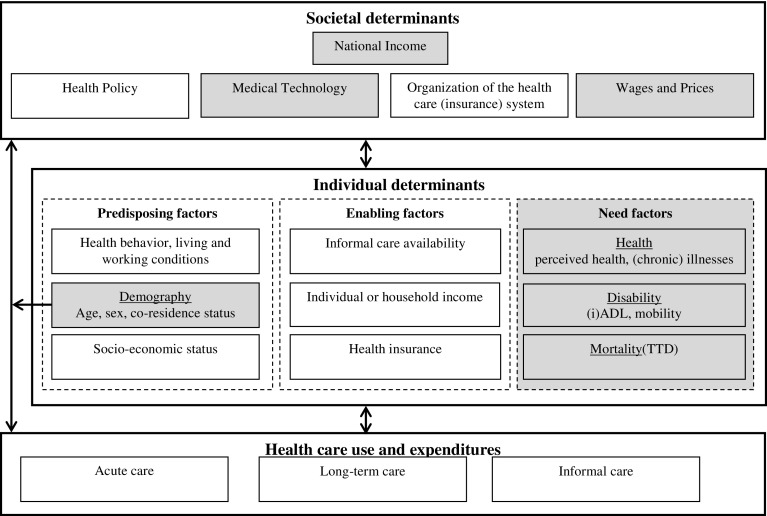
Although the consequences of population aging for growth in health expenditures have been widely investigated, research on this topic is rather fragmented. Therefore, these consequences are not fully understood. This paper reviews the consequences of population aging for health expenditure growth in Western countries by combining insights from epidemiological and health economics research. Based on a conceptual model of health care use, we first review evidence on the relationship between age and health expenditures to provide insight into the direct effect of aging on health expenditure growth. Second, we discuss the interaction between aging and the main societal drivers of health expenditures. Aging most likely influences growth in health expenditures indirectly, through its influence on these societal factors. The literature shows that the direct effect of aging depends strongly on underlying health and disability. Commonly used approximations of health, like age or mortality, insufficiently capture complex dynamics in health. Population aging moderately increases expenditures on acute care and strongly increases expenditures on long-term care. The evidence further shows that the most important driver of health expenditure growth, medical technology, interacts strongly with age and health, i.e., population aging reinforces the influence of medical technology on health expenditure growth and vice versa. We therefore conclude that population aging will remain in the centre of policy debate. Further research should focus on the changes in health that explain the effect of longevity gains on health expenditures, and on the interactions between aging and other societal factors driving expenditure growth.
Keywords: Acute care; Health expenditures; Long-term care; Morbidity; Population aging; Technology.
Figures
References
-
- Baicker K, Skinner JS (2011) Health care spending growth and the future of U.S. tax rates. NBER working paper no. 16772. Bureau of Economic Research, Cambridge
-
- Baumol WJ. Macroeconomics of unbalanced growth: the anatomy of urban crisis. Am Econ Rev. 1967;57:415–426.
Publication types
LinkOut - more resources
Full Text Sources
Other Literature Sources
