


Macro- and micro-level predictors of age categorization: results from the European Social Survey
- PMID: 28804310
- PMCID: PMC5549183
- DOI: 10.1007/s10433-013-0282-8
Macro- and micro-level predictors of age categorization: results from the European Social Survey
Abstract
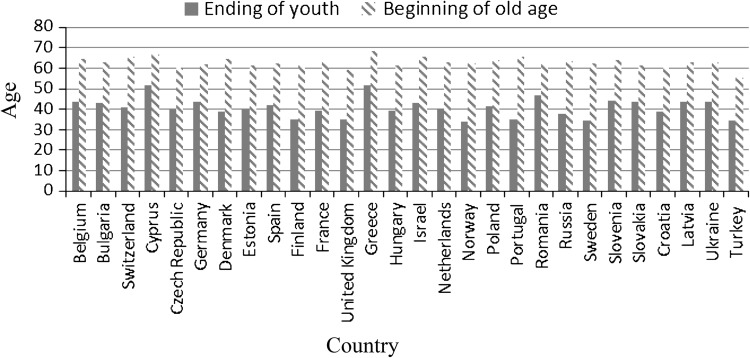
This study evaluated macro- and micro-level variables associated with individuals' perception of the ending of youth, the beginning of old age, and the length of the middle age period. The European Social Survey is a biennial multi-country, cross-sectional survey. Our analysis is based on the fourth wave, which included a rotating module on ageism. The source sample consisted of 28 countries and a total of 54,988 respondents. Whereas macro-level variability accounted for 14 % of the variance associated with the perception of the ending of youth, only 5.7 % of the variance associated with the perception of the beginning of old age was accounted for by macro-level variability. Almost 10 % of the variance associated with the perception of the middle age period was associated with macro-level variability. Different patterns of macro- and micro-level correlates emerged for the ending of youth, beginning of old age, and the period of middle age. Overall, results demonstrate that individual differences in the perception of the ending of youth, the beginning of old age, and the length of the middle age period are more pronounced than contextual differences. Results also suggest that individuals' mental maps regarding the timing of these events are not necessarily concordant.
Keywords: Contextual level; Epidemiology; Hierarchical analysis; Subjective; Terror management theory.
Figures
References
-
- Abrams D, Lima L (2007) Experiences and expressions of ageism. http://www.europeansocialsurvey.org/index.php?option=com_content&task=vi.... Accessed May 2013
-
- Abrams D, Vauclair C-M, Swift H (2011) Predictors of attitudes to age in Europe. Research Report No. 735: Department for Work and Pensions. http://research.dwp.gov.uk/asd/asd5/rports2011-2012/rrep735.pdf. Accessed 12 Nov 2012
-
- Andrew M, Eggerling-Boeck J, Sandefur GD, Smith B. The “inner side” of the transition to adulthood: how young adults see the process of becoming an adult. Adv Life Course Res. 2006;11:225–251. doi: 10.1016/S1040-2608(06)11009-6. - DOI
-
- Atkinson AB. On the measurement of inequality. J Econ Theory. 1970;2(3):244–263. doi: 10.1016/0022-0531(70)90039-6. - DOI
LinkOut - more resources
Full Text Sources
Other Literature Sources
