Review
. 2017 Jul 28:8:838.
doi: 10.3389/fimmu.2017.00838. eCollection 2017.

The Impact of Western Diet and Nutrients on the Microbiota and Immune Response at Mucosal Interfaces

Affiliations
Review

The Impact of Western Diet and Nutrients on the Microbiota and Immune Response at Mucosal Interfaces

Donjete Statovci et al. Front Immunol. .

Abstract

Recent findings point toward diet having a major impact on human health. Diets can either affect the gut microbiota resulting in alterations in the host's physiological responses or by directly targeting the host response. The microbial community in the mammalian gut is a complex and dynamic system crucial for the development and maturation of both systemic and mucosal immune responses. Therefore, the complex interaction between available nutrients, the microbiota, and the immune system are central regulators in maintaining homeostasis and fighting against invading pathogens at mucosal sites. Westernized diet, defined as high dietary intake of saturated fats and sucrose and low intake of fiber, represent a growing health risk contributing to the increased occurrence of metabolic diseases, e.g., diabetes and obesity in countries adapting a westernized lifestyle. Inflammatory bowel diseases (IBD) and asthma are chronic mucosal inflammatory conditions of unknown etiology with increasing prevalence worldwide. These conditions have a multifactorial etiology including genetic factors, environmental factors, and dysregulated immune responses. Their increased prevalence cannot solely be attributed to genetic considerations implying that other factors such as diet can be a major contributor. Recent reports indicate that the gut microbiota and modifications thereof, due to a consumption of a diet high in saturated fats and low in fibers, can trigger factors regulating the development and/or progression of both conditions. While asthma is a disease of the airways, increasing evidence indicates a link between the gut and airways in disease development. Herein, we provide a comprehensive review on the impact of westernized diet and associated nutrients on immune cell responses and the microbiota and how these can influence the pathology of IBD and asthma.

Keywords: asthma; inflammatory bowel disease; microbiota; micronutrients; saturated fat; westernized diet.


Figures
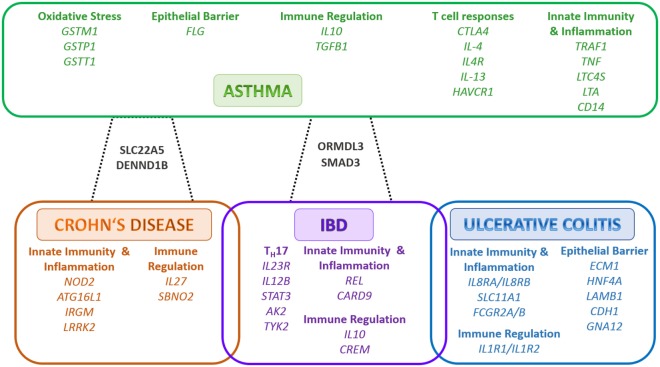
Figure 1
Figure 1
Shared and individual inflammatory bowel disease (IBD) and Asthma susceptibility genes/loci. The outlined genes are grouped according to function. In green color are the genes associated to asthma, in blue color are the genes associated to ulcerative colitis only, in orange color are the genes associated to Crohn’s disease only, in purple color are the genes associated to IBD, in black color are the genes associated to asthma and Crohn’s disease or asthma and IBD, respectively. Adapted from Ref. (–40). Abbreviations: AK2, adenylate kinase 2; ATG16L1, autophagy related 16 like 1; CARD9, caspase recruitment domain family member 9; CD14, cluster of differentiation 14; CDH1, cadherin 1; CREM, CAMP responsive element modulator; CTLA4, cytotoxic T-lymphocyte associated protein 4; DENND1B, DENN domain containing 1B; ECM1, extracellular matrix protein 1; FCGR2A, Fc fragment of IgG receptor IIa; FCGR2B, Fc fragment of IgG receptor IIb; FLG, filaggrin; GNA12, G-protein subunit alpha 12; GSTM1, glutathione S-transferase mu 1; GSTP1, glutathione S-transferase pi 1; GSTT1, glutathione S-transferase theta 1; HAVCR1, hepatitis A virus cellular receptor 1; HNF4A, hepatocyte nuclear factor 4 alpha; IL-13, interleukin 13; IL-4, interleukin 4; IL-10, interleukin 10; IL-12B, interleukin 12B; IL-1R1, interleukin 1 receptor type 1; IL-1R2, interleukin 1 receptor type 2; IL23R, interleukin 23 receptor; IL-27, interleukin 27; IL-4R, interleukin 4 receptor; CXCR1, C–X–C motif chemokine receptor 1; CXCR2, C–X–C motif chemokine receptor 2; IRGM, immunity related GTPase M; LAMB1, laminin subunit beta 1; LRRK2, leucine rich repeat kinase 2; LTA, lymphotoxin alpha; LTC4S, leukotriene C4 synthase; NOD2, nucleotide binding oligomerization domain containing 2; ORMDL3, ORMDL sphingolipid biosynthesis regulator 3; REL, REL proto-oncogene, NF-κB subunit; SBNO2, strawberry notch homolog 2; SLC11A1, solute carrier family 11 member 1; SLC22A5, solute carrier family 22 member 5; SMAD3, SMAD Family Member 3; STAT3, signal transducer and activator of transcription 3; Th, T helper cell; TGFB1, transforming growth factor beta 1; TNF, tumor necrosis factor; TRAF1, TNF receptor associated factor 1; TYK2, tyrosine kinase 2.
Figure 2
Figure 2
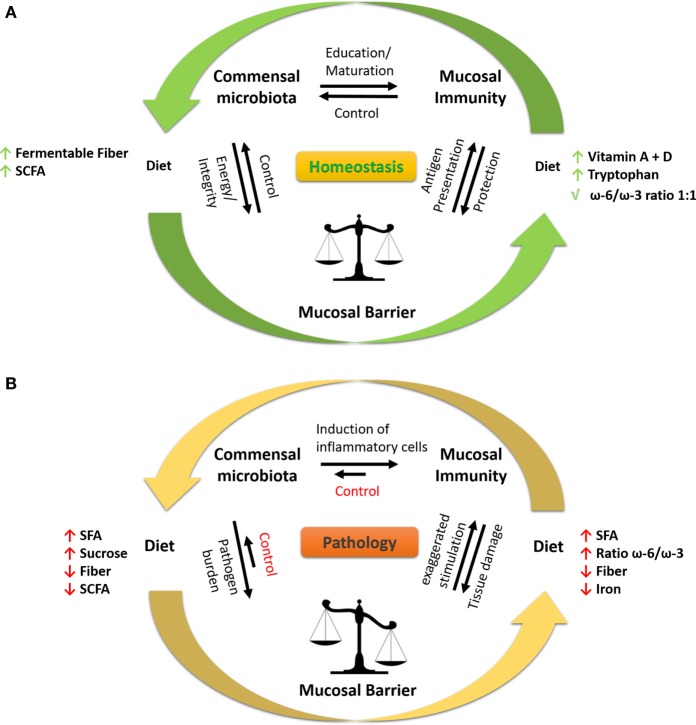
Interaction between diet, microbiota, and immune response at mucosal sites. (A) To keep a healthy state, the local microbiota and mucosal immune system are in homeostasis at mucosal sites. The microbiota educates and promotes the maturation of the immune system by induction of pro-inflammatory and anti-inflammatory immune cells, e.g., Th17 (SFB), T regulatory cells (Clostridia spp.), and Th1 (Bacteroides fragilis). Moreover, the immune system surveys microbial activities (e.g., antigen sampling at the mucosal barrier) and responds in a controlled fashion by producing, e.g., antimicrobial peptides, sIgA to prevent tissue damage. The integrity of the mucosal barrier is sustained by bacteria-produced metabolites (e.g., SCFA) such as butyrate resulting in high expression of tight-junction proteins and mucus production, thereby restricting interaction of microbes to the lumen and luminal epitheliums. The diet is involved in all processes, serving the microbiome with fermentable fibers and the immune system and epithelium with essential nutrients, e.g., vitamins and minerals. (B) During pathological conditions, such as inflammatory bowel disease and asthma, the homeostasis at the mucosal barrier is disrupted. A westernized diet, i.e., high in SFA, high ω-6/ω-3 ratio, high sucrose and iron (oral iron supplements), and low in fiber promotes inflammation and growth of pathogenic/pathobiont (disease causing) bacteria in the gut. The microbiota, which is rich in non-beneficial bacteria, favorably induces the maturation of pro-inflammatory immune cells, leading to uncontrolled inflammation resulting in tissue damage of the mucosal compartment. The damaged mucosa and shifted immune response fail to control the microbiota, which exaggerates the pathophysiological state. Under certain conditions, bacteria-derived LPS enters the systemic circulation and further stimulates the immune system toward a pro-inflammatory state. Abbreviations: LPS, lipopolysaccharide; SCFAs, short-chain fatty acids; SFAs, saturated fatty acids; SFB, segmented filamentous bacteria; sIgA, secretory immunoglobulin A; ω-6/ω-3, omega-6/omega-3 fatty acid ratio; Th, T helper.
Figure 3
Figure 3
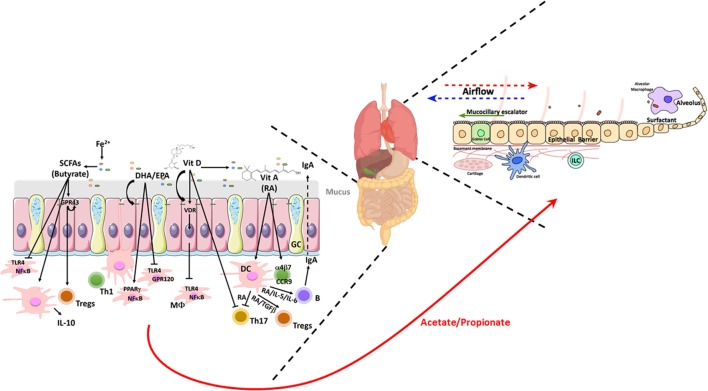
Schematic illustrating the nutrient factors regulating microbial and host responses in the healthy gut and lung. Homeostatic balance at the mucosa due to a balanced diet rich in fiber allows for regulated interactions between the epithelia and the microbiome. This dialog with the microbiome allows for appropriate epithelial barrier function, mucus secretion, and underlying immune sensing. In the gut, a balanced microbiome generates SCFAs and dietary long chain FAs and the fat-soluble vitamins A and D which induce a tolerogenic mucosal immune state locally at the gut but also systemically and particularly in the lung. The gut-derived SCFAs acetate and propionate enhance DCs, ILC, and macrophage phagocytic function and Tregs balance resulting in the control of lung microbiota and efficient mucocillary clearance of inhaled microbes and particulates. Lung figure adapted from Ref. (41). Abbreviations: CCR9, C–C motif chemokine receptor 9; DCs, dendritic cells; DHA, docosahexaenoic acid; EPA, eicosapentaenoic acid; FAs, fatty acids; GC, goblet cells; GPR, G-protein coupled receptor; ILC, innate lymphoid cells; α4β7, integrin α4β7; IL-1β, interleukin 1 beta; IL-4, interleukin 4; IL-5, interleukin 5; IL-10, interleukin 10; Fe2+, iron; MΦ, macrophage; NFκB, nuclear factor kappa-light-chain-enhancer of activated B cells; PPARγ, peroxisome proliferator-activated receptor gamma; RA, retinoic acid; SCFAs, short-chain fatty acids; TGFβ, transforming growth factor beta; Th, T helper; Tregs, T regulatory cells; TLR4, toll-like receptor 4; VitA, vitamin A; VitD, vitamin D; VDR, vitamin D receptor; healthy bacteria phyla—formula image, bacteroides; formula image, firmicutes; formula image, barrier integrity.
Figure 4
Figure 4
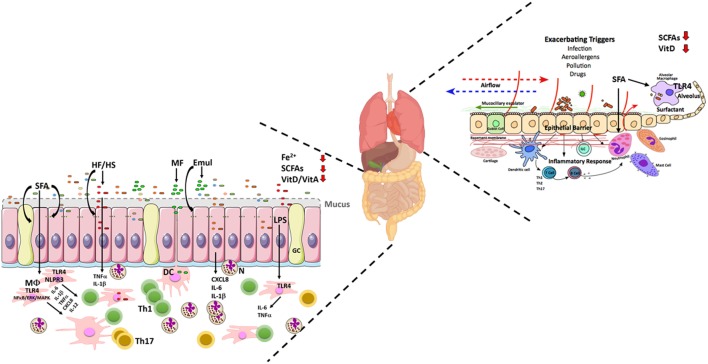
Schematic illustrating the nutrient factors affecting microbial and host responses in the inflamed gut in inflammatory bowel disease (IBD) and the lung in Asthma. In both IBD and Asthma genetic susceptibility, microbiota, and dietary changes result in disease development and inflammation. Dysfunctional epithelia barrier function allows for malabsorption of nutrients, inappropriate immune sampling, and colonization of the gut by pathobionts and subsequent disease exacerbation. In the lung, environmental triggers stimulate inflammatory and allergic reactions resulting in mucus hypersecretion, epithelia, and tissue remodeling and resulting compromised of lung function. This microenvironment change allows for microbial changes which allow for increased respiratory infections in asthmatic patients. Both IBD and asthma pathogenesis is related to reduced microbiota-derived SCFAs, malabsorption of iron and Vitamins and reduced gut-derived SCFA result in a trend toward an inflammatory sensing of the mucosa associated microbiota. A diet high in SFA increases TLR4 sensing and subsequent inflammatory reactions to the microbiota resulting in disease progression. This dysregulated mucosal inflammation changes the epithelia barrier function and subsequently alters the microbiota of both sensitive immune sites displaying the characteristic phenotypes associated with both IBD and asthma. Lung figure adapted from Ref. (41). Abbreviations: CXCL8, C–X–C Motif Chemokine Ligand 8; DCs, dendritic cells; Emul, emulsifier; GC, goblet cell; HF/HS, high-fat/high sucrose; ILC, innate lymphoid cells; IL-1β, interleukin 1 beta; IL-6, interleukin 6; IL-12, interleukin 12; Fe2+, iron; LPS, lipopolysaccharide; MΦ, macrophage; MAPK/ERK, mitogen-activated protein kinase/extracellular signal-regulated kinase; MF, milk fat diet; N, neutrophils; NFκB, nuclear factor kappa-light-chain-enhancer of activated B cells; PPARγ, peroxisome proliferator-activated receptor gamma; SFA, saturated fatty acids; SCFAs, short-chain fatty acids; TGFβ, transforming growth factor beta; Th, T helper; TNF, tumor necrosis factor; TLR4, toll-like receptor 4; VitA, vitamin A; VitD, vitamin D; healthy bacteria phyla— formula image, bacteroides; formula image, firmicutes; formula image, adherent and invasive Escherichia coli (AIEC); formula image, Bilophila wadsworthia; formula image, other altered bacterial spp; formula image, compromised barrier integrity.

References

    1. El-Gabalawy H, Guenther LC, Bernstein CN. Epidemiology of immune-mediated inflammatory diseases: incidence, prevalence, natural history, and comorbidities. J Rheumatol Suppl (2010) 85:2–10. 10.3899/jrheum.091461 - DOI - PubMed
    1. Molodecky NA, I, Soon S, Rabi DM, Ghali WA, Ferris M, Chernoff G, et al. Increasing incidence and prevalence of the inflammatory bowel diseases with time, based on systematic review. Gastroenterology (2012) 142:46–54.e42; quiz e30. 10.1053/j.gastro.2011.10.001 - DOI - PubMed
    1. Kotlyar DS, Shum M, Hsieh J, Blonski W, Greenwald DA. Non-pulmonary allergic diseases and inflammatory bowel disease: a qualitative review. World J Gastroenterol (2014) 20:11023–32. 10.3748/wjg.v20.i32.11023 - DOI - PMC - PubMed
    1. Uranga JA, Lopez-Miranda V, Lombo F, Abalo R. Food, nutrients and nutraceuticals affecting the course of inflammatory bowel disease. Pharmacol Rep (2016) 68:816–26. 10.1016/j.pharep.2016.05.002 - DOI - PubMed
    1. Leiria LO, Martins MA, Saad MJ. Obesity and asthma: beyond T(H)2 inflammation. Metabolism (2015) 64:172–81. 10.1016/j.metabol.2014.10.002 - DOI - PubMed

LinkOut - more resources