


ALK in Non-Small Cell Lung Cancer (NSCLC) Pathobiology, Epidemiology, Detection from Tumor Tissue and Algorithm Diagnosis in a Daily Practice
- PMID: 28805682
- PMCID: PMC5575610
- DOI: 10.3390/cancers9080107
ALK in Non-Small Cell Lung Cancer (NSCLC) Pathobiology, Epidemiology, Detection from Tumor Tissue and Algorithm Diagnosis in a Daily Practice
Abstract
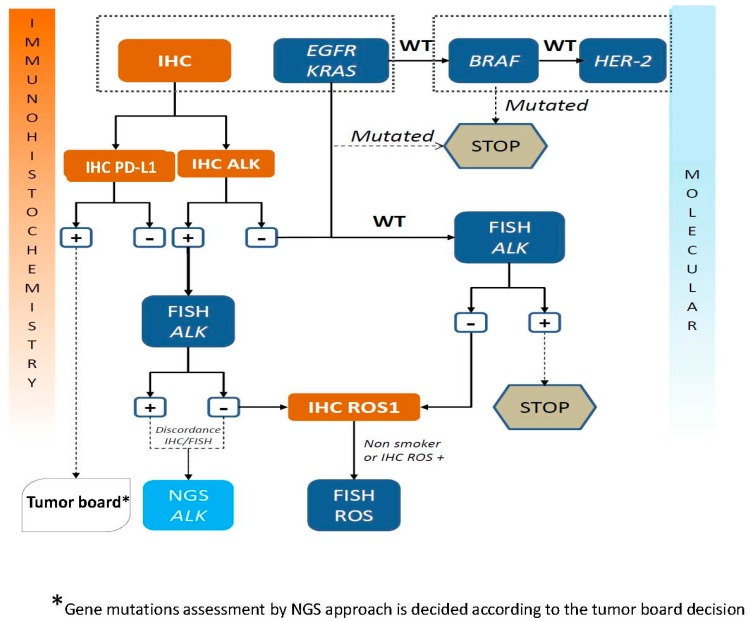
Patients with advanced-stage non-small cell lung carcinoma (NSCLC) harboring an ALK rearrangement, detected from a tissue sample, can benefit from targeted ALK inhibitor treatment. Several increasingly effective ALK inhibitors are now available for treatment of patients. However, despite an initial favorable response to treatment, in most cases relapse or progression occurs due to resistance mechanisms mainly caused by mutations in the tyrosine kinase domain of ALK. The detection of an ALK rearrangement is pivotal and can be done using different methods, which have variable sensitivity and specificity depending, in particular, on the quality and quantity of the patient's sample. This review will first highlight briefly some information regarding the pathobiology of an ALK rearrangement and the epidemiology of patients harboring this genomic alteration. The different methods used to detect an ALK rearrangement as well as their advantages and disadvantages will then be examined and algorithms proposed for detection in daily routine practice.
Keywords: ALK rearrangement, lung cancer, biology, immunohistochemistry, FISH, molecular biology..
Conflict of interest statement
The author declares having received honoraria from Pfizer, AstraZeneca, Roche, BMS, Boerhinger, MSD, Thermofisher, Qiagen and to have participated in different scientific advisory board meetings.
Figures
References
-
- Ilie M., Hofman P. Expanding opportunities for crizotinib resistance in ALK-positive lung cancer patients. Transl. Cancer Res. 2016;5:203–205. doi: 10.21037/tcr.2016.03.02. - DOI
-
- Di Maio M., de Marinis F., Hirsch F.R., Gridelli C. Diagnostic and therapeutic issues for patients with advanced non-small cell lung cancer harboring anaplastic lymphoma kinase rearrangement: European vs. US perspective (review) Int. J. Oncol. 2014;45:509–515. doi: 10.3892/ijo.2014.2453. - DOI - PubMed
-
- Qian M., Zhu B., Wang X., Liebman M. Drug resistance in ALK-positive non-small cell lung cancer patients. Semin. Cell Dev. Biol. 2017;64:150–157. - PubMed
Publication types
LinkOut - more resources
Full Text Sources
Other Literature Sources
