


An economic evaluation of vector control in the age of a dengue vaccine
- PMID: 28806786
- PMCID: PMC5573582
- DOI: 10.1371/journal.pntd.0005785
An economic evaluation of vector control in the age of a dengue vaccine
Abstract
Introduction: Dengue is a rapidly emerging vector-borne Neglected Tropical Disease, with a 30-fold increase in the number of cases reported since 1960. The economic cost of the illness is measured in the billions of dollars annually. Environmental change and unplanned urbanization are conspiring to raise the health and economic cost even further beyond the reach of health systems and households. The health-sector response has depended in large part on control of the Aedes aegypti and Ae. albopictus (mosquito) vectors. The cost-effectiveness of the first-ever dengue vaccine remains to be evaluated in the field. In this paper, we examine how it might affect the cost-effectiveness of sustained vector control.
Methods: We employ a dynamic Markov model of the effects of vector control on dengue in both vectors and humans over a 15-year period, in six countries: Brazil, Columbia, Malaysia, Mexico, the Philippines, and Thailand. We evaluate the cost (direct medical costs and control programme costs) and cost-effectiveness of sustained vector control, outbreak response and/or medical case management, in the presence of a (hypothetical) highly targeted and low cost immunization strategy using a (non-hypothetical) medium-efficacy vaccine.
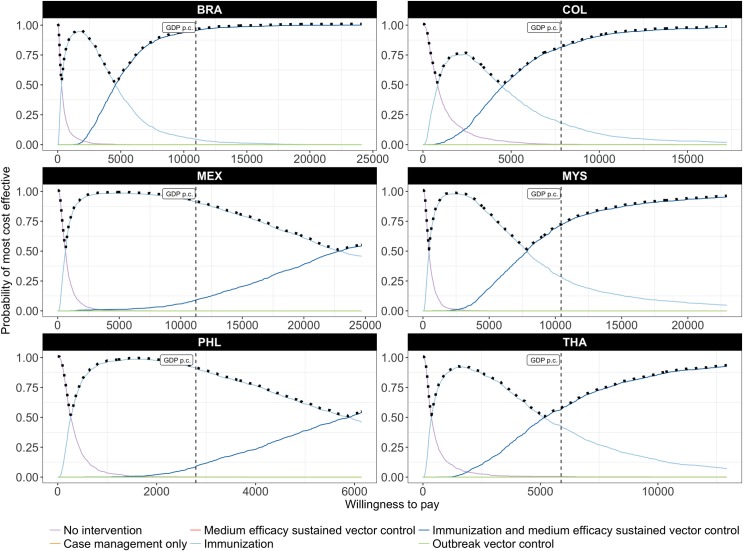
Results: Sustained vector control using existing technologies would cost little more than outbreak response, given the associated costs of medical case management. If sustained use of existing or upcoming technologies (of similar price) reduce vector populations by 70-90%, the cost per disability-adjusted life year averted is 2013 US$ 679-1331 (best estimates) relative to no intervention. Sustained vector control could be highly cost-effective even with less effective technologies (50-70% reduction in vector populations) and in the presence of a highly targeted and low cost immunization strategy using a medium-efficacy vaccine.
Discussion: Economic evaluation of the first-ever dengue vaccine is ongoing. However, even under very optimistic assumptions about a highly targeted and low cost immunization strategy, our results suggest that sustained vector control will continue to play an important role in mitigating the impact of environmental change and urbanization on human health. If additional benefits for the control of other Aedes borne diseases, such as Chikungunya, yellow fever and Zika fever are taken into account, the investment case is even stronger. High-burden endemic countries should proceed to map populations to be covered by sustained vector control.
Conflict of interest statement
The authors have declared that no competing interests exist. The authors alone are responsible for the views expressed in this article and they do not necessarily represent the views, decisions or policies of the institutions with which they are affiliated.
Figures
References
-
- Brady OJ, Gething PW, Bhatt S, Messina JP, Brownstein JS, Hoen AG, et al. Refining the global spatial limits of dengue virus transmission by evidence-based consensus. PLoS Negl Trop Dis. 2012;6: e1760 doi: 10.1371/journal.pntd.0001760 - DOI - PMC - PubMed
-
- Shepard DS, Coudeville L, Halasa YA, Zambrano B, Dayan GH. Economic impact of dengue illness in the Americas. Am J Trop Med Hyg. 2011;84: 200–207. doi: 10.4269/ajtmh.2011.10-0503 - DOI - PMC - PubMed
-
- Shepard DS, Undurraga EA, Halasa YA. Economic and disease burden of dengue in Southeast Asia. PLoS Negl Trop Dis. 2013;7: e2055 doi: 10.1371/journal.pntd.0002055 - DOI - PMC - PubMed
-
- Shepard DS, Halasa YA, Tyagi BK, Adhish SV, Nandan D, Karthiga KS, et al. Economic and Disease Burden of Dengue Illness in India. Am J Trop Med Hyg. 2014; doi: 10.4269/ajtmh.14-0002 - DOI - PMC - PubMed
-
- Huy R, Wichmann O, Beatty M, Ngan C, Duong S, Margolis HS, et al. Cost of dengue and other febrile illnesses to households in rural Cambodia: a prospective community-based case-control study. BMC Public Health. 2009;9: 155 doi: 10.1186/1471-2458-9-155 - DOI - PMC - PubMed
MeSH terms
Substances
Grants and funding
LinkOut - more resources
Full Text Sources
Other Literature Sources
Medical
