


Evaluation of the cervix tissue homogeneity by ultrasound elastography in infertile women for the prediction of embryo transfer ease: a diagnostic accuracy study
- PMID: 28806905
- PMCID: PMC5557509
- DOI: 10.1186/s12958-017-0283-0
Evaluation of the cervix tissue homogeneity by ultrasound elastography in infertile women for the prediction of embryo transfer ease: a diagnostic accuracy study
Abstract
Background: Ultrasound elastography is a non-invasive medical imaging technique able to quantitatively characterize the stiffness of a given tissue. It has been shown to predict the risk for cervical insufficiency and preterm delivery, and to allow differentiation of malignancy from normal tissue. The present study sought to evaluate whether cervical tissue dishomogeneity, as assessed by cervical ultrasound elastography, may predict the embryo transfer (ET) ease in infertile women undergoing IVF/ICSI.
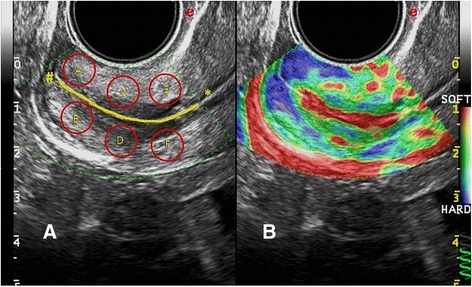
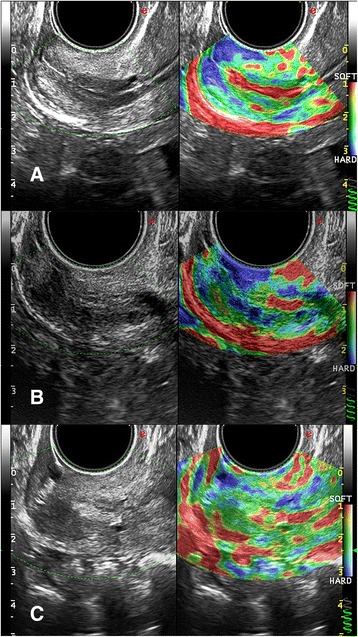
Methods: We evaluated 154 infertile patients with no history of previous ET or intrauterine insemination. Cervical stiffness was evaluated in six regions of interest (ROI), compared two by two to obtain strain ratio (SR) values. Since a SR value of 1 was suggestive of tissue homogeneity, we computed 1-SR/SR-1 values to obtain a measure of the degree of cervical tissue dishomogeneity that we named "dishomogeneity index" (DI). Ultrasound-guided ET was performed by an expert operator blinded to the results of cervical elastography. The prediction ability of elastography on ET ease was evaluated by binary logistic regression, and the predictive accuracy of the independent variables was quantified with area under the curve (AUC) estimates derived from receiver operating characteristic (ROC) curve.
Results: ET resulted to be easy in 99 out of 154 patients (64,2%), difficult in 54 patients (35%), and impossible in one. DI values in cervical medial lips region correctly classified 86.9% of patients, according to binary logistic regression, with a sensitivity of 81.4% and a specificity of 89,9%, positive likelihood ratio (LR) 8.07 and negative LR of 0.21. A DI cut-off value of 0.29 predicted a difficulty of ET with a sensitivity of 88,9% and a specificity of 85%.
Conclusions: Cervical ultrasound elastography, by allowing the identification of cervical tissue dishomogeneity, may be of help in predicting the ET ease in infertile women candidates to IVF/ICSI.
Keywords: Assisted reproduction; Cervical canal; Elastography; Embryo transfer; Female infertility.
Conflict of interest statement
Ethics approval and consent to participate
All procedures performed in studies involving human participants were in accordance with the ethical standards of the institutional and/or national research committee and with the 1964 Helsinki declaration and its later amendments or comparable ethical standards. The present prospective diagnostic study was approved by the local Independent Ethical Committee (IEC) on January 27, 2016 (IEC approval n. 4953/2016).
Consent for publication
Not applicable.
Competing interests
The authors declare that they have no competing interest.
Publisher’s Note
Springer Nature remains neutral with regard to jurisdictional claims in published maps and institutional affiliations.
Figures
References
-
- Kava-Braverman A, Martinez F, Rodriguez I, Alvarez M, Barri PN, Coroleu B. What is a difficult transfer? Analysis of 7,714 embryo transfers: the impact of maneuvers during embryo transfers on pregnancy rate and a proposal of objective assessment. Fertil Steril. 2017. epub ahead of print. - PubMed
MeSH terms
LinkOut - more resources
Full Text Sources
Other Literature Sources
Medical
Research Materials
