


The impact of the lookback period and definition of confirmatory events on the identification of incident cancer cases in administrative data
- PMID: 28806932
- PMCID: PMC5556662
- DOI: 10.1186/s12874-017-0407-4
The impact of the lookback period and definition of confirmatory events on the identification of incident cancer cases in administrative data
Abstract
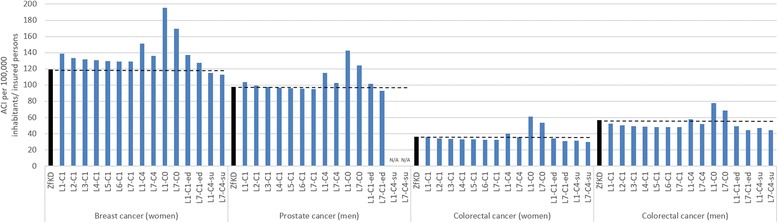
Background: This cohort study examined the impact of the lengths of lookback and confirmation periods as well as the definition of confirmatory events on the number of incident cancer cases identified and age-standardized cumulative incidences (ACI) estimated in administrative data using German cancer registry data as a benchmark.
Methods: ACI per 100,000 insured persons for breast, prostate and colorectal cancer were estimated using BARMER Statutory Health Insurance claims data. Incident cancer cases were defined as having an in- or outpatient diagnosis in 2013, no diagnosis in a lookback period of 1 year and a second diagnosis (or death) in a confirmation period of 1 quarter. We varied lookback periods from 1 to 7 years, confirmation periods from 1 to 4 quarters as well as the definition of confirmatory events and compared ACI estimates to cancer registry data.
Results: ACI were higher for breast (138.7) and prostate (103.6) but lower for colorectal cancer (42.1) when compared to cancer registries (119.3, 98.0 and 45.5, respectively). Extending the lookback period to 7 years reduced ACI to 129.0, 95.1 and 38.3. An extended confirmation period of 4 quarters increased ACI to 151.3, 114.9 and 46.8. Including breast and colorectal surgeries as a confirmatory event reduced ACI to 114.9 and 37.1, respectively.
Conclusions: The choice of lookback and confirmation periods and the definition of confirmatory events have considerable impact on the number of incident cancer cases identified and ACI estimated. Researchers need to be aware of potential misclassification when identifying incident cancer cases in administrative data. Further validation studies as well as studies using administrative data to estimate cancer incidences should consider several choices of the lookback and confirmation periods and the definition of confirmatory events to show how these parameters impact the validity and robustness of their results.
Keywords: Administrative claims; Breast neoplasms; Colorectal neoplasms; Epidemiology; Health services research; Incidence; International classification of diseases; Neoplasms; Prostatic neoplasms; Validation.
Conflict of interest statement
Authors’ information
JC is a doctoral researcher at the University of Bremen. In his thesis, JC examines the strengths and limitations regarding the use of SHI claims data for the evaluation of national cancer screening programs. TS is head of the Drug Safety Unit at the Leibniz Institute for Prevention Research and Epidemiology - BIPS. KJ is a former employee of this unit. As most of the safety studies in this unit are based on SHI claims data, one research focus are the strengths and limitations of this data.
Ethics approval and consent to participate
In Germany, the use of SHI claims data for research purposes is regulated by the Code of Social Law. The involved SHI fund, namely the BARMER, as the responsible authority approved the use of the data for this study. Informed consent was not required by law, since the study was based on pseudonymous data.
Consent for publication
Not applicable.
Competing interests
The authors declare that they have no competing interests.
Publisher’s Note
Springer Nature remains neutral with regard to jurisdictional claims in published maps and institutional affiliations.
Figures
References
-
- Stewart B, Wild C, editors. World Cancer Report 2014. International Agency for Research on Cancer, WHO: Lyon; 2014. - PubMed
-
- Baldi I, Vicari P, Di Cuonzo D, Zanetti R, Pagano E, Rosato R, Sacerdote C, Segnan N, Merletti F, Ciccone G. A high positive predictive value algorithm using hospital administrative data identified incident cancer cases. J Clin Epidemiol. 2008;61(4):373–379. doi: 10.1016/j.jclinepi.2007.05.017. - DOI - PubMed
-
- Ramsey SD, Mandelson MT, Etzioni R, Harrison R, Smith R, Taplin S. Can administrative data identify incident cases of colorectal cancer? A comparison of two health plans. Health Serv Outcome Res Methodol. 2004;5(1):27–37. doi: 10.1007/s10742-005-5562-0. - DOI
MeSH terms
LinkOut - more resources
Full Text Sources
Other Literature Sources
Medical
