


Factors influencing outcomes after medial hamstring lengthening with semitendinosus transfer in patients with cerebral palsy
- PMID: 28806980
- PMCID: PMC5556982
- DOI: 10.1186/s12984-017-0296-0
Factors influencing outcomes after medial hamstring lengthening with semitendinosus transfer in patients with cerebral palsy
Abstract
Background: Although several studies have investigated the outcomes after distal hamstring lengthening (DHL), no study has undertaken an approach that included all or most of the important factors that could influence the results. This study was performed to evaluate the outcomes after DHL and analyze the factors that influence the improvement and serial change in knee motion after surgery in patients with cerebral palsy (CP), using a linear mixed model (LMM).
Methods: The study included 314 ambulatory CP patients (594 limbs) with spsastic diplegia who were followed up after undergoing DHL as part of a single-event multilevel surgery and who underwent preoperative and postoperative 3-dimensional (3D) gait analyses. Relevant kinematic values, including knee flexion at initial contact, minimum knee flexion in the stance phase, knee range of motion (ROM), mean pelvic tilt and gait deviation index (GDI) score, were the outcome measures. Changes in knee motion and the GDI score were adjusted for multiple factors, such as sex, the Gross Motor Function Classification System (GMFCS) level, and concomitant surgeries as fixed effects, and follow-up duration, laterality, and each subject as random effects, using a LMM.
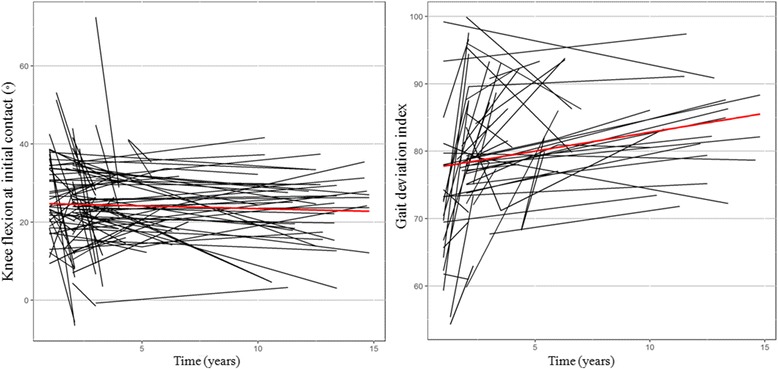
Results: We found significant improvements in knee flexion at initial contact, minimum knee flexion in the stance phase, knee ROM, and GDI score 2 years after DHL. In patients with GMFCS level I and II, improvement in all sagittal knee kinematics was maintained during follow-up. In addition, GDI score, which represents overall gait pathology, consistently improved throughout the follow-up duration (1.2 per year, p = 0.008).
Conclusion: Medial hamstring lengthening with semitendinosus transfer, as a part of a SEMLS, was effective procedure in treating flexed knee gait with regard to sagittal knee kinematics and GDI score in spastic CP with flexed knee gait.
Keywords: Cerebral palsy; Distal hamstring lengthening; Flexed knee gait.
Conflict of interest statement
Ethics approval and consent to participate
This retrospective study was approved by the institutional review board of our hospital (B-1308/216–115), and informed consent was waived owing to the retrospective nature of the study.
Consent for publication
Not applicable.
Competing interests
The authors declare that they have no competing interests.
Publisher’s Note
Springer Nature remains neutral with regard to jurisdictional claims in published maps and institutional affiliations.
Figures


References
-
- Wren TA, Rethlefsen S, Kay RM. Prevalence of specific gait abnormalities in children with cerebral palsy: influence of cerebral palsy subtype, age, and previous surgery. J Pediatr Orthop. 2005;25:79–83. - PubMed
-
- Kay RM, Rethlefsen SA, Skaggs D, Leet A. Outcome of medial versus combined medial and lateral hamstring lengthening surgery in cerebral palsy. J Pediatr Orthop. 2002;22:169–172. - PubMed
MeSH terms
LinkOut - more resources
Full Text Sources
Other Literature Sources
Medical
Miscellaneous
