


Successful intravenous thrombolysis for ischemic stroke after reversal of dabigatran anticoagulation with idarucizumab: a case report
- PMID: 28806993
- PMCID: PMC5557536
- DOI: 10.1186/s13256-017-1404-2
Successful intravenous thrombolysis for ischemic stroke after reversal of dabigatran anticoagulation with idarucizumab: a case report
Abstract
Background: Non-vitamin K antagonist oral anticoagulants, including dabigatran, are currently widely used for the prevention of stroke and systemic embolism in patients with non-valvular atrial fibrillation. Recently, idarucizumab, a monoclonal antibody fragment for immediate reversal of dabigatran-induced anticoagulation, has been introduced into the market to be used in life-threatening bleeding or urgent surgery, allowing for rapid normalization of clotting parameters. The use of idarucizumab is not yet well established in patients presenting with acute ischemic stroke on dabigatran who are candidates for thrombolytic therapy.
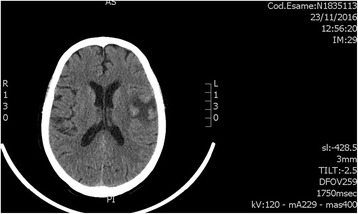
Case presentation: We report the case of a 71-year-old hypertensive Caucasian woman with non-valvular atrial fibrillation treated with dabigatran 150 mg twice daily, who presented with acute ischemic stroke causing right-sided hemiparesis and aphasia. Two hours after presentation to the emergency department, a decision was made to administer idarucizumab for achieving complete reversal of any potential anticoagulant effect of dabigatran and, in the absence of any contraindications, our patient underwent successful thrombolysis. At discharge, our patient was able to walk unassisted and had only residual aphasia. Twenty days later, she had completely recovered motor function of her right side, with further progressive improvement of aphasia. Repeat cranial computed tomography confirmed the absence of hemorrhage, and anticoagulant therapy with dabigatran 150 mg twice daily was resumed.
Conclusions: Our case report adds to the evidence that idarucizumab administration is safe in the setting of patients with atrial fibrillation treated with dabigatran who develop acute ischemic stroke requiring thrombolysis.
Keywords: Dabigatran; Idarucizumab; Ischemic stroke; Non-vitamin K antagonist oral anticoagulants; Thrombolysis.
Conflict of interest statement
Ethics approval and consent to participate
Not applicable.
Consent for publication
Written informed consent was obtained from the patient for publication of this case report and any accompanying images. A copy of the written consent is available for review by the Editor-in-Chief of this journal.
Competing interests
SA has received speaker honoraria from Boehringer Ingelheim, Pfizer, Bayer, Bristol-Myers Squibb, and Daiichi Sankyo. LC has received speaker honoraria from Boehringer Ingelheim, Pfizer, and Bristol-Myers Squibb. GZ has received a speaker honorarium from Boehringer Ingelheim, and Bayer. ER and ER declare that they have no conflict of interest.
Publisher’s Note
Springer Nature remains neutral with regard to jurisdictional claims in published maps and institutional affiliations.
Figures
References
-
- Kumar S, Danik SB, Altman RK, Barrett CD, Lip GY, Chatterjee S, et al. Non-vitamin K antagonist oral anticoagulants and antiplatelet therapy for stroke prevention in patients with atrial fibrillation: a meta-analysis of randomized controlled trials. Cardiol Rev. 2016;24:218–23. doi: 10.1097/CRD.0000000000000088. - DOI - PubMed
Publication types
MeSH terms
Substances
LinkOut - more resources
Full Text Sources
Other Literature Sources
Medical
