. 2017 Oct 1;77(19):5339-5348.
doi: 10.1158/0008-5472.CAN-16-3410. Epub 2017 Aug 14.

Chromatin-Associated Protein SIN3B Prevents Prostate Cancer Progression by Inducing Senescence

Affiliations

Chromatin-Associated Protein SIN3B Prevents Prostate Cancer Progression by Inducing Senescence

Anthony J Bainor et al. Cancer Res. .

Abstract

Distinguishing between indolent and aggressive prostate adenocarcinoma remains a priority to accurately identify patients who need therapeutic intervention. SIN3B has been implicated in the initiation of senescence in vitro Here we show that in a mouse model of prostate cancer, SIN3B provides a barrier to malignant progression. SIN3B was required for PTEN-induced cellular senescence and prevented progression to invasive prostate adenocarcinoma. Furthermore, SIN3B was downregulated in human prostate adenocarcinoma correlating with upregulation of its target genes. Our results suggest a tumor suppressor function for SIN3B that limits prostate adenocarcinoma progression, with potential implications for the use of SIN3B and its target genes as candidate diagnostic markers to distinguish indolent from aggressive disease. Cancer Res; 77(19); 5339-48. ©2017 AACR.


Conflict of interest statement

Conflict of Interest: The authors declare no potential conflicts of interest.

Figures
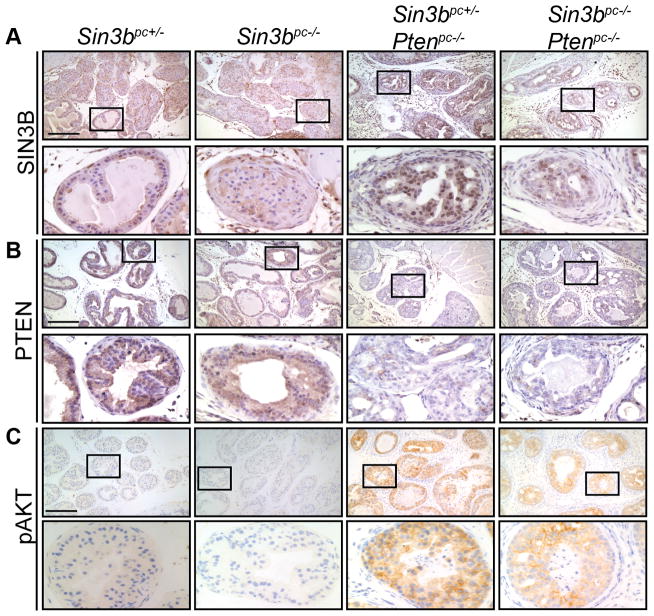
Figure 1
Figure 1
Deletion of Sin3b does not impair loss of PTEN-driven AKT activation. A, Representative images of immunohistochemistry for SIN3B on paraffin sections of the dorsolateral lobe of prostates taken from three-month-old Sin3bpc+/−, Sin3bpc−/−, Sin3bpc+/− Ptenpc−/−, and Sin3bpc−/− Ptenpc−/− mice. B, PTEN. C, pAKT. Top Panel = 10× magnification. Bottom Panel = 40× magnification. Scale bar = 200 μm. n = 3 for each genotype.
Figure 2
Figure 2
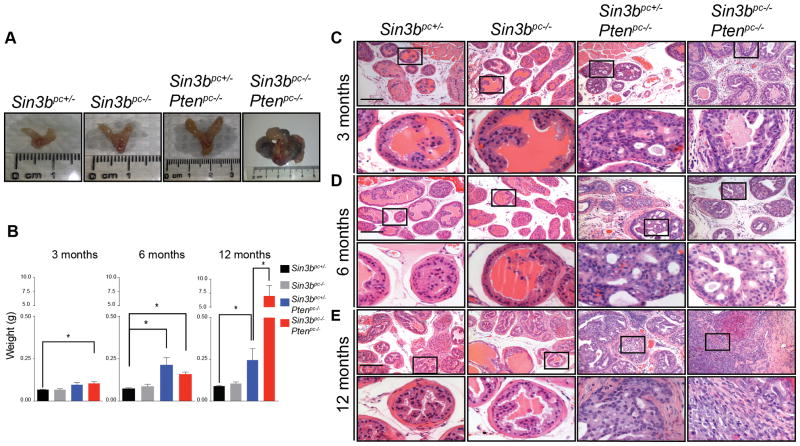
SIN3B prevents Pten deletion-induced prostate cancer. A, Representative images of prostates taken from twelve-month-old Sin3bpc+/−, Sin3bpc−/−, Sin3bpc+/− Ptenpc−/−, and Sin3bpc−/− Ptenpc−/− mice. n = 4, 5, 8, 7 respectively. B, Weight in grams of whole prostates taken from three, six and twelve month-old Sin3bpc+/− (n = 5, 4, 5), Sin3bpc−/− (n = 4, 4, 5), Sin3bpc+/− Ptenpc−/− (n = 10, 6, 8), and Sin3bpc−/− Ptenpc−/− (n = 9, 10, 7) mice, respectively. * p<0.05 via student’s t-test. C–E, Representative images of H&E staining on paraffin sections of the dorsolateral lobe of prostates taken from three-, six-, and twelve-month-old Sin3bpc+/− (n = 5, 4, 5), Sin3bpc−/− (n = 4, 4, 5), Sin3bpc+/− Ptenpc−/− (n = 10, 6, 8), and Sin3bpc−/− Ptenpc−/− (n = 9, 10, 7) mice, respectively. Top Panel = 10× magnification. Bottom Panel = 40× magnification. Scale bar = 200 μm.
Figure 3
Figure 3
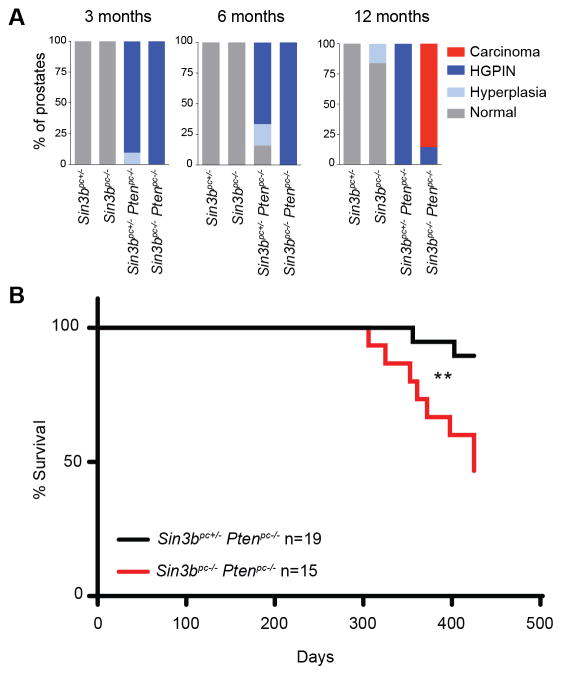
Loss of Sin3b-induced PCa is lethal and occurs late in life. A, Kaplan-Meier survival curve of Sin3bpc+/− Ptenpc−/− (black, n = 19) and Sin3bpc−/− Ptenpc−/− (red, n = 15) mice. ** p=0.0065. B, Quantification of pathological scoring conducted using H&E stained sections taken from three, six, and twelve-month-old Sin3bpc+/− (n = 5, 4, 4), Sin3bpc−/− (n = 4, 4, 5), Sin3bpc+/− Ptenpc−/− (n = 10, 6, 8), and Sin3bpc−/− Ptenpc−/− (n = 9, 10, 7) mice, respectively.
Figure 4
Figure 4
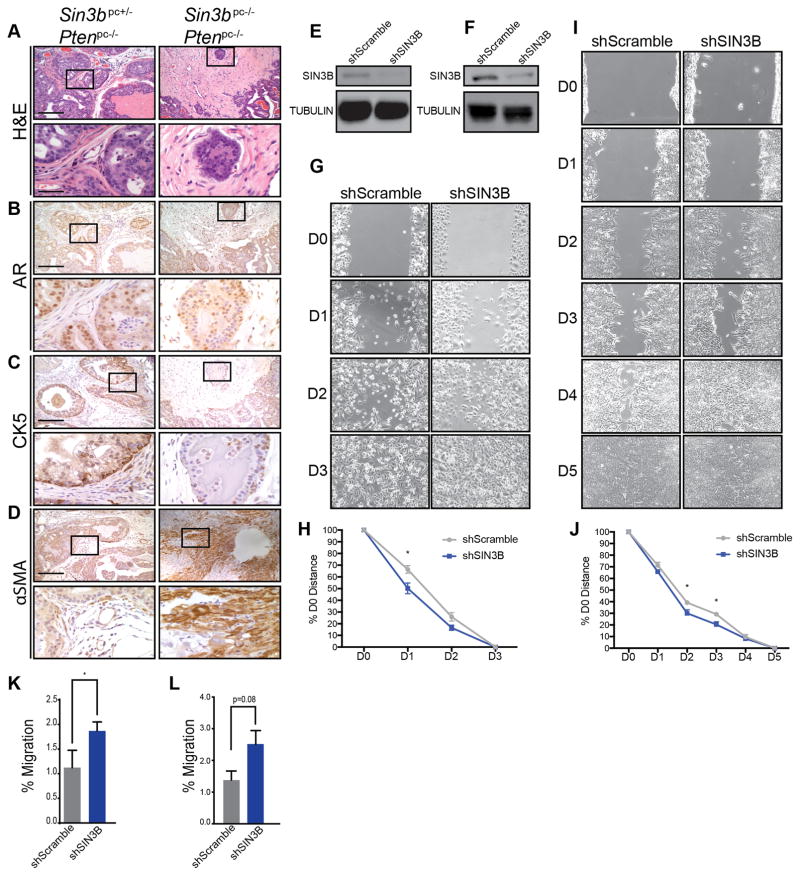
SIN3B protects against aggressive PCa. A, Representative images of H&E staining on paraffin sections of the dorsolateral lobe of prostates taken from 12-month-old Sin3bpc+/− Ptenpc−/− (n = 8) and Sin3bpc−/− Ptenpc−/− (n = 7) mice. B, Immunohistochemistry for AR on serial paraffin sections of the dorsolateral lobe of prostates taken from twelve-month-old Sin3bpc+/− Ptenpc−/− mice (n = 3) and Sin3bpc−/− Ptenpc−/− (n = 3) mice. C, Immunohistochemistry for CK5 on serial paraffin sections of the dorsolateral lobe of prostates taken from twelve-month-old Sin3bpc+/− Ptenpc−/− (n = 3) and Sin3bpc−/− Ptenpc−/− (n = 3) mice. Top Panel = 10× magnification. Bottom Panel = 40× magnification. Scale bar = 200 μm. D, Immunohistochemistry for αSMA on paraffin sections of the dorsolateral lobe of prostates taken from twelve-month-old Sin3bpc+/− Ptenpc−/− (n = 3) and Sin3bpc−/− Ptenpc−/− (n = 3) mice. Top Panel = 10× magnification. Bottom Panel = 40× magnification. Scale bar = 200 μm. E, Immunoblot analysis for SIN3B and TUBULIN using 40 μg of whole cell extracts from PC3 cells stably transduced with either shRNA against Scramble or SIN3B. F, Immunoblot analysis for SIN3B and TUBULIN using 40 μg of whole cell extracts from LNCaP C4-2 cells stably transduced with either shRNA against Scramble or SIN3B. G, Scratch assay using cells lines in E. D0–3 represent days post scratch. H, Quantification of G. n=3, student’s t-test was used to assess significance at each time point. * p<0.05. I, Scratch assay using cells lines in F. D0–5 represent days post scratch. J, Quantification of I. n=3, student’s t-test was used to assess significance at each time point. * p<0.05. K, Transwell migration assay using cell lines in E. Average±SEM of n = 3 experiments. Student’s t-test was used to assess significance. * p<0.05. L, Transwell migration assay using cell lines in F. Average±SEM of n = 3 experiments. Student’s t-test was used to assess significance. P=0.08, NS.
Figure 5
Figure 5
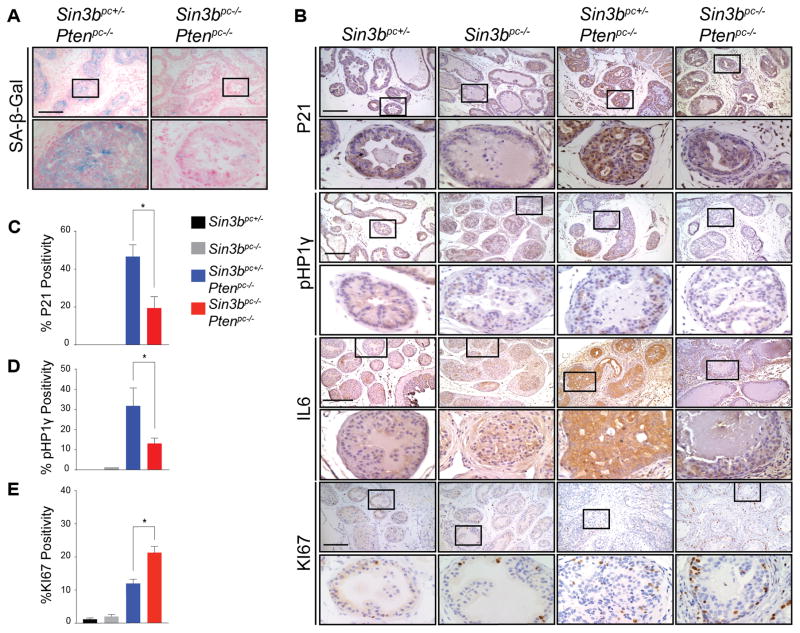
SIN3B is required for PICS. A, Representative images of SA-β-Gal on fresh-frozen sections of the dorsolateral lobe of prostates taken from three-month-old Sin3bpc+/− Ptenpc−/−, and Sin3bpc−/− Ptenpc−/− mice. n = 2, 3 respectively. B, Representative images of immunohistochemistry for KI67, P21, pHP1γ, and IL6 on paraffin sections of the dorsolateral lobe of prostates taken from three-month-old Sin3bpc+/−, Sin3bpc−/−, Sin3bpc+/− Ptenpc−/−, and Sin3bpc−/− Ptenpc−/− mice. n = 3 each. Top Panel = 10× magnification. Bottom Panel = 40× magnification. Scale bar = 200 μm. C, Quantification of KI67 positive nuclei. n = 3, 3, 5, 5 respectively. Student’s t-test was used to assess significance. * p<0.05. D, P21. n = 3, 3, 4, 5 respectively. E, pHP1γ. n = 3, 3, 5, 6 respectively.
Figure 6
Figure 6
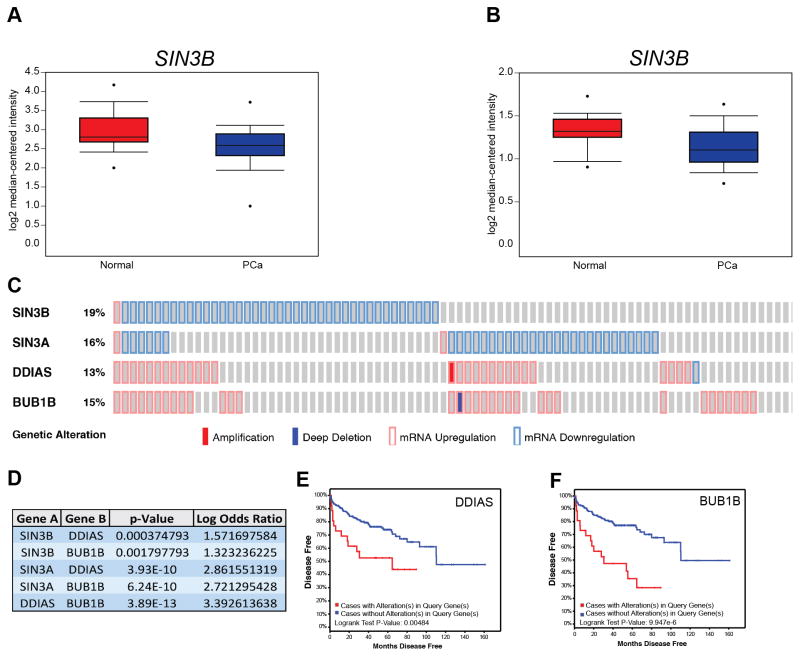
The SIN3B complex is differentially regulated in human PCa. A and B, Oncomine box and whisker plots of SIN3B expression in normal and PCa human samples. A was derived from the study in (23) B was derived from the study in (24). Both plots have p-values < 0.05. C, Oncoprint plot of SIN3B and SIN3A, and their target genes DDIAS and BUB1B derived from cBioPortal using the study in reference (23,25,26). Amplification = filled red box, Deep Deletion = filled blue box, mRNA Upregulation = red outline, mRNA Downregulation = blue outline. D, Statistical analysis of the co-occurrence between the genes listed in C. E, Disease-free survival Kaplan-Meier curve of patients harboring DDIAS upregulation > 2 standard deviations derived using cBioPortal and the study in reference (23,25,26). F, Disease-free survival Kaplan-Meier curve of patients harboring BUB1B upregulation > 2 standard deviations derived using cBioPortal and the study in reference (23,25,26).

References

    1. Siegel R, Ward E, Brawley O, Jemal A. Cancer statistics, 2011: the impact of eliminating socioeconomic and racial disparities on premature cancer deaths. CA Cancer J Clin. 2011;61:212–36. - PubMed
    1. Hoffman RM. Clinical practice. Screening for prostate cancer. N Engl J Med. 2011;365:2013–9. - PubMed
    1. Schroder FH, Hugosson J, Roobol MJ, Tammela TL, Ciatto S, Nelen V, et al. Screening and prostate-cancer mortality in a randomized European study. N Engl J Med. 2009;360:1320–8. - PubMed
    1. Sartor AO, Hricak H, Wheeler TM, Coleman J, Penson DF, Carroll PR, et al. Evaluating localized prostate cancer and identifying candidates for focal therapy. Urology. 2008;72:S12–24. - PubMed
    1. DiMauro T, David G. Ras-induced Senescence and its Physiological Relevance in Cancer. Current Cancer Drug Targets. 2010 In Press. - PMC - PubMed

Publication types

MeSH terms