


Early photosynthetic eukaryotes inhabited low-salinity habitats
- PMID: 28808007
- PMCID: PMC5603991
- DOI: 10.1073/pnas.1620089114
Early photosynthetic eukaryotes inhabited low-salinity habitats
Abstract
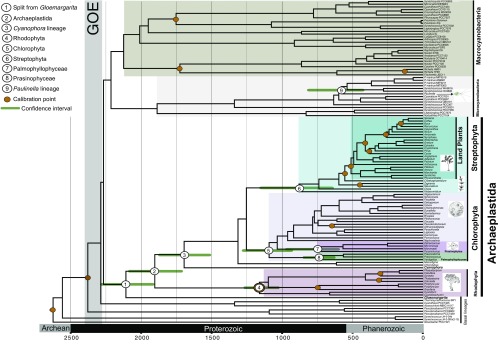
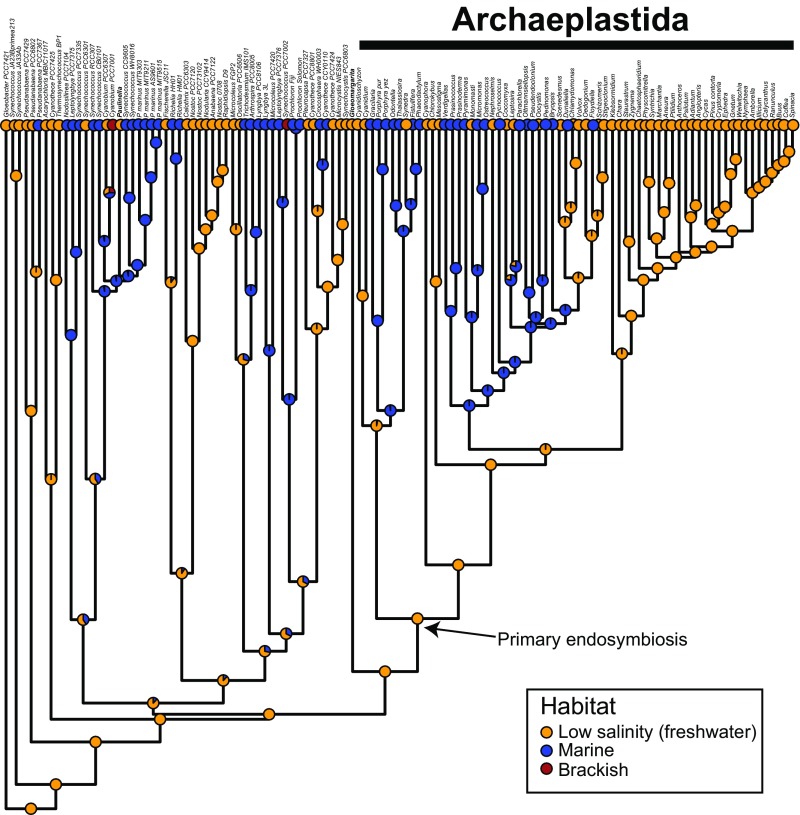
The early evolutionary history of the chloroplast lineage remains an open question. It is widely accepted that the endosymbiosis that established the chloroplast lineage in eukaryotes can be traced back to a single event, in which a cyanobacterium was incorporated into a protistan host. It is still unclear, however, which Cyanobacteria are most closely related to the chloroplast, when the plastid lineage first evolved, and in what habitats this endosymbiotic event occurred. We present phylogenomic and molecular clock analyses, including data from cyanobacterial and chloroplast genomes using a Bayesian approach, with the aim of estimating the age for the primary endosymbiotic event, the ages of crown groups for photosynthetic eukaryotes, and the independent incorporation of a cyanobacterial endosymbiont by Paulinella Our analyses include both broad taxon sampling (119 taxa) and 18 fossil calibrations across all Cyanobacteria and photosynthetic eukaryotes. Phylogenomic analyses support the hypothesis that the chloroplast lineage diverged from its closet relative Gloeomargarita, a basal cyanobacterial lineage, ∼2.1 billion y ago (Bya). Our analyses suggest that the Archaeplastida, consisting of glaucophytes, red algae, green algae, and land plants, share a common ancestor that lived ∼1.9 Bya. Whereas crown group Rhodophyta evolved in the Mesoproterozoic Era (1,600-1,000 Mya), crown groups Chlorophyta and Streptophyta began to radiate early in the Neoproterozoic (1,000-542 Mya). Stochastic mapping analyses indicate that the first endosymbiotic event occurred in low-salinity environments. Both red and green algae colonized marine environments early in their histories, with prasinophyte green phytoplankton diversifying 850-650 Mya.
Keywords: Cyanobacteria; chloroplast; photosynthetic eukaryotes; phylogenomics; relaxed molecular clock.
Conflict of interest statement
The authors declare no conflict of interest.
Figures


Comment in
-
Hold the salt: Freshwater origin of primary plastids.Proc Natl Acad Sci U S A. 2017 Sep 12;114(37):9759-9760. doi: 10.1073/pnas.1712956114. Epub 2017 Aug 31. Proc Natl Acad Sci U S A. 2017. PMID: 28860199 Free PMC article. No abstract available.
-
Reply to Nakov et al.: Model choice requires biological insight when studying the ancestral habitat of photosynthetic eukaryotes.Proc Natl Acad Sci U S A. 2017 Dec 12;114(50):E10608-E10609. doi: 10.1073/pnas.1717417114. Epub 2017 Dec 5. Proc Natl Acad Sci U S A. 2017. PMID: 29208724 Free PMC article. No abstract available.
-
Models with unequal transition rates favor marine origins of Cyanobacteria and photosynthetic eukaryotes.Proc Natl Acad Sci U S A. 2017 Dec 12;114(50):E10606-E10607. doi: 10.1073/pnas.1716692114. Epub 2017 Dec 5. Proc Natl Acad Sci U S A. 2017. PMID: 29208725 Free PMC article. No abstract available.
References
Publication types
MeSH terms
Associated data
LinkOut - more resources
Full Text Sources
Other Literature Sources
