. 2017 Aug 14;7(1):8035.
doi: 10.1038/s41598-017-08142-3.

Carotid Body-Mediated Chemoreflex Drive in The Setting of low and High Output Heart Failure

Affiliations

Carotid Body-Mediated Chemoreflex Drive in The Setting of low and High Output Heart Failure

Rodrigo Del Rio et al. Sci Rep. .

Abstract

Enhanced carotid body (CB) chemoreflex function is strongly related to cardiorespiratory disorders and disease progression in heart failure (HF). The mechanisms underlying CB sensitization during HF are not fully understood, however previous work indicates blood flow per se can affect CB function. Then, we hypothesized that the CB-mediated chemoreflex drive will be enhanced only in low output HF but not in high output HF. Myocardial infarcted rats and aorto-caval fistulated rats were used as a low output HF model (MI-CHF) and as a high output HF model (AV-CHF), respectively. Blood flow supply to the CB region was decreased only in MI-CHF rats compared to Sham and AV-CHF rats. MI-CHF rats exhibited a significantly enhanced hypoxic ventilatory response compared to AV-CHF rats. However, apnea/hypopnea incidence was similarly increased in both MI-CHF and AV-CHF rats compared to control. Kruppel-like factor 2 expression, a flow sensitive transcription factor, was reduced in the CBs of MI-CHF rats but not in AV-CHF rats. Our results indicate that in the setting of HF, potentiation of the CB chemoreflex is strongly associated with a reduction in cardiac output and may not be related to other pathophysiological consequences of HF.


Conflict of interest statement

The authors declare that they have no competing interests.

Figures
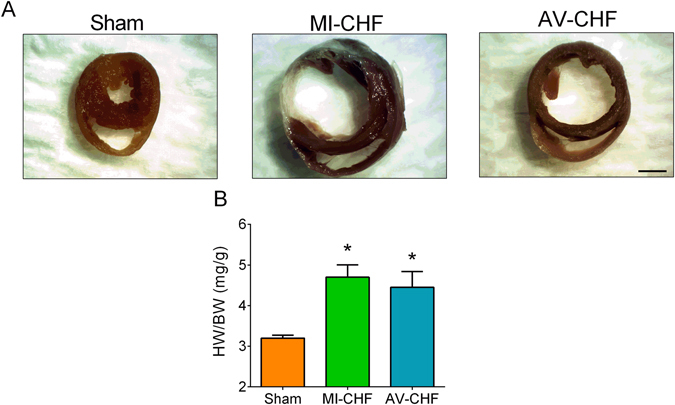
Figure 1
Figure 1
Rats with myocardial infarction (MI-CHF) and arteriovenous fistula (AV-CHF) have similar degrees of cardiac hypertrophy. (A) Representative images of hearts obtained in one Sham rat, one rat with MI-CHF and one rat with AV-CHF. Note the large ventricular dilation in both MI-CHF and AV-CHF vs. Sham condition. (B) Cardiac hypertrophy (heart weight/body weight [HW/BW]) was evident in both MI-CHF and AV-CHF rats compared to Sham rats. *p < 0.05 vs. Sham condition, Sidak post-hoc test after one-way ANOVA, n = 6 rats.
Figure 2
Figure 2
Carotid artery blood flow in low output and high output heart failure. (A) Representative traces of carotid artery blood flow, assessed by Doppler at rest in one Sham rat, one MI-CHF rat and one AV-CHF rat. (B) Summary data showing carotid artery blood flow. Note that blood flow to the CB region was significantly reduced in MI-CHF vs. Sham. Also note that AV-CHF rats display similar blood flow values compared to Sham rats. *p < 0.05 vs. Sham; +p < 0.05 vs. AV-CHF condition, Sidak post-hoc test after one-way ANOVA, n = 6 rats.
Figure 3
Figure 3
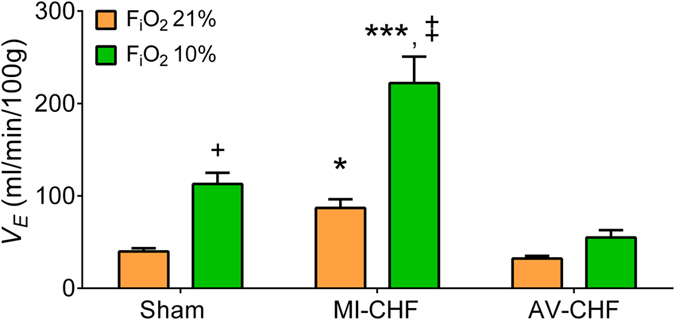
Carotid body-mediated chemoreflex function in heart failure rats. The hypoxic ventilatory response was increased in MI-CHF rats compared to Sham condition. However, in AV-CHF the peripheral chemoreflex ventilatory response to acute hypoxic stimulation was blunted. ***p < 0.001 vs. Sham; *p < 0.05 vs. Sham; +p < 0.001 vs. AV-CHF; and +p < 0.05 vs. AV-CHF, Sidak post-hoc test after one-way ANOVA, n = 6 rats.
Figure 4
Figure 4
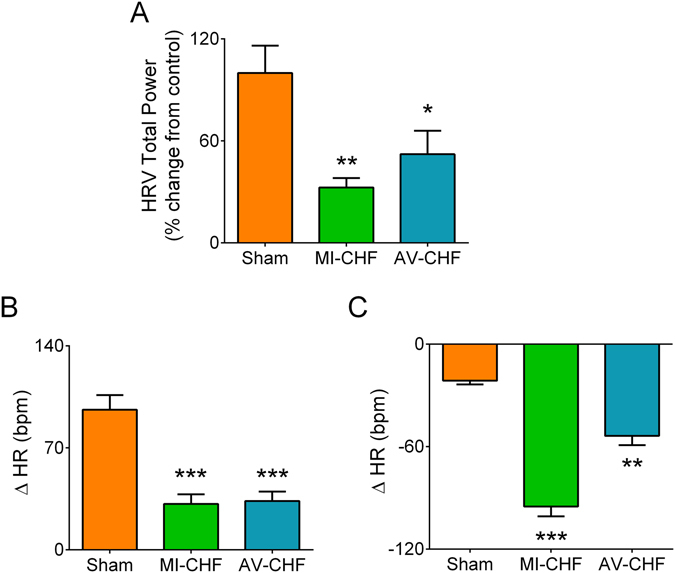
Myocardial infarction (MI-CHF) and arteriovenous fistula (AV-CHF) rats display autonomic imbalance. (A) The total power of heart rate variability (HRV) was decreased in MI-CHF and AV-CHF vs. Sham condition. (B) MI-CHF and AV-CHF rats display cardiac parasympathetic withdrawal and enhanced sympathetic cardiac tone as evidenced by a decreased tachycardic response (ΔHR) following i.p. bolus of atropine (1 mg/kg) and an increased bradycardic response (C) following propranolol (1 mg/kg, i.p.), respectively. ***p < 0.001, **p < 0.01 and *p < 0.05 vs. Sham condition, Sidak post-hoc test after one-away ANOVA, n = 4 rats.
Figure 5
Figure 5
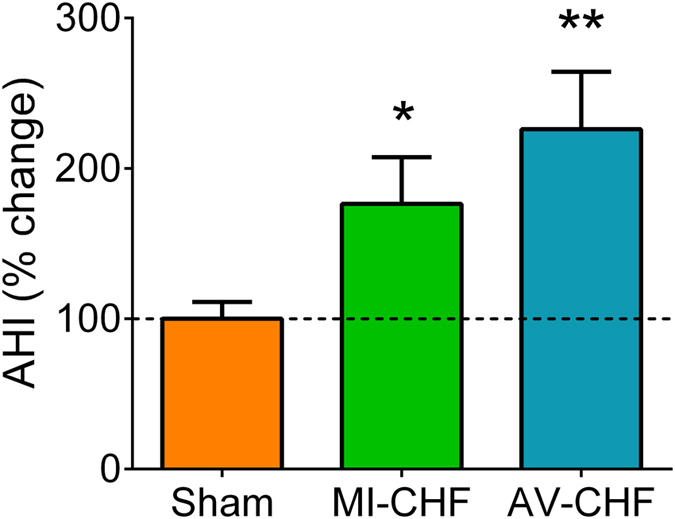
Incidence of apnea-hypopnea in rats with low output heart failure (MI-CHF) and high output heart failure (AV-CHF). The apnea-hypopnea index (AHI) was increased in both MI and AV CHF rats vs. Sham condition. **p < 0.01 and *p < 0.05 vs. Sham condition, Sidak post-hoc test after one-way ANOVA, n = 6 rats.
Figure 6
Figure 6
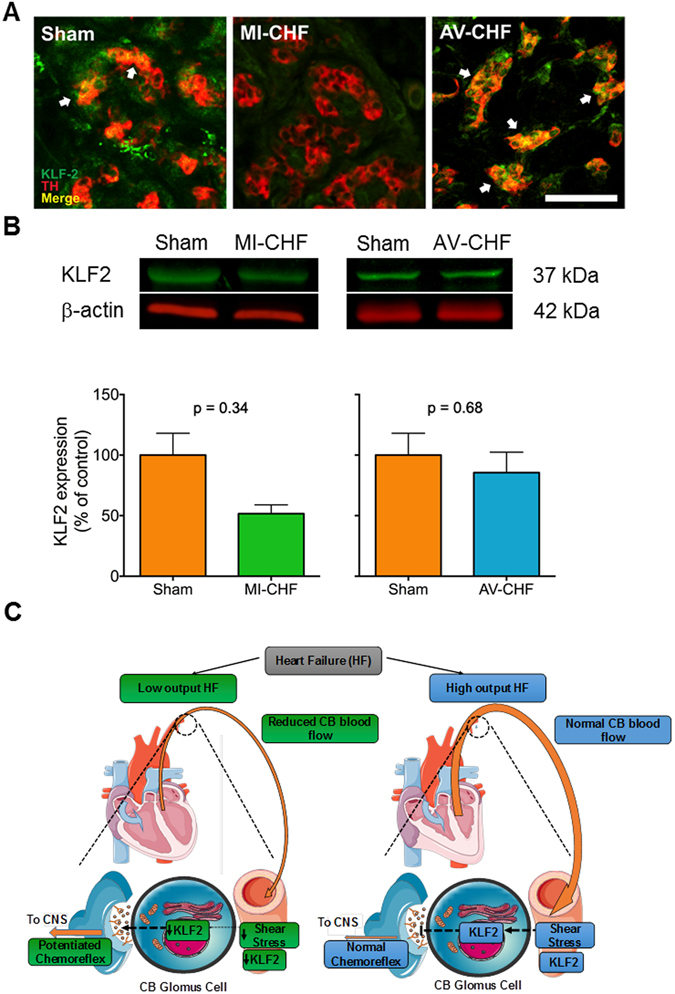
Krüppel-like factor 2 (KLF2) expression is reduced in myocardial infarction (MI-CHF) but normal in arteriovenous fistula (AV-CHF) rats. (A) Fluorescence intensity for KLF2 in the CB from MI-CHF was markedly decreased compared to Sham rats. Notably, AV-CHF rats showed similar KLF2 average fluorescence in the CB compared to Sham rats. (B) Representative immunoblots for KLF2 obtained in one Sham rat, one MI-CHF rat and one AV-CHF rat and summary data showing the changes in the expression levels of KFL2 in MI-CHF and in AV-CHF (p = 0.34, Sham vs. MI-CHF; p = 0.68, Sham vs. AV-CHF; Wilcoxon sum-rank test, n = 4). (C) Proposed model showing the role of blood flow in CB sensitization in low vs high output heart failure. MI-CHF rats display reduced blood flow to the CB that leads to a decreased expression of shear stress-sensitive transcription factors (i.e. KLF2) promoting CB glomus cells hyperactivity and finally ending in an enhanced chemoreflex drive. On the contrary, AV-CHF rats display normal blood flow to the CB with no changes in KLF2 expression and normal CB-mediated chemoreflex drive. Dotted lines: extrapolation of the carotid circulation to the carotid bodies.

References

    1. Remme WJ, Swedberg K, Task Force for the D, Treatment of Chronic Heart Failure ESoC. Guidelines for the diagnosis and treatment of chronic heart failure. Eur Heart J. 2001;22:1527–1560. doi: 10.1053/euhj.2001.2783. - DOI - PubMed
    1. Ambrosy AP, et al. The global health and economic burden of hospitalizations for heart failure: lessons learned from hospitalized heart failure registries. J Am Coll Cardiol. 2014;63:1123–1133. doi: 10.1016/j.jacc.2013.11.053. - DOI - PubMed
    1. Swedberg K, et al. Guidelines for the diagnosis and treatment of chronic heart failure: executive summary (update 2005): The Task Force for the Diagnosis and Treatment of Chronic Heart Failure of the European Society of Cardiology. Eur Heart J. 2005;26:1115–1140. doi: 10.1093/eurheartj/ehi166. - DOI - PubMed
    1. Esler M. The 2009 Carl Ludwig Lecture: Pathophysiology of the human sympathetic nervous system in cardiovascular diseases: the transition from mechanisms to medical management. Journal of applied physiology. 2010;108:227–237. doi: 10.1152/japplphysiol.00832.2009. - DOI - PubMed
    1. Ponikowski P, et al. Peripheral chemoreceptor hypersensitivity: an ominous sign in patients with chronic heart failure. Circulation. 2001;104:544–549. doi: 10.1161/hc3101.093699. - DOI - PubMed

Publication types

Substances