


Comparison of the Penetration Depth of Conventional and Nano-Particle Calcium Hydroxide into Dentinal Tubules
- PMID: 28808467
- PMCID: PMC5527216
- DOI: 10.22037/iej.v12i3.16421
Comparison of the Penetration Depth of Conventional and Nano-Particle Calcium Hydroxide into Dentinal Tubules
Abstract
Introduction: The aim of this in vitro study was to evaluate and compare the penetration depth of conventional (CH) and nano-particle calcium hydroxide (NCH) into dentinal tubules.
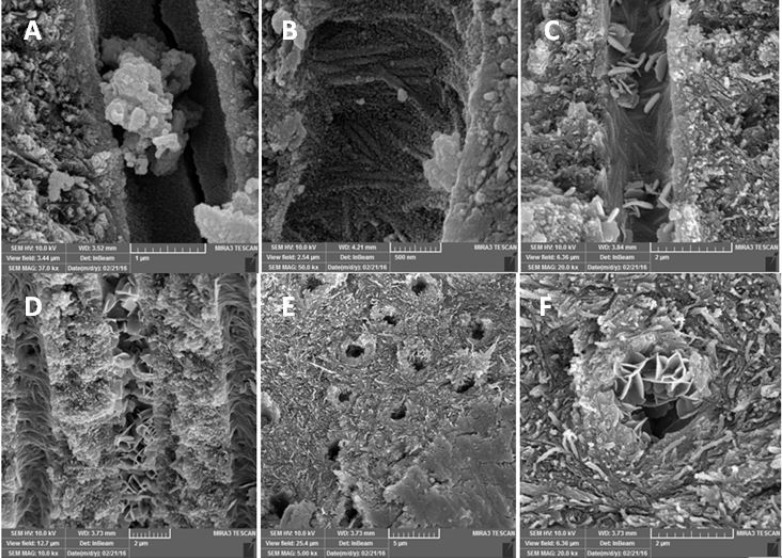
Methods and materials: Ninety human single-rooted teeth were instrumented by RaCe rotary system and after chemomechanical preparation were randomly divided in two equal groups (n=45). In the first group conventional CH and in the other NCH was used as intracanal medicament. After 2 weeks of incubation all roots were intentionally split at longitudinal axis and prepared for scanning electron microscope (SEM) observation. Three zones of each root, coronal, middle and apical were examined under SEM and the maximum penetration depth of the dressing material into dentinal tubules was recorded for each zone. Data were analyzed using the independent sample t test and the level of significance was set at 0.05.
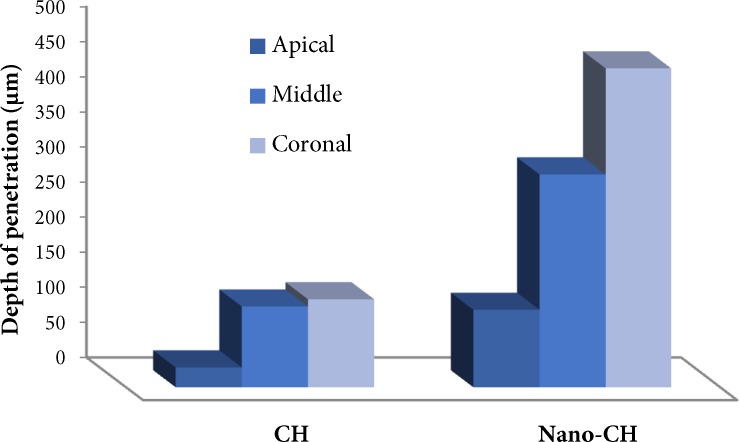
Results: In all of the three zones, NCH group had greater penetration depth than CH (P<0.001). In both groups the penetration depth increased from the apical section to the coronal.
Conclusion: The depth of penetration of nano-particle calcium hydroxide into the dentinal tubules was significantly higher than that of conventional calcium hydroxide. The lowest penetration depth was observed in apical zone in both groups.
Keywords: Calcium Hydroxide; Dentinal Tubules; Nano Particle; Penetration Depth; Tubular Penetration.
Conflict of interest statement
‘None declared’.
Figures
References
-
- Nair P. On the causes of persistent apical periodontitis: a review. Int Endod J. 2006;39(4):249–81. - PubMed
-
- Fava L, Saunders W. Calcium hydroxide pastes: classification and clinical indications. Int Endod J. 1999;32(4):257–82. - PubMed
-
- Byström A, Claesson R, Sundqvist G. The antibacterial effect of camphorated paramonochlorophenol, camphorated phenol and calcium hydroxide in the treatment of infected root canals. Dent Traumatol. 1985;1(5):170–5. - PubMed
LinkOut - more resources
Full Text Sources