


The relationship between male sexual signals, cognitive performance, and mating success in stickleback fish
- PMID: 28808542
- PMCID: PMC5551085
- DOI: 10.1002/ece3.3091
The relationship between male sexual signals, cognitive performance, and mating success in stickleback fish
Abstract
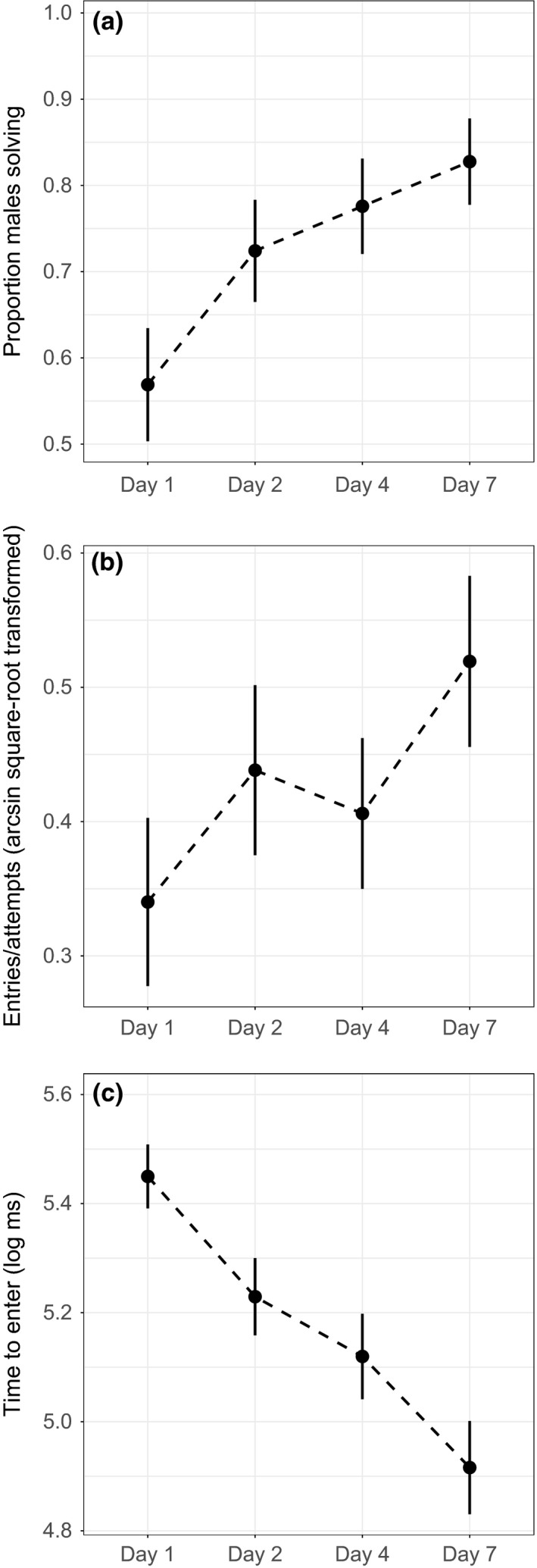
Cognitive ability varies dramatically among individuals, yet the manner in which this variation correlates with reproduction has rarely been investigated. Here, we ask (1) do male sexual signals reflect their cognitive ability, and (2) is cognitive ability associated with male mating success? Specifically, we presented threespine sticklebacks (Gasterosteus aculeatus) with a detour-reaching task to assess initial inhibitory control. Fish that performed better were those who solved the detour-reaching task, solved it faster, and required fewer attempts to solve. We then reexamined males' performance on this task over several days to assess learning ability in this context. We next measured sexual signals (coloration, nest area, and courtship vigor) and asked whether they reveal information about these male cognitive abilities. Finally, we examined whether success at attracting a female is associated with male cognition. After controlling for the strong effect of neophobia, we found that no measured sexual signals were associated with initial inhibitory control. Sexual signals were also not associated with change in performance on the detour-reaching task over time (learning). However, females preferred mating with males who had better initial inhibitory control. We speculate that inhibitory control is a critical trait for male sticklebacks. In this system, males perform all parental care, but must avoid eating their own fry which closely resemble their prey items. Therefore, males with better inhibitory control may be more likely to successfully raise their offspring to independence. Our research adds to a growing list of mating systems and taxa in which cognition is important for measures related to fitness.
Keywords: cognition; detour‐reaching task; female choice; inhibitory control; learning; sexual selection; sexual signal; threespine stickleback.
Figures


References
-
- Albert, A. Y. K. , Millar, N. P. , & Schluter, D. (2007). Character displacement of male nuptial colour in threespine sticklebacks (Gasterosteus aculeatus) . Biological Journal of the Linnean Society, 91, 37–48.
-
- Amici, F. , Aureli, F. , & Call, J. (2008). Fission‐fusion dynamics, behavioral flexibility, and inhibitory control in primates. Current Biology, 18, 1415–1419. https://doi.org/10.1016/j.cub.2008.08.020 - DOI - PubMed
-
- Anderson, R. C. , Searcy, W. A. , Peters, S. , Hughes, M. , DuBois, A. L. , & Nowicki, S. (2016). Song learning and cognitive ability are not consistently related in a songbird. Animal Cognition, 20, 309–320. - PubMed
-
- Bates, D. , Maechler, M. , Bolker, B. , & Walker, S. (2013). Lme4: Linear Mixed‐Effects Models Using Eigen and S4. R Package Version 1.0‐5. Retrieved from http://CRAN.R-project.org/package=lme4/ (last accessed 17 November 2016).
Associated data
LinkOut - more resources
Full Text Sources
Other Literature Sources
Molecular Biology Databases
