


Plasma metabolite abundances are associated with urinary enterolactone excretion in healthy participants on controlled diets
- PMID: 28808723
- PMCID: PMC5607107
- DOI: 10.1039/c7fo00684e
Plasma metabolite abundances are associated with urinary enterolactone excretion in healthy participants on controlled diets
Abstract
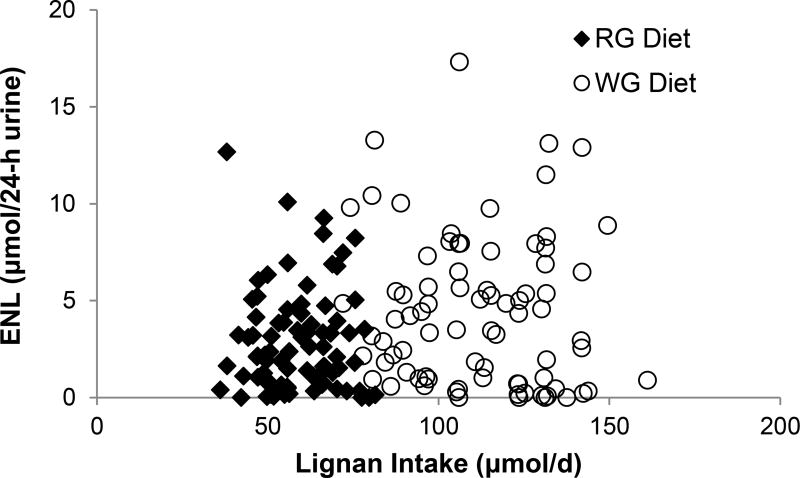
Enterolignans, products of gut bacterial metabolism of plant lignans, have been associated with reduced risk of chronic diseases, but their association with other plasma metabolites is unknown. We examined plasma metabolite profiles according to urinary enterolignan excretion in a cross-sectional analysis using data from a randomized crossover, controlled feeding study. Eighty healthy adult males and females completed two 28-day feeding periods differing by glycemic load, refined carbohydrate, and fiber content. Lignan intake was calculated from food records using a polyphenol database. Targeted metabolomics was performed by LC-MS on plasma from fasting blood samples collected at the end of each feeding period. Enterolactone (ENL) and enterodiol, were measured in 24 h urine samples collected on the penultimate day of each study period using GC-MS. Linear mixed models were used to test the association between enterolignan excretion and metabolite abundances. Pathway analyses were conducted using the Global Test. Benjamini-Hochberg false discovery rate (FDR) was used to control for multiple testing. Of the metabolites assayed, 121 were detected in all samples. ENL excretion was associated positively with plasma hippuric acid and melatonin, and inversely with epinephrine, creatine, glycochenodeoxycholate, and glyceraldehyde (P < 0.05). Hippuric acid only satisfied the FDR of q < 0.1. END excretion was associated with myristic acid and glycine (q < 0.5). Two of 57 pathways tested were associated significantly with ENL, ubiquinone and terpenoid-quinone biosynthesis, and inositol phosphate metabolism. These results suggest a potential role for ENL or ENL-metabolizing gut bacteria in regulating plasma metabolites.
Conflict of interest statement
The authors have no conflicts of interest to declare.
Figures
References
-
- Adolphe JL, Whiting SJ, Juurlink BH, Thorpe LU, Alcorn J. Health effects with consumption of the flax lignan secoisolariciresinol diglucoside. Br J Nutr. 2010;103(7):929–38. - PubMed
-
- Webb AL, McCullough ML. Dietary lignans: potential role in cancer prevention. Nutr Cancer. 2005;51(2):117–31. - PubMed
-
- Axelson M, Sjovall J, Gustafsson BE, Setchell KD. Origin of lignans in mammals and identification of a precursor from plants. Nature. 1982;298(5875):659–60. - PubMed
-
- Heinonen S, Nurmi T, Liukkonen K, Poutanen K, Wahala K, Deyama T, et al. In vitro metabolism of plant lignans: new precursors of mammalian lignans enterolactone and enterodiol. J Agric Food Chem. 2001;49(7):3178–86. - PubMed
Publication types
MeSH terms
Substances
Grants and funding
LinkOut - more resources
Full Text Sources
Other Literature Sources
Miscellaneous
