. 2017:1656:229-251.
doi: 10.1007/978-1-4939-7237-1_15.

Isolation, Purification, and Culture of Primary Murine Sensory Neurons

Affiliations

Isolation, Purification, and Culture of Primary Murine Sensory Neurons

Sarah Katzenell et al. Methods Mol Biol. 2017.

Erratum in

Abstract

Cultured primary neurons have been of extraordinary value for the study of neuronal anatomy, cell biology, and physiology. While use of neuronal cell lines has ease and utility, there are often caveats that arise due to their mitotic nature. This methods article presents detailed methodology for the preparation, purification, and culture of adult murine sensory neurons for the study of herpes simplex virus lytic and latent infections. While virology is the application for our laboratory, these cultures also have broad utility for neurobiologists and cell biologists. While these primary cultures have been highly informative, the methodology is challenging to many investigators. Through publication of this highly detailed protocol, it is our hope that the use of this culture system can spread in the field to allow more rapid progress in furthering our understanding of neurotropic virus infection.

Keywords: Neuron purification; Neurotropic virus infection; Primary neuron culture.


Figures
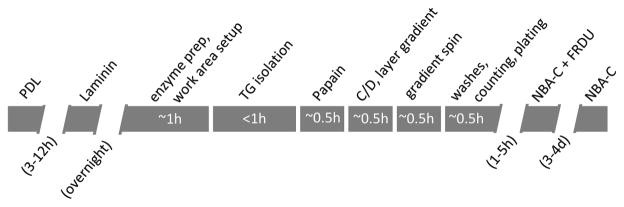
Fig. 1
Fig. 1
Steps in the neuron isolation process. Coverslips should be coated with PDL and Laminin the day before neuron isolation. This will take a few minutes, followed by >3 h and overnight incubation, respectively. Neuron isolation should take a total of ~4 h. This will include ~1 h of setup, <1 h to isolate the TGs, <1 h of enzymatic digestions (20 min each, with some additional time for spin down), and ~1 h to separate, wash, count, and seed the neurons. This is followed by >1 h incubation, and then 3–4 days culturing, at which point the neuron cultures are ready for use in experiments
Fig. 2
Fig. 2
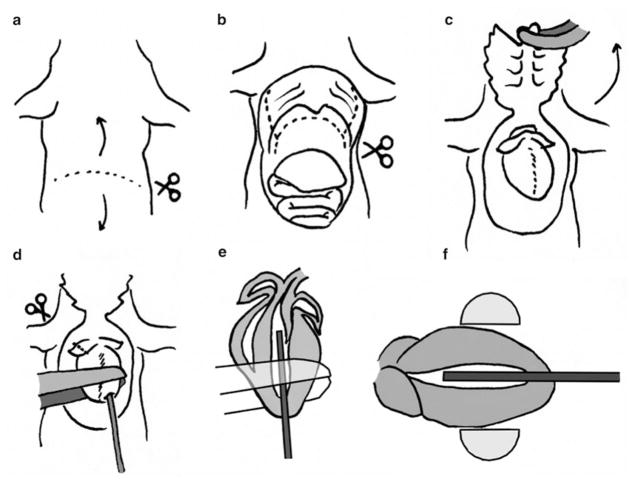
Transcardial perfusion. Lay the mouse on its back, with the tail toward you, and the head away from you. (a) Use small scissors to cut the skin and muscle right below the ribcage. (b) Cut the diaphragm and ribcage, then (c) fold the ribcage up and away, exposing the heart. Use large forceps to grasp the heart while inserting the needle into the left ventricle, taking care not to punch clear through (d–f). Use a small hemostat (locked) to secure the needle in the heart, and then cut a hole in the right atrium (d). Begin perfusing with PBS
Fig. 3
Fig. 3
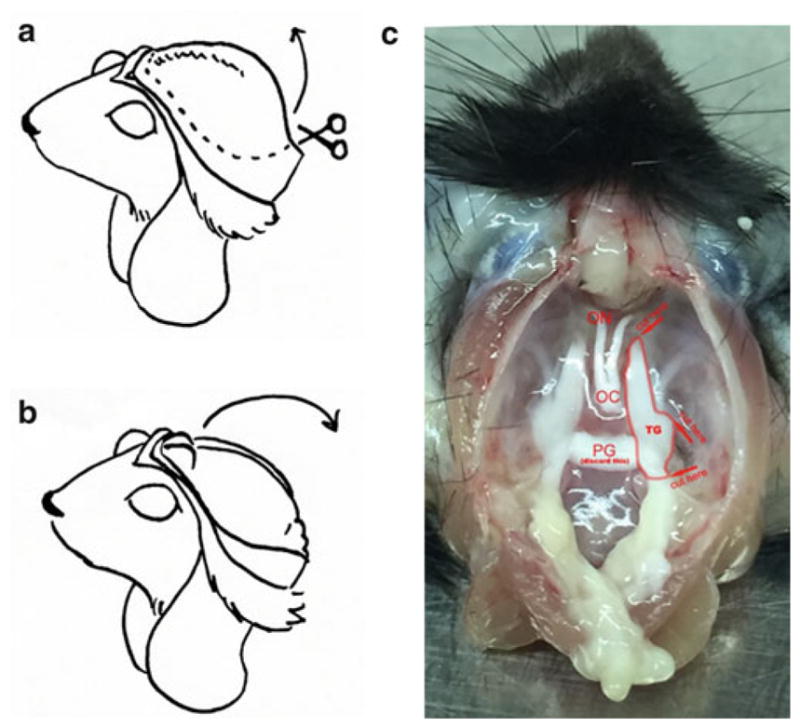
TG isolation. After separating the head from the carcass, cut the skin from neck to between the eyes, and fold the skin flaps under the mouse’s chin (a). Cut the exposed skull along left and right, to between the eyes, then lift the bone up and away (a). Pull the brain out toward you (b), exposing the base of the skull (c). TG dissection: Picture shows a mouse head after brain removal. Trigeminal ganglion is double lined. Arrows indicate cutting sites and the orientation of the cutting. Abbreviations: TG trigeminal ganglion, ON optic nerve, OC optic chiasm, PG pituitary gland. The optic nerves and chiasm should be visible at the top, the TGs along the base to either side, and the pituitary gland along the base between the TGs. Cut the connective tissue anchoring the TGs to the skull, and sever the nerve where it enters the skull—you should now be able to lift out the TGs (C)
Fig. 4
Fig. 4
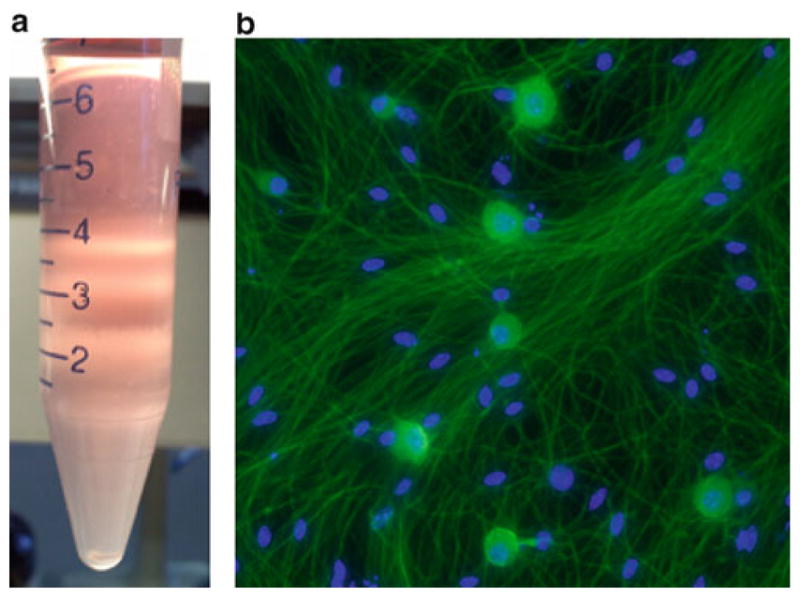
Gradient separation and culture. (a) After the gradient has been spun, there should be four visibly distinct cell suspension layers and a pellet. Collect the liquid and two cell suspension layers from just above the 2.5 ml line to just below the 1 ml line, a total of ~2 ml. Discard the remainder. (b) Fluorescence microscopy of cultured TG neurons for 4 days stained with β-3 tubulin (green) and Dapi (blue)
Fig. 5
Fig. 5
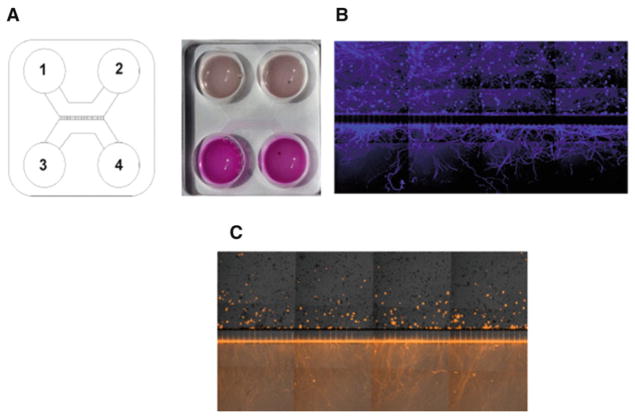
Use of microfluidic chambers to culture TG neurons. (a) Schematic representation of a microfluidic device with compartments enumerated to follow the protocol above. The picture (right) shows a microfluidic device filled with NBA complete medium (all compartments) and NBA complete medium plus the cell tracker DiI (compartments 3 and 4). (b) Representative image of trigeminal neurons cultured for 3 days in a microfluidic device. Neurons were stained with β-3 tubulin (blue). Neuron cell bodies are present only in the upper compartment, with axons projecting through the capillaries to the lower compartment. (c) The same culture as described in b. The cell tracker DiI (orange) was added to the lower compartment. This treatment stains only those neurons that have grown axonal projections through the capillaries

References

    1. Smith G. Herpesvirus transport to the nervous system and back again. Annu Rev Microbiol. 2012;66:153–176. - PMC - PubMed
    1. Rosato PC, Leib DA. Neuronal interferon signaling is required for protection against herpes simplex virus replication and pathogenesis. PLoS Pathog. 2015;11(7):e1005028. - PMC - PubMed
    1. Malin SA, Davis BM, Molliver DC. Production of dissociated sensory neuron cultures and considerations for their use in studying neuronal function and plasticity. Nat Protoc. 2007;2(1):152–160. - PubMed
    1. Bertke AS, Swanson SM, Chen J, Imai Y, Kinchington PR, Margolis TP. A5-positive primary sensory neurons are Nonpermissive for productive infection with herpes simplex virus 1 in vitro. J Virol. 2011;85(13):6669–6677. - PMC - PubMed
    1. Rosato PC, Leib DA. Intrinsic innate immunity fails to control herpes simplex virus and vesicular stomatitis virus replication in sensory neurons and fibroblasts. J Virol. 2014;88(17):9991–10001. - PMC - PubMed

Publication types

LinkOut - more resources