Review
. 2013 Feb 4;6(2):460-482.
doi: 10.3390/ma6020460.

Advances in Fabrication Materials of Honeycomb Structure Films by the Breath-Figure Method

Affiliations
Review

Advances in Fabrication Materials of Honeycomb Structure Films by the Breath-Figure Method

Liping Heng et al. Materials (Basel). .

Abstract

Creatures in nature possess almost perfect structures and properties, and exhibit harmonization and unification between structure and function. Biomimetics, mimicking nature for engineering solutions, provides a model for the development of functional surfaces with special properties. Recently, honeycomb structure materials have attracted wide attention for both fundamental research and practical applications and have become an increasingly hot research topic. Though progress in the field of breath-figure formation has been reviewed, the advance in the fabrication materials of bio-inspired honeycomb structure films has not been discussed. Here we review the recent progress of honeycomb structure fabrication materials which were prepared by the breath-figure method. The application of breath figures for the generation of all kinds of honeycomb is discussed.

Keywords: breath-figure method; fabrication material; hexagonal geometry structure; honeycomb structure; hybrid film; nanoparticle; pattern structure; polymer film; small organic molecule.


Figures
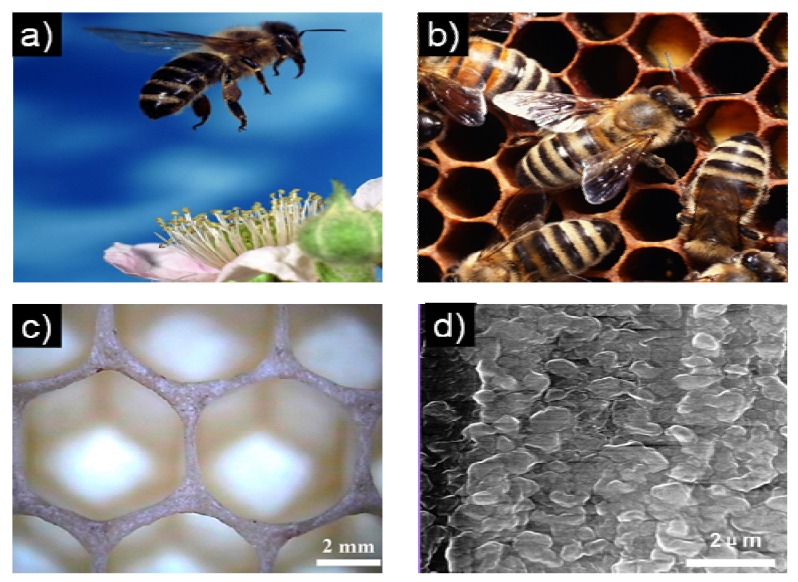
Figure 1
Figure 1
Photos of the (a) honeybee; and (b) the combs; (c) top view of fresh honeycomb walls and cells; (d) environmental scanning electron microscope (ESEM) image of a cross section of the cell wall showing wax grains [10].
Figure 2
Figure 2
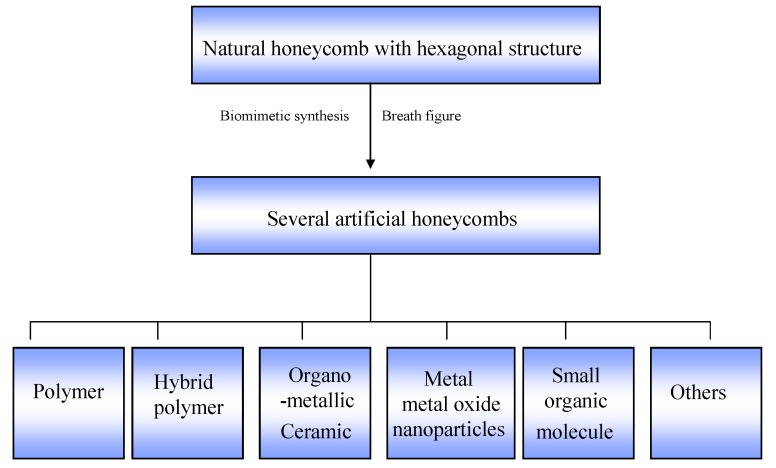
The design and fabrication of several artificial honeycombs whose inspiration comes from the natural honeycomb.
Figure 3
Figure 3
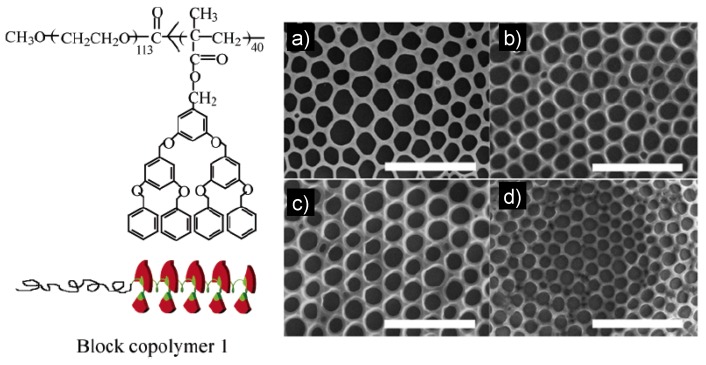
SEM images of the honeycomb structure of films prepared at different relative humidities (RHs): (a) 95%; (b) 90%; (c) 85%; (d) 80%. Other conditions: block copolymer 1 concentration, 0.75 mg/mL; spreading volume, 40 μL; temperature, 18 °C. The bar is 10 μm [60].
Figure 4
Figure 4
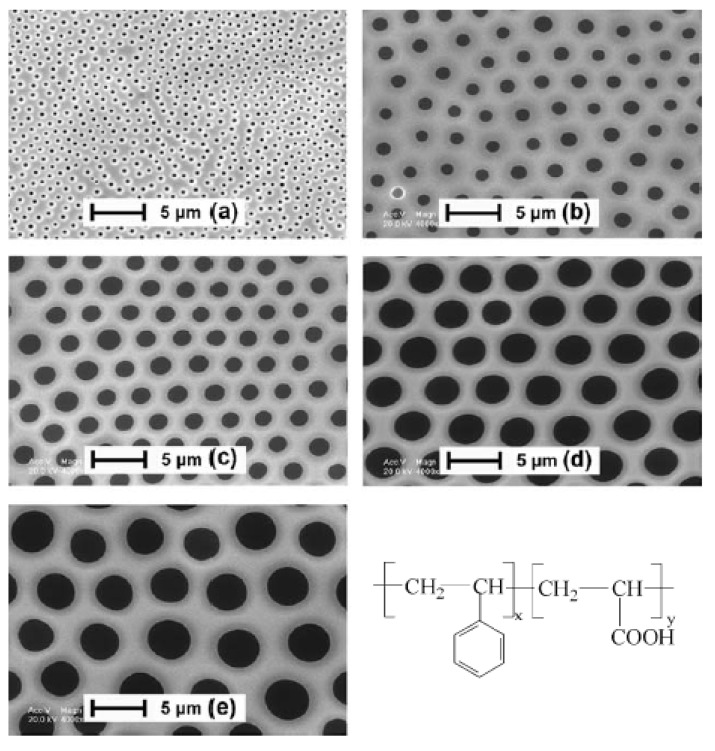
SEM images of the PS-b-PAA films prepared under different relative humidities. Solid substrate: glass slide; volume of PS-b-PAA/THF solution: 10 mL; solution concentration: 10 mg mL−1; relative humidity: (a) 60%; (b) 74%; (c) 80%; (d) 84%; (e) 94%. The structures of PS-b-PAA amphiphilic copolymer. x and y are the numbers of PS blocks and PAA blocks, respectively [32].
Figure 5
Figure 5
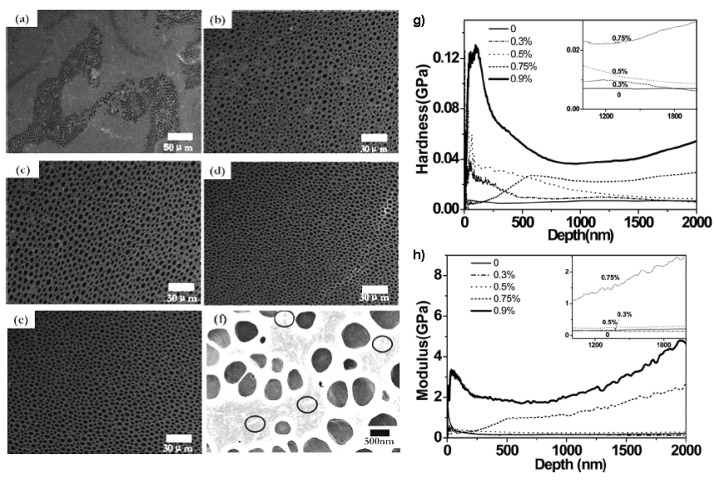
SEM images of the prepared honeycomb structure films. From image (ae) the contents of nanoclay in the polymer solution are 0 wt%, 0.3 wt%, 0.5 wt%, 0.75 wt%, and 0.9 wt%, respectively; (f) High-magnification SEM image of; (e) showing the walls of the porous structure consisting of the clay layer with a thickness of ca. 50–80 nm and length of ca. 300–600 nm, marked by circles. From these figures, it can be seen that the pores have become more orderly and homogenous with the increase of nano-clay content (g) Hardness; and (h) modulus curves of polyimide-clay honeycomb structure films prepared with different clay content solution. Inset: Plot of the enlarged curves (with the nano-clay contents of 0 wt%, 0.3 wt%, 0.5 wt%, and 0.75 wt%) of (g) hardness; and (h) modulus with the range of 1000–2000 nm depth. From these figures, we know that the hardness and the Young’s modulus increased with increasing clay content [92].
Figure 6
Figure 6
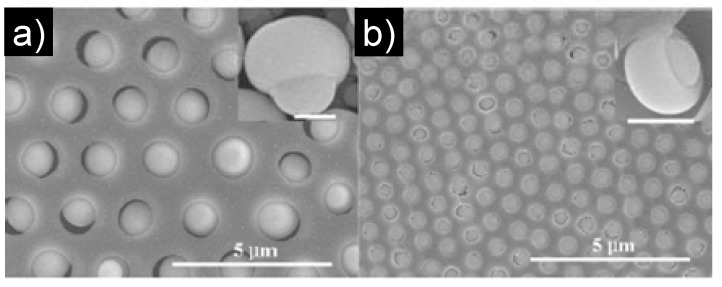
SEM images of the obtained composite film from the TiCl4/PS/CHCl3 solution with different concentrations of TiCl4: (a) 0.3% v/v; and (b) 0.4% v/v (PS, 1 wt %, relative humidity, 30%). Insets in (a) and (b) are the magnified mushroom-like particles, respectively. Scale bar = 0.5 μm [93].
Figure 7
Figure 7
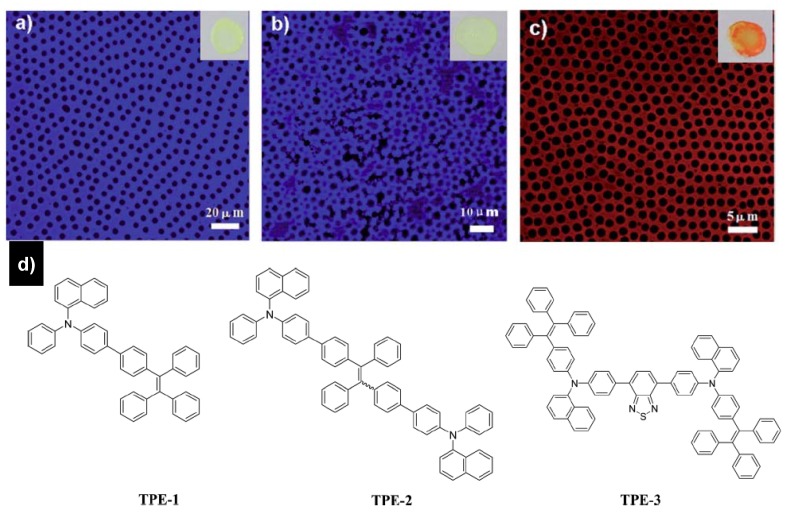
The fluorescent images of the as-prepared honeycomb structure films from (a) TPE-1; (b) TPE-2; and (c) TPE-3, The insets are the corresponding photographs of the films; excitation: 405 nm; (d) molecular structures of tetraphenylethene derivatives used in experiments [99].
Figure 8
Figure 8
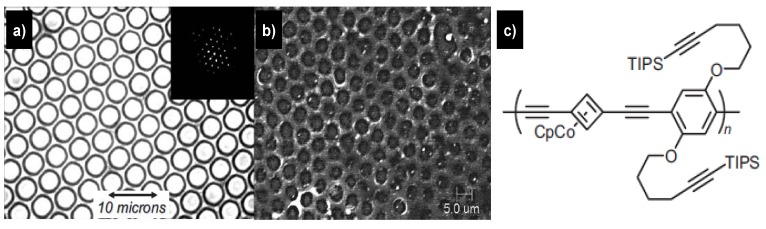
Bubble arrays from polymer PPE (a) before; and (b) after pyrolysis at 500 °C under nitrogen. The inset in (a) shows the hexagonal diffraction pattern of the array [100].
Figure 9
Figure 9
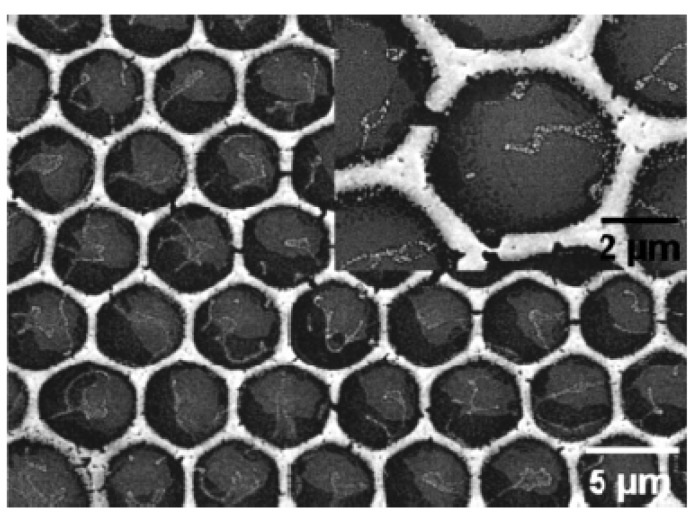
SEM image of a 5.36 g/L Au NPs deposited sample annealed at 400 °C for 60 min. The inset shows a magnified view of one of the hexagons [106].
Figure 10
Figure 10
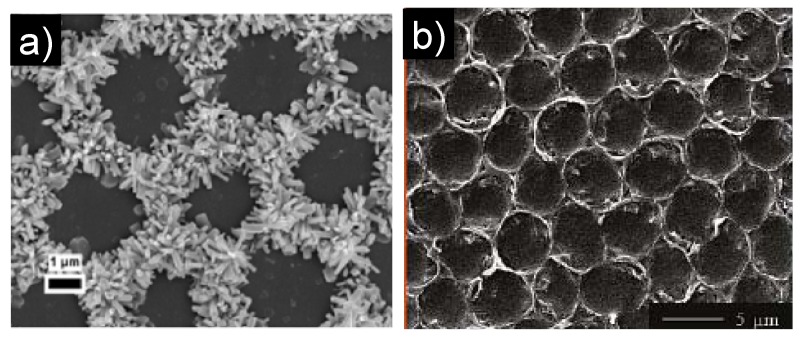
(a) SEM image of hydrothermal ZnO nanorod arrays grown from Zn(acct)2 honeycomb structured pattern.[48]; (b) SEM image of the PS/TTIP as TiO2 precursor honeycomb structured film after 24 h UV light treatment and then calcined at 550 °C [111].
Figure 11
Figure 11
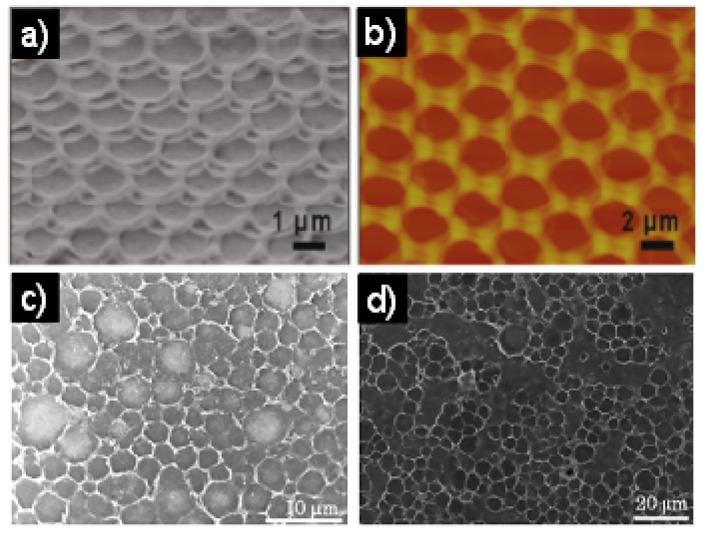
Honeycomb-patterned film prepared from 0.75 mg/mL of DNA-DTDA complex: (a) SEM image; (b) AFM image [121]. Typical SEM images of the honeycomb GO-complex films fabricated from the toluene solution (1.0 mg/mL) on glass substrates under (c) 80%; and (d) 90% RH [122].

References

    1. Humphrey J.A.C., Dykesc E.S. Thermal energy conduction in a honey bee comb due to cell-heating Bees. J. Theor. Biol. 2008;250:194–208. doi: 10.1016/j.jtbi.2007.09.026. - DOI - PubMed
    1. Human H., Nicolson S.W., Dietemann V. Do honeybees, apis mellifera scutellata, regulate humidity in their nest? Naturwissenchafen. 2006;93:397–401. doi: 10.1007/s00114-006-0117-y. - DOI - PubMed
    1. Sakagami K., Yamashita I., Yairi M., Morimoto M. Sound absorption characteristics of a honeycomb-backed microperforated panel absorber: Revised theory and experimental validation. Noise Control. Eng. J. 2010;58:157–162. doi: 10.3397/1.3294861. - DOI
    1. Toyoda M., Sakagami K., Takahashi D., Morimoto M. Effect of a honeycomb on the sound absorption characteristics of panel-type absorbers. Appl. Acoust. 2011;72:943–948. doi: 10.1016/j.apacoust.2011.05.017. - DOI
    1. Thompson D.W. On Growth and Form. Cambridge University Press; Cambridge, UK: 1961. pp. 88–119.