. 2017 Aug;14(2):1271-1276.
doi: 10.3892/etm.2017.4642. Epub 2017 Jun 22.

Association of polycystic ovary syndrome with metabolic syndrome and gestational diabetes: Aggravated complication of pregnancy

Affiliations

Association of polycystic ovary syndrome with metabolic syndrome and gestational diabetes: Aggravated complication of pregnancy

Kui Yao et al. Exp Ther Med. 2017 Aug.

Abstract

Polycystic ovary syndrome (PCOS) affects 5-20% of the reproductive age women globally. PCOS is diagnosed by the presence of hyperandrogenism, oligo-anovulation, and polycystic morphology of at least one ovary. Insulin resistance (IR), hyperinsulinemia and associated metabolic abnormalities including metabolic syndrome play a significant role in the development of PCOS. The chances of developing MS in PCOS women was shown to increase by almost 14-fold in patients with increasing body mass index. Even in the absence of overt obesity, a preferential deposition of intra-abdominal fat is noted in PCOS women and this intra-abdominal fat leads to impaired insulin action and functional IR and hyperandrogenism. Functional ovarian hyperandrogenism of ovaries was suggested to be a consequence of IR, which activates androgen synthesizing enzyme, cytochrome p450-c17α-hydroxylase, in ovarian theca cells and causes elevated oxidative stress accompanied by lower antioxidant status in ovaries, which contribute to PCOS pathogenesis. The elevated levels of luteinizing hormone that accompany the early stages of hyperandrogenemia, accelerate ovarian functional deterioration, which is further aggravated by hyperinsulinemia, in PCOS women. The risk of developing gestational diabetes in PCOS women is approximately three times greater, as compared to non-PCOS women, due to IR and hyperinsulinemia. Typical insulin-sensitizing drugs such as metformin, have been used to curtail IR and hyperinsulinemia in pregnant PCOS women, with varying results indicating the complexity of the disease and the need for better controlled studies and additional efforts for PCOS-specific drug discovery.

Keywords: cytochrome p450-c17α-hydroxylase; functional ovarian hyperandro-genism; gestational diabetes; hyperinsulinemia; metabolic syndrome; polycystic ovary syndrome.


Figures
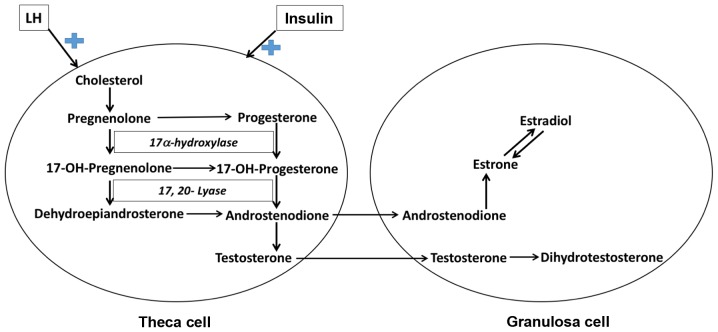
Figure 1.
Figure 1.
Steroid hormone biosynthetic pathways in ovary. In the ovarian theca cells androgen formation is stimulated by LH via the steroidogenic pathway. Androgen biosynthesis following stimulation by LH is modulated by cytochrome P450c17, which possesses both 17-hydroxylase and 17,20-lyase activities in theca cells. Androstenedione formed in theca cells is also taken up by granulosa cells, where it can contribute to the formation of estrogens. Androstenodione in theca cells is converted to testosterone, which leads to hyperandrogenism. Insulin also stimulates androgen production by theca cells. LH, luteinizing hormone.
Figure 2.
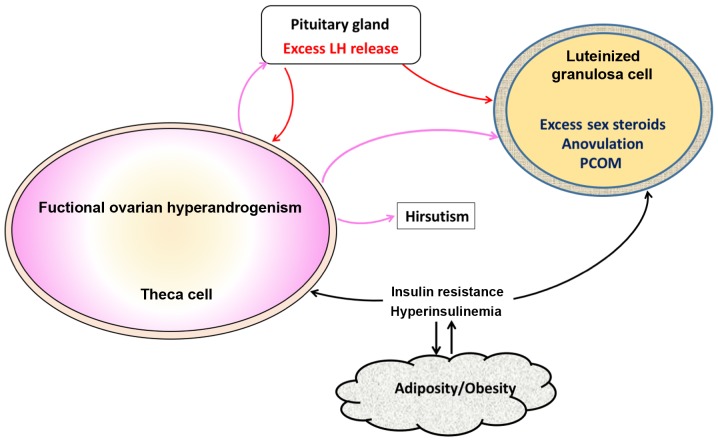
Figure 2.
Pathological events in PCOS. Ovarian hyperandrogenism is very common in PCOS and contributes to several abnormalities including hirsutism, oligo-anovulation, and PCOM. LH secretion from pituitary gland is needed for the ovarian androgen production, but other factors such as hyperinsulinism and obesity are also necessary for full-blown pathogenesis of PCOS. Insulin resistance, which is very common in PCOS leads to hyperinsulinemia, which stimulates theca cells and aggravates hyperandrogenism. Excess insulin along with androgen, luteinize granulosa cells prematurely. Adipogenesis is another abnormality resulting from hyperinsulinism. Elevated androgens coming from theca cells in turn stimulate pituitary and cause LH excess, which worsens hyperandrogenism. These changes in granulosa cells further exacerbate PCOM and lead to oligo-anovulation. PCOS, polycystic ovary syndrome; PCOM, polycystic ovarian morphology; LH, luteinizing hormone.

References

    1. Azziz R, Carmina E, Chen Z, Dunaif A, Laven JS, Legro RS, Lizneva D, Natterson-Horowtiz B, Teede HJ, Yildiz BO. Polycystic ovary syndrome. Nat Rev Dis Primers. 2016;2:16057. doi: 10.1038/nrdp.2016.57. - DOI - PubMed
    1. Amato MC, Vesco R, Vigneri E, Ciresi A, Giordano C. Hyperinsulinism and polycystic ovary syndrome (PCOS): role of insulin clearance. J Endocrinol Invest. 2015;38:1319–1326. doi: 10.1007/s40618-015-0372-x. - DOI - PubMed
    1. Diamanti-Kandarakis E, Dunaif A. Insulin resistance and the polycystic ovary syndrome revisited: an update on mechanisms and implications. Endocr Rev. 2012;33:981–1030. doi: 10.1210/er.2011-1034. - DOI - PMC - PubMed
    1. Ford ES. The metabolic syndrome and mortality from cardiovascular disease and all-causes: findings from the National Health and Nutrition Examination Survey II Mortality Study. Atherosclerosis. 2004;173:309–314. doi: 10.1016/j.atherosclerosis.2003.12.022. - DOI - PubMed
    1. Polak K, Czyzyk A, Simoncini T, Meczekalski B. New markers of insulin resistance in polycystic ovary syndrome. J Endocrinol Invest. 2017;40:1–8. doi: 10.1007/s40618-016-0523-8. - DOI - PMC - PubMed