


Sleep Duration and Risk of Type 2 Diabetes
- PMID: 28811317
- PMCID: PMC7612309
- DOI: 10.1542/peds.2017-0338
Sleep Duration and Risk of Type 2 Diabetes
Abstract
Background: Associations between sleep duration and type 2 diabetes (T2D) risk markers in childhood have been little studied. We examined associations between self-reported sleep duration and T2D risk markers in children.
Methods: Cross-sectional study of 4525 multiethnic UK children aged 9 to 10 years. Sleep time was calculated from self-reported usual time of going to bed and getting up on a school day, validated in a subset using accelerometers. Fasting blood samples provided levels of serum lipids and insulin, plasma glucose, and HbA1c. Physical measures included height, weight, bioimpedance, and blood pressure. Multilevel linear regression models of anthropometric, T2D, and cardiovascular risk markers with sleep duration were adjusted for sex, age, month, ethnicity, socioeconomic position, observer (physical measures only), and random effect of school.
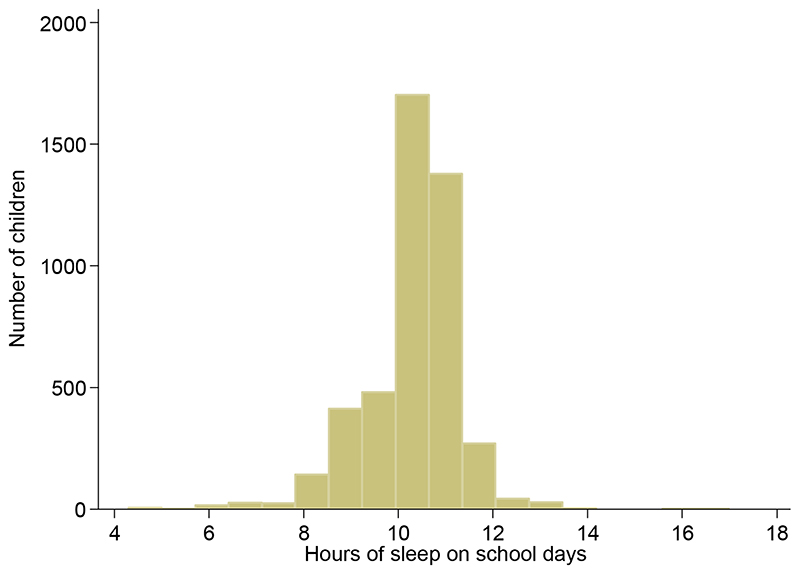
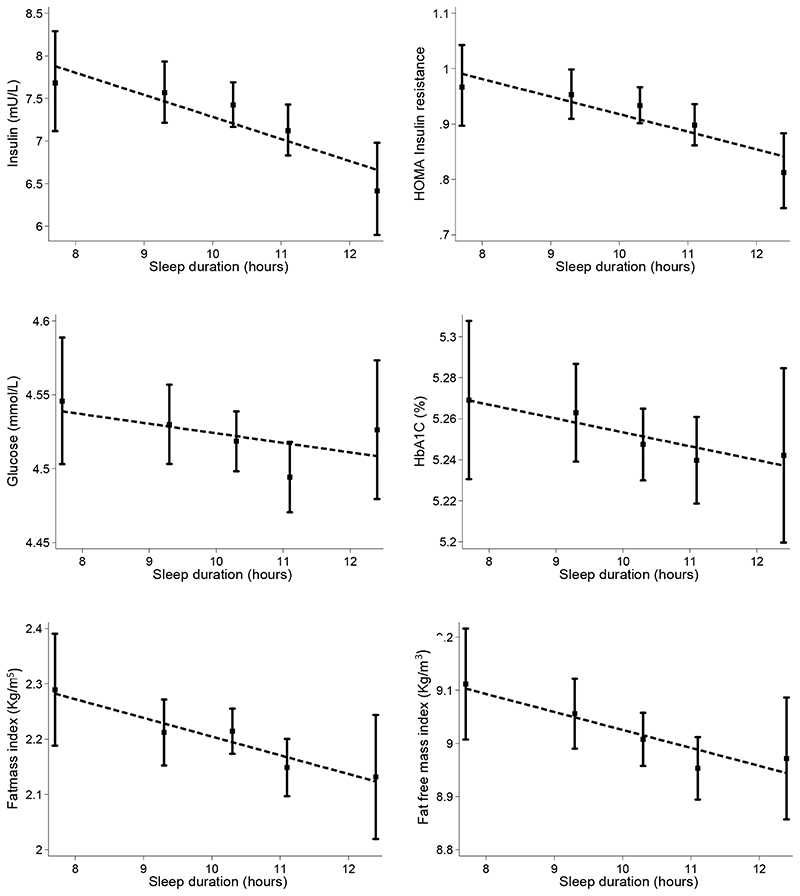
Results: On average, children slept 10.5 hours per night (95% range 8.0-12.0 hours). There were strong inverse graded relationships between sleep duration, adiposity, and diabetes risk markers. In adjusted models, a 1-hour-longer sleep duration was associated with 0.19 lower BMI (95% confidence interval [CI] 0.09 to 0.28), 0.03 kg/m5 lower fat mass index (95% CI 0.00 to 0.05 kg/m5), 2.9% lower homeostasis model assessment insulin resistance (95% CI 1.2% to 4.4%), and 0.24% lower fasting glucose (95% CI 0.03% to 0.44%); there was no association with HbA1c or cardiovascular risk. Associations with insulin and glucose remained after an additional adjustment for adiposity markers.
Conclusions: The finding of an inverse association between sleep duration and T2D risk markers in childhood is novel. Intervention studies are needed to establish the causality of these associations, which could provide a simple strategy for early T2D prevention.
Copyright © 2017 by the American Academy of Pediatrics.
Conflict of interest statement
POTENTIAL CONFLICT OF INTEREST: The authors have indicated they have no potential conflicts of interest to disclose.
Figures
Comment in
-
Weighing the Causal Evidence That Associates Short Sleep Duration With Obesity.Pediatrics. 2017 Sep;140(3):e20172015. doi: 10.1542/peds.2017-2015. Epub 2017 Aug 15. Pediatrics. 2017. PMID: 28811316 No abstract available.
-
Diabetes: Risk of T2DM in children - influence of sleep duration.Nat Rev Endocrinol. 2017 Oct;13(10):561. doi: 10.1038/nrendo.2017.117. Epub 2017 Sep 1. Nat Rev Endocrinol. 2017. PMID: 28862267 No abstract available.
References
-
- Gatineau M, Hancock C, Holman N, et al. Adult obesity and type 2 diabetes. 2014. [Accessed March 2016]. https://www.gov.uk/government/uploads/system/uploads/attachment_data/fil... .
-
- IDF Diabetes Atlas. 6th. International Diabetes Federation; Brussels, Belgium: 2013. [Accessed March 2016]. https://www.idf.org/sites/default/files/EN_6E_Atlas_Full_0.pdf .
-
- Davies SC, Barlow J. Our Children Deserve Better: Prevention Pays. Annual Report of the Chief Medical Officer 2012; 2013.
MeSH terms
Substances
Grants and funding
LinkOut - more resources
Full Text Sources
Other Literature Sources
Medical
