Review
. 2013 Jul 12;6(7):2789-2818.
doi: 10.3390/ma6072789.

Persistent Luminescence in Non-Eu2+-Doped Compounds: A Review

Affiliations
Review

Persistent Luminescence in Non-Eu2+-Doped Compounds: A Review

Koen Van den Eeckhout et al. Materials (Basel). .

Abstract

During the past few decades, the research on persistent luminescent materials has focused mainly on Eu2+-doped compounds. However, the yearly number of publications on non-Eu2+-based materials has also increased steadily. By now, the number of known persistent phosphors has increased to over 200, of which over 80% are not based on Eu2+, but rather, on intrinsic host defects, transition metals (manganese, chromium, copper, etc.) or trivalent rare earths (cerium, terbium, dysprosium, etc.). In this review, we present an overview of these non-Eu2+-based persistent luminescent materials and their afterglow properties. We also take a closer look at some remaining challenges, such as the excitability with visible light and the possibility of energy transfer between multiple luminescent centers. Finally, we summarize the necessary elements for a complete description of a persistent luminescent material, in order to allow a more objective comparison of these phosphors.

Keywords: long-lasting phosphorescence; persistent luminescence; rare earths.


Figures
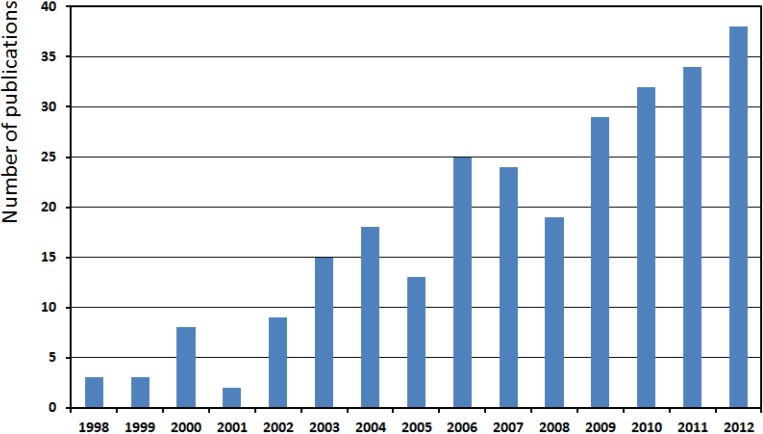
Figure 1
Figure 1
Number of papers published on non-Eu2+-doped persistent luminescent compounds, according to the Web of Science.
Figure 2
Figure 2
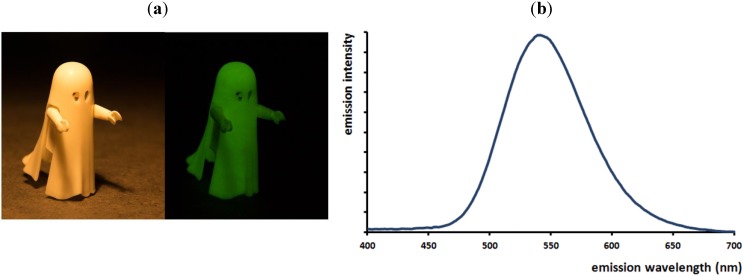
(a) Green persistent luminescence in a Playmobil® ghost toy based on ZnS:Cu, Co. (b) Afterglow emission spectrum of ZnS:Cu, Co centered around 540 nm.
Figure 3
Figure 3
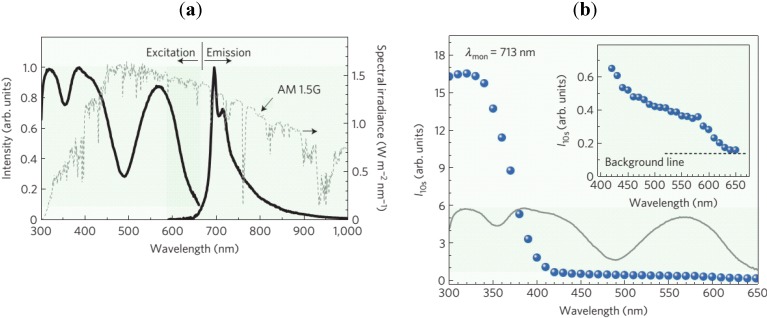
(a) Excitation and emission spectrum of Zn3Ga2Ge2O10:0.5%Cr3+; (b) Effectiveness of excitation wavelength (energy) for persistent luminescence of Zn3Ga2Ge2O10:0.5%Cr3+. The afterglow intensity after 10 s is monitored as a function of the excitation wavelength (Reprinted with permission from [2]).
Figure 4
Figure 4
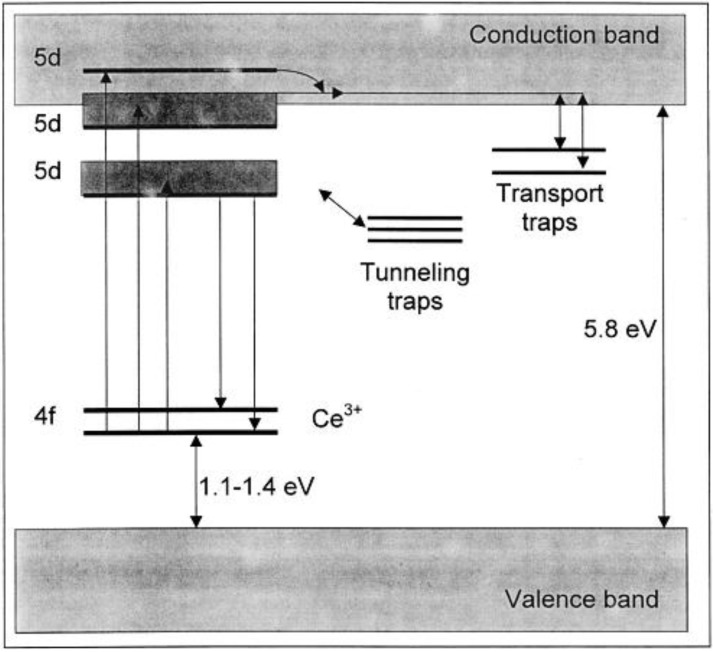
Energy level diagram for CaAl2O4: Ce3+, showing the positions of the Ce3+ levels relative to the bandgap of the host and the proposed trapping mechanism. After excitation in the conduction band, trapping occurs through the conduction band. After excitation in the lower 5d levels, trapping occurs through tunneling (Reprinted with permission from [77]. Copyright 2003 The Electrochemical Society).
Figure 5
Figure 5
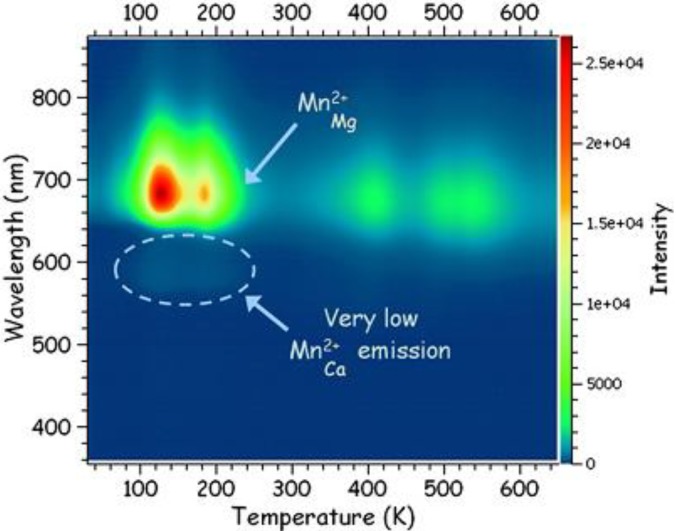
Thermoluminescence (TL)-emission mapping: the emission spectrum is monitored during the thermoluminescence experiment, showing which traps are related to which activators. An example is shown for Mn2+-emission in CaMgSi2O6 (Reprinted with permission from [33]. Copyright 2010 Elsevier)
Figure 6
Figure 6
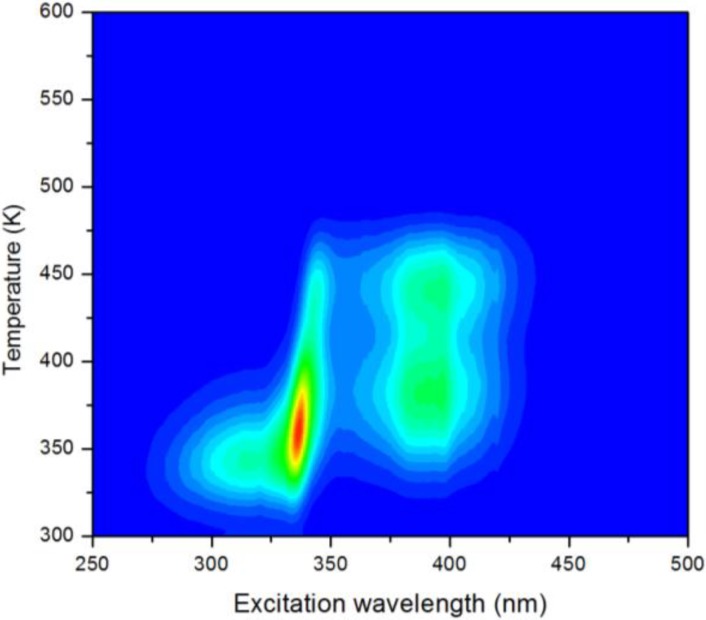
TL-excitation mapping: the TL measurement is repeated for different excitation wavelengths, showing which wavelengths are suited for trap filling. An example is shown for Cu+-emission in ZnS (presented earlier in [258]). It can be seen that different kinds of traps are being filled by short (<340 nm) and longer (>340 nm) wavelengths, where 340 nm corresponds to the band gap of the ZnS host compound.

References

    1. Smet P.F., Poelman D., Hehlen M.P. Focus Issue Introduction: Persistent Phosphors. Opt. Mater. Express. 2012;2:452–454. doi: 10.1364/OME.2.000452. - DOI
    1. Pan Z., Lu Y.Y., Liu F. Sunlight-Activated Long-Persistent Luminescence in the Near-Infrared from Cr3+-Doped Zinc Gallogermanates. Nat. Mater. 2012;11:58–63. doi: 10.1038/nmat3173. - DOI - PubMed
    1. Le Masne de Chermont Q., Chanéac C., Seguin J., Pellé F., Maîtrejean S., Jolivet J.P., Gourier D., Bessodes M., Scherman D. Nanoprobes with Near-Infrared Persistent Luminescence for in vivo Imaging. Proc. Natl. Acad. Sci. USA. 2007;104:9266–9271. doi: 10.1073/pnas.0702427104. - DOI - PMC - PubMed
    1. Matsuzawa T., Aoki Y., Takeuchi N., Murayama Y. A New Long Phosphorescent Phosphor with High Brightness, SrAl2O4:Eu2+, Dy3+ J. Electrochem. Soc. 1996;143:2670–2673. doi: 10.1149/1.1837067. - DOI
    1. Van den Eeckhout K., Smet P.F., Poelman D. Persistent Luminescence in Eu2+-Doped Compounds: A Review. Mater. 2010;3:2536–2566. doi: 10.3390/ma3042536. - DOI - PMC - PubMed